Have you ever paused while writing honoured or honored because both spellings looked correct? You are not alone.
Many English learners, students, professionals, and writers face this confusion every day. The good news is that both words are correct, but they belong to different English varieties.
Choosing the right spelling depends on where your audience lives and which writing style you follow. In this guide, you’ll learn the difference between honoured and honored, their meanings, correct usage, pronunciation, examples, grammar rules, and regional preferences.
By the end, you’ll know exactly which spelling to use in emails, academic writing, business communication, and everyday English.
Honoured or Honored – Quick Answer
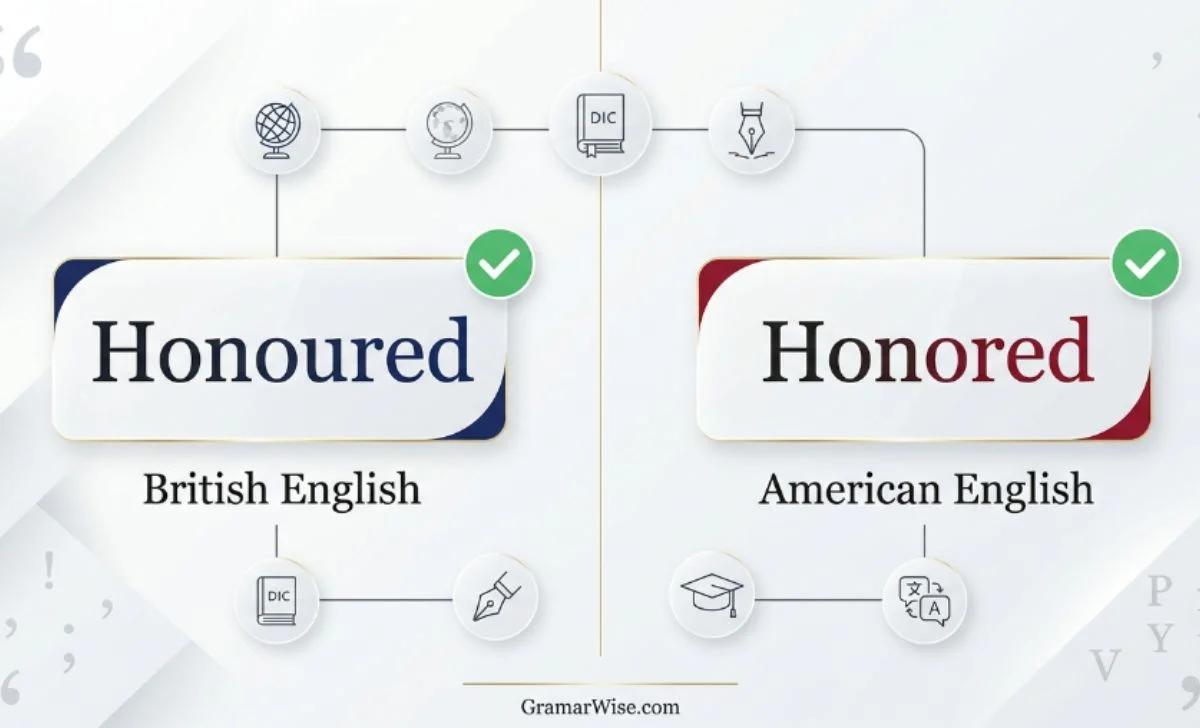
Honoured and honored have the same meaning. The only difference is the spelling.
- Honoured is the preferred spelling in British English, Australian English, and most other countries that follow British spelling.
- Honored is the standard spelling in American English.
Both words mean to show respect, recognize an achievement, express gratitude, or feel privileged by something.
Examples:
- I am honoured to receive this award. (British English)
- I am honored to receive this award. (American English)
Neither spelling is wrong. The correct choice depends on your audience and the English style you are using.
Correct Example
✅ British English
- We are honoured to welcome you today.
- She felt honoured to represent her country.
- I would be honoured to accept your invitation.
✅ American English
- We are honored to welcome you today.
- She felt honored to represent her country.
- I would be honored to accept your invitation.
Incorrect Example
These examples become incorrect only when the spelling does not match the writing style.
❌ British English
- We are honored to welcome you today.
❌ American English
- We are honoured to welcome you today.
The meaning is still clear, but professional writing usually follows one spelling style consistently.
What Does Honoured or Honored Mean?
The words honoured and honored are the past tense and past participle of honour (British spelling) and honor (American spelling). They describe showing respect, receiving recognition, feeling privileged, or accepting something with gratitude.
Whether you write honoured or honored, the meaning never changes.
Common Meanings
The word can have several closely related meanings.
| Meaning | Example |
|---|---|
| Given respect | The soldier was honoured for bravery. |
| Recognized with an award | She was honored by the university. |
| Feeling privileged | I am honoured to speak here today. |
| Showing admiration | The ceremony honoured local heroes. |
| Accepting respectfully | We are honored by your presence. |
Simple Usage Examples
Here are natural examples used in everyday English.
I am honoured meaning
The phrase means “I feel deeply grateful and privileged.”
Example:
- I am honoured to receive this recognition.
- I am honoured to work with such an experienced team.
- I am honoured to be part of this celebration.
I’m honoured or honored
Both are correct.
- I’m honoured to meet you. (British English)
- I’m honored to meet you. (American English)
I would be honored or honoured
Both versions are grammatically correct.
Examples:
- I would be honoured to join your event.
- I would be honored to help your organization.
- We would be honoured to host the conference.
Honoured or Honored Synonyms
Depending on the sentence, common synonyms include:
- Privileged
- Respected
- Appreciated
- Recognized
- Celebrated
- Distinguished
- Esteemed
- Praised
- Valued
- Admired
Example:
“I feel honoured.”
can also be written as
- I feel privileged.
- I feel deeply grateful.
- I feel respected.
Although these words are similar, honoured often expresses both respect and personal gratitude.
The Origin of Honoured or Honored
The difference between honoured and honored is not about grammar. It comes from the history of English spelling.
The British spelling kept the original -our ending, while American English later simplified many words by removing the letter “u.”
This is the same reason we have:
- honour → honor
- colour → color
- favourite → favorite
- neighbour → neighbor
- labour → labor
Word History
The word comes from the Latin word honor, meaning respect, dignity, or esteem.
Later, it entered Old French as honor and honour before becoming part of Middle English.
British English preserved the -our spelling.
During the early nineteenth century, American lexicographer Noah Webster promoted simpler spellings to create a distinct American writing style. As a result, words ending in -our became -or in American English.
That is why modern English now has two accepted spellings.
Why the Confusion Happens
Several reasons explain why writers mix these spellings.
- People read content from both the UK and the US.
- International companies use different style guides.
- Search engines display results from multiple countries.
- Movies, books, and websites expose readers to both spelling systems.
- Spell-check tools change spelling based on language settings.
Many learners think one spelling is wrong because they see different versions online. In reality, both are standard English.
British English vs American English
The biggest difference between honoured and honored is regional spelling.
British English keeps the traditional -our ending.
American English uses the simplified -or ending.
Neither spelling changes pronunciation or meaning.
Comparison Table
| Feature | British English | American English |
|---|---|---|
| Preferred spelling | Honoured | Honored |
| Base word | Honour | Honor |
| Past tense | Honoured | Honored |
| Past participle | Honoured | Honored |
| Common countries | United Kingdom, Australia, New Zealand | United States |
| Meaning | Respected, recognized, privileged | Respected, recognized, privileged |
| Pronunciation | Same | Same |
| Formal writing | Preferred | Preferred |
| Academic writing | Follow British style guide | Follow American style guide |
Here are more examples of similar spelling differences.
| British English | American English |
|---|---|
| Honour | Honor |
| Colour | Color |
| Favourite | Favorite |
| Neighbour | Neighbor |
| Labour | Labor |
| Behaviour | Behavior |
| Humour | Humor |
| Valour | Valor |
The key rule is simple:
- If you write for a UK, Australian, or Commonwealth audience, use honoured.
- If you write for an American audience, use honored.
- Never switch between the two spellings in the same document unless you are quoting a source or following a specific style guide.
Honoured or Honored vs Other Variations
Many people search for different spellings of honoured and honored because English uses two major spelling systems. While some variations are correct, others are simply spelling mistakes. Understanding the difference helps you write with confidence and maintain consistency.
Spelling Comparison Table
| Word | Correct or Incorrect | Usage | Preferred Region |
|---|---|---|---|
| Honoured | ✅ Correct | Standard spelling | United Kingdom, Australia, New Zealand, Ireland |
| Honored | ✅ Correct | Standard spelling | United States |
| Honour | ✅ Correct | Noun and verb | British English |
| Honor | ✅ Correct | Noun and verb | American English |
| Honouring | ✅ Correct | Present participle | British English |
| Honoring | ✅ Correct | Present participle | American English |
| Honourable | ✅ Correct | Adjective | British English |
| Honorable | ✅ Correct | Adjective | American English |
| Honourably | ✅ Correct | Adverb | British English |
| Honorably | ✅ Correct | Adverb | American English |
| Honnered | ❌ Incorrect | Misspelling | None |
| Honourd | ❌ Incorrect | Misspelling | None |
| Honorred | ❌ Incorrect | Misspelling | None |
| Honourd | ❌ Incorrect | Misspelling | None |
The safest approach is to follow one spelling style throughout your document. Mixing British and American spellings can make professional writing look inconsistent.
Which Spelling Should You Use?
The best spelling depends on your audience, publication, or organization. Since both forms are correct, choose the version that matches your readers.
US Audience
If your readers are in the United States, always use honored.
Examples:
- We are honored to announce the winner.
- She was honored for her outstanding service.
- I am honored to accept this award.
American newspapers, universities, businesses, and government organizations all use honored.
UK Audience
For readers in the United Kingdom, use honoured.
Examples:
- We are honoured to welcome our guests.
- He was honoured for his contribution to science.
- I feel honoured to receive this invitation.
British publishers, schools, and official organizations follow this spelling.
International Writing
International businesses often choose one style guide and use it consistently.
General recommendation:
- Choose British English if your audience is mainly Europe, Australia, New Zealand, or Commonwealth countries.
- Choose American English if your audience is mainly the United States.
The important point is consistency.
Academic Writing
Universities normally require students to follow one recognized style guide.
Examples include:
- APA Style → American English
- MLA Style → American English
- Chicago Manual of Style → American English
- Oxford Style → British English
Always follow your institution’s preferred style rather than mixing spellings.
Social Media Usage
On social media, both spellings appear every day.
Examples:
British English
- I am honoured to join this amazing team.
- Truly honoured to receive this recognition.
American English
- I’m honored to be part of this event.
- Feeling honored to receive this award.
Readers usually understand both spellings without confusion.
Common Mistakes with Honoured or Honored
Although the words are simple, writers often make avoidable mistakes.
Frequent Errors
Mistake 1: Mixing British and American spelling
❌ We are honoured to welcome everyone to our annual event. Our organization is honored to host you.
✅ British English
- We are honoured to welcome everyone.
- Our organization is honoured to host you.
✅ American English
- We are honored to welcome everyone.
- Our organization is honored to host you.
Mistake 2: Using the wrong style for your audience
A British newspaper should normally write:
✅ She was honoured by the King.
Instead of:
❌ She was honored by the King.
Likewise, an American publication would normally prefer honored.
Mistake 3: Confusing honour with respect
People sometimes think honoured always means “respected.”
In reality, it can also mean:
- feeling privileged
- receiving an award
- expressing gratitude
- recognizing someone’s achievements
Example:
“I am honoured to speak today.”
This means I feel privileged, not simply respected.
Corrected Examples
| Incorrect | Correct |
|---|---|
| I am honorred to be here. | I am honored to be here. |
| We are honourd to help. | We are honoured to help. |
| She was honnered yesterday. | She was honored yesterday. |
| I’m honored to meet you. (British article) | I’m honoured to meet you. |
| I’m honoured to meet you. (American article) | I’m honored to meet you. |
Honoured or Honored in Everyday Examples
The word appears in many real-life situations, including emails, speeches, business communication, education, and social media.
Emails
British English
Dear Professor,
I am honoured to accept your invitation to speak at the conference.
Kind regards,
American English
Dear Professor,
I am honored to accept your invitation to speak at the conference.
Best regards,
Social Media
British English
- Feeling honoured to receive this award today.
- Truly honoured to work with such an inspiring team.
- I am honoured to share this achievement with everyone.
American English
- Feeling honored to receive this incredible opportunity.
- I’m honored to be recognized today.
- So honored to join this amazing organization.
News Writing
British English
- The athlete was honoured during the national ceremony.
- Local volunteers were honoured for their community service.
American English
- The athlete was honored during the national ceremony.
- Veterans were honored at the annual event.
School Writing
Examples students can use:
- I felt honoured to represent my school.
- She was honored for academic excellence.
- The principal honoured outstanding students.
- Our teacher said she felt honored to teach the graduating class.
Business Writing
Professional communication often includes this word.
Examples:
- We are honoured to partner with your organization.
- We are honored to welcome our new clients.
- The company honored its employees for outstanding performance.
- We would be honoured to discuss future opportunities.
- I would be honored to attend your business conference.
These examples sound natural and professional in formal communication.
Google Trends & Usage Data
Search interest for honoured and honored depends mainly on geography.
People usually search the spelling they see in schools, newspapers, and official publications.
Popular Countries
| Country | More Common Spelling |
|---|---|
| United States | Honored |
| United Kingdom | Honoured |
| Canada | Both (depends on style guide, British spelling is slightly more common) |
| Australia | Honoured |
| India | Honoured is generally preferred, although both appear online |
Because English is used worldwide, Google shows results for both spellings depending on the user’s location and language settings.
Why People Search This Keyword
Users commonly search this topic because they want to know:
- Which spelling is correct?
- Is honoured British English?
- Is honored American English?
- What does “I am honoured” mean?
- How do you pronounce honour and honor?
- Can both spellings be used interchangeably?
- Which spelling should I use in business emails?
- Which version is better for academic writing?
- What is the difference between honour and honor?
- Which spelling helps me write professionally?
Understanding these questions helps writers choose the correct spelling for every audience.
Related Grammar Rules
The difference between honoured and honored follows the same grammar pattern as many other British and American spelling variations.
Learning these rules makes it easier to avoid common spelling mistakes.
Similar Spelling Mistakes
| British English | American English |
|---|---|
| Colour | Color |
| Favourite | Favorite |
| Neighbour | Neighbor |
| Behaviour | Behavior |
| Labour | Labor |
| Humour | Humor |
| Rumour | Rumor |
| Valour | Valor |
| Glamour | Glamor |
All of these pairs have identical meanings. Only the spelling changes according to the regional variety of English.
Helpful Grammar Tips
- Choose one English variety before you begin writing.
- Stay consistent throughout your article, essay, or email.
- Match your spelling to your audience.
- Use honoured with honour, honouring, and honourable.
- Use honored with honor, honoring, and honorable.
- Remember that pronunciation remains almost identical in both British and American English.
- If you’re writing for international readers, follow the style guide required by your organization or publisher.
- When using spelling or grammar checkers, set the correct language (UK English or US English) before proofreading.
Main FAQs ko numbering ke sath dubara likh raha hoon.
FAQs
1. Is honoured or honored correct?
Yes. Both spellings are correct. Honoured is used in British English, while honored is the standard spelling in American English.
2. What is the difference between honoured and honored?
There is no difference in meaning. The only difference is regional spelling. Honoured follows British English, while honored follows American English.
3. Is honoured British English?
Yes. Honoured is the preferred spelling in British English. It is also commonly used in Australia, New Zealand, and many Commonwealth countries.
4. Is honored American English?
Yes. Honored is the standard spelling in American English and is used in schools, businesses, government documents, and media across the United States.
5. What does “I am honoured” mean?
“I am honoured” means I feel privileged, grateful, or deeply respected.
Example:
I am honoured to receive this prestigious award.
6. What does “I am honored” mean?
It has exactly the same meaning as “I am honoured.” The only difference is that it uses American English spelling.
7. Should I write “I’m honoured” or “I’m honored”?
Use I’m honoured if you are writing in British English. Use I’m honored if you are writing in American English.
8. Is “I would be honoured” correct?
Yes. It is completely correct in British English.
Example:
I would be honoured to attend your event.
9. Is “I would be honored” correct?
Yes. It is the correct American English spelling.
Example:
I would be honored to join your conference.
10. How do you pronounce honour or honor?
Both words are pronounced almost the same despite the spelling difference. The first syllable receives the main stress, and the pronunciation does not change between British and American English.
11. Is honour the correct UK spelling?
Yes. Honour is the standard spelling in the United Kingdom and other countries that follow British English.
12. Why does British English use “our” instead of “or”?
British English keeps the traditional -our ending inherited from earlier forms of English and French.
13. Why does American English use “or”?
American English adopted simplified spellings after language reforms promoted by Noah Webster, replacing many -our endings with -or.
14. Is honoured a formal word?
Yes. It is widely used in formal speeches, award ceremonies, invitations, academic writing, and professional communication.
15. Can I use honoured in business emails?
Yes. It sounds polite, respectful, and professional.
Example:
We are honoured to work with your organization.
16. Is honored suitable for professional writing?
Yes. It is the preferred spelling in American business communication, official documents, and corporate writing.
17. What are the best synonyms for honoured?
Some common synonyms include:
- Privileged
- Appreciated
- Recognized
- Respected
- Esteemed
- Celebrated
- Admired
- Valued
- Praised
- Distinguished
18. Can I mix honoured and honored in the same article?
No. Choose either British English or American English and use the same spelling consistently throughout your content.
19. Which spelling is better for SEO?
Neither spelling is universally better. Use the version your target audience is most likely to search for. For UK readers, use honoured. For US readers, use honored.
20. Which spelling should international writers use?
International writers should follow the spelling style required by their university, employer, publisher, or client and remain consistent throughout the document.
21. Is honoured wrong in America?
No. Americans understand honoured, but honored is the expected and preferred spelling in American English.
22. Is honored wrong in Britain?
No. British readers understand honored, but honoured is considered the standard spelling in British English.
23. Which spelling is commonly used in Canada?
Both spellings are accepted in Canada. However, many Canadian schools and government organizations prefer British-style spellings, including honoured.
24. Does the pronunciation change between honoured and honored?
No. The pronunciation remains almost identical. Only the spelling changes according to the regional variety of English.
25. What is the easiest way to remember the difference?
Use this simple memory trick:
- Honoured = British English (contains “our”)
- Honored = American English (contains “or”)
If your audience is in the UK, Australia, or other Commonwealth countries, write honoured. If your audience is in the United States, write honored.
Conclusion
Choosing between honoured and honored is simple once you understand the regional spelling difference.
Both words have the same meaning and express respect, recognition, gratitude, or the feeling of being privileged.
Use honoured when writing in British English and honored when following American English. The most important rule is to stay consistent throughout your writing, whether you are creating business emails, academic papers, website content, or social media posts.
Matching your spelling to your audience improves readability and professionalism. When you know who you are writing for, selecting the correct version becomes easy.
Consistent spelling helps build trust, avoids confusion, and makes your English writing clear, polished, and more effective.
Discover More Blog :
- Inportant or Important : Learn the Correct Spelling
- Planned or Planed : The Difference Most Writers Get Wrong