Have you ever typed tonite in a text message and later wondered if it was the correct spelling? Many people make this mistake because both tonite and tonight sound exactly the same when spoken.
The confusion has grown with texting, social media, and online chats, where shorter spellings are common. However, sounding the same does not make two spellings equally correct.
If you write emails, school assignments, blog posts, or business documents, choosing the right spelling matters.
This guide explains the difference between tonite and tonight, their meanings, origins, grammar rules, and proper usage.
By the end, you will know which spelling to use in every writing situation with confidence.
Tonite or Tonight – Quick Answer
If you are trying to decide between tonite and tonight, the answer is simple:
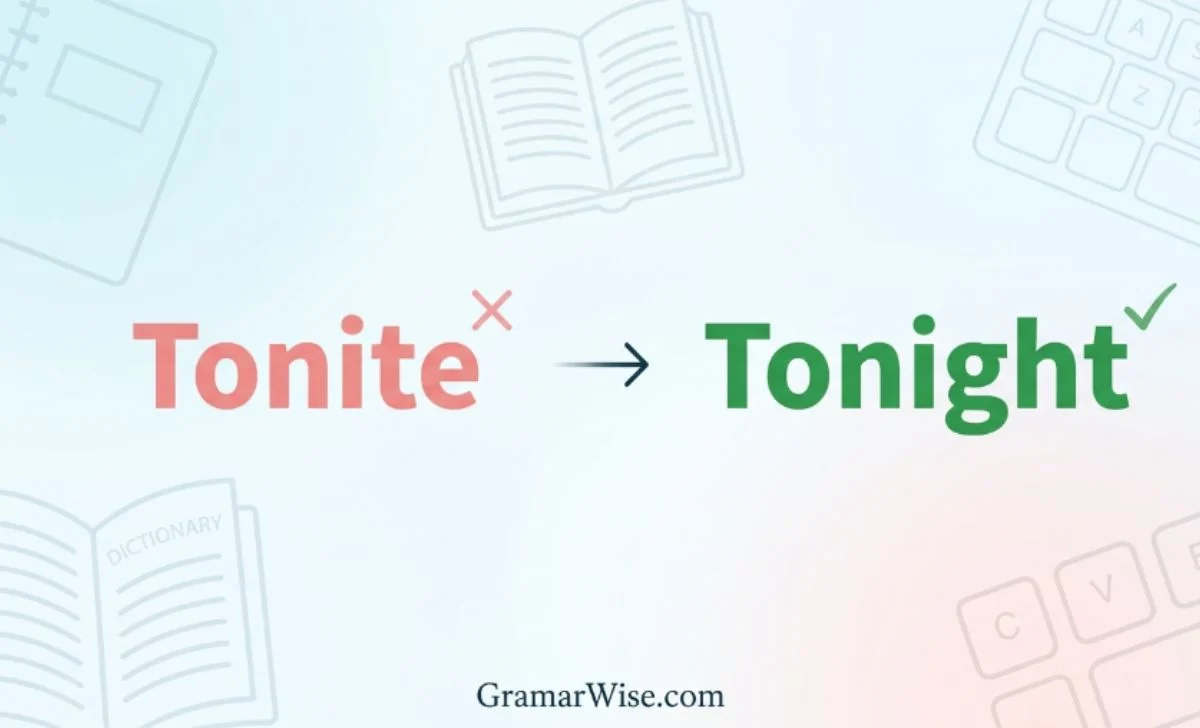
Tonight is the correct and standard English spelling. Tonite is an informal spelling that is mostly used in text messages, social media posts, advertising, and casual conversations.
You should always use tonight in formal, academic, professional, and business writing.
Although many people recognize tonite, it is not accepted as the standard spelling by major dictionaries or grammar style guides.
In short:
- Tonight = Correct for every type of writing.
- Tonite = Informal and best avoided outside casual communication.
Correct Example
These examples follow standard English grammar.
- We are going to watch a movie tonight.
- I will finish my homework tonight.
- The concert begins tonight at 8 p.m.
- Are you free tonight?
- She plans to travel tonight.
Incorrect Example
These examples are not suitable for formal writing.
- We are going to watch a movie tonite.
- I will submit the report tonite.
- The meeting starts tonite.
- Please complete your assignment tonite.
Tonight is the correct and standard English spelling. Tonite is an informal spelling mainly used in text messages, social media, and advertising.
If your writing will be read by a teacher, employer, client, or a wider audience, always use tonight.
Tonite vs Tonight at a Glance
| Feature | Tonight | Tonite |
|---|---|---|
| Standard English spelling | ✅ Yes | ❌ No |
| Formal writing | ✅ Yes | ❌ No |
| Academic writing | ✅ Yes | ❌ No |
| Business writing | ✅ Yes | ❌ No |
| Casual texting | ✅ Yes | ✅ Yes |
| Social media | ✅ Yes | ✅ Sometimes |
| Recommended choice | ⭐ Always | Only for informal chats |
What Does Tonite or Tonight Mean?
The words tonite and tonight have the same meaning. Both refer to the evening or night of the current day. The only real difference is the spelling.
Tonight is the accepted spelling in modern English. It appears in dictionaries, books, newspapers, websites, official documents, and educational materials.
Tonite is simply a shortened spelling that became popular because it is quicker to type. While many people use it in casual messages, it is considered a nonstandard form.
If your goal is clear, correct, and professional writing, tonight is always the better choice.
Common Meanings
The word tonight can be used in two ways.
As an Adverb
It means during this evening or night.
Examples
- We are eating out tonight.
- I will call you tonight.
- They are arriving tonight.
- The match will be played tonight.
As a Noun
It refers to the evening or night of today.
Examples
- Tonight will be colder than yesterday.
- Tonight is perfect for a family dinner.
- Tonight promises clear skies.
Although tonite can express the same idea, it should not replace tonight in standard English writing.
Simple Usage Examples
Here are a few examples that show the correct spelling in everyday situations.
| Situation | Correct Sentence |
|---|---|
| Talking about plans | We are having dinner tonight. |
| Making an invitation | Would you like to come over tonight? |
| School work | I must finish my project tonight. |
| News report | Heavy rain is expected tonight. |
| Business email | The presentation is scheduled for tonight. |
Now compare them with the informal version.
| Informal Sentence | Better Standard Sentence |
|---|---|
| See you tonite! | See you tonight! |
| Party tonite! | Party tonight! |
| Call me tonite. | Call me tonight. |
| Movie tonite. | Movie tonight. |
In casual chats with friends, many people may write tonite, but in every important situation, tonight is the correct spelling to use.
Which is correct: tonite or tonight?
Tonight is the correct and standard English spelling. Tonite is an informal spelling commonly seen in text messages, social media, and advertising. For formal, academic, business, and professional writing, always use tonight.
The Origin of Tonite or Tonight
The difference between tonite and tonight is not about meaning. It is about how the English language developed over time. While tonight became the accepted spelling in standard English, tonite emerged later as a shortened, informal version.
Understanding their history makes it easier to see why one spelling belongs in formal writing and the other is mostly limited to casual communication.
Word History
The word tonight has been used in English for centuries. It developed from the phrase to night, which meant during this night or on this night.
As English spelling became more consistent, the two words merged into the single word tonight.
Over time, dictionaries, grammar books, publishers, and schools recognized tonight as the standard spelling.
Today, it appears in newspapers, novels, government documents, business emails, academic papers, and everyday writing.
The spelling tonite appeared much later. During the late nineteenth and early twentieth centuries, some advertisers and writers began shortening words to make them quicker to read and easier to remember.
Just as nite became an informal spelling of night, tonite appeared as a simplified version of tonight.
Although it became popular in signs, advertisements, and later in text messages and social media, tonite never replaced tonight as the correct English spelling.
Timeline of the Word
| Period | Development |
|---|---|
| Old English | Expressions meaning “this night” were written in different forms. |
| Middle English | The phrase to night became common. |
| Early Modern English | The spelling changed to the single word tonight. |
| 1900s | Tonite appeared in advertising and informal writing. |
| Today | Tonight is the standard spelling, while tonite remains informal. |
Why the Confusion Happens
Many people believe tonite is correct because they see it online every day. In reality, the confusion comes from changes in digital communication rather than changes in grammar.
Here are the main reasons people mix up the two spellings.
1. Text Messages Encourage Shorter Words
People often shorten words while texting to save time.
For example:
- Tonight → Tonite
- Before → B4
- You → U
These shortcuts are convenient, but they are not considered standard English.
2. Social Media Promotes Informal Writing
Platforms like Instagram, Facebook, TikTok, and X encourage casual conversations. As a result, spellings such as tonite appear more frequently than they do in books or newspapers.
3. Advertisements Use Creative Spellings
Businesses sometimes choose tonite because it looks catchy.
Examples include:
- Live Music Tonite
- Special Offer Tonite
- One Night Only Tonite
These are marketing choices rather than grammar rules.
4. Both Words Sound the Same
Perhaps the biggest reason for the confusion is pronunciation.
Both tonight and tonite are pronounced exactly the same. Because there is no difference in speech, many people assume there is no difference in spelling.
However, pronunciation does not determine whether a spelling is correct.
5. English Learners Copy Online Usage
Many learners see tonite in chats or comments and assume it is accepted English. Unfortunately, that leads to mistakes in essays, exams, and professional writing.
Quick Answer
People confuse tonite and tonight because they sound identical and the shorter spelling is common in texting and social media. However, only tonight is accepted as the standard English spelling.
British English vs American English
Many English words have different spellings depending on the country.
For example:
| British English | American English |
|---|---|
| Colour | Color |
| Centre | Center |
| Favourite | Favorite |
| Travelling | Traveling |
However, tonight is not one of these words.
Both British English and American English use the same spelling:
Tonight
The spelling tonite is considered informal in both language varieties. It is not the preferred form in schools, newspapers, books, universities, or professional communication.
Whether you are writing for readers in London, New York, Toronto, Sydney, or New Delhi, tonight is the correct spelling.
Comparison Table
| Feature | British English | American English |
|---|---|---|
| Standard spelling | Tonight | Tonight |
| Accepted in dictionaries | ✅ Yes | ✅ Yes |
| Used in newspapers | ✅ Yes | ✅ Yes |
| Used in schools | ✅ Yes | ✅ Yes |
| Used in business writing | ✅ Yes | ✅ Yes |
| Is tonite standard? | ❌ No | ❌ No |
Examples in British English
- We are meeting tonight.
- The football match begins tonight.
- It may snow tonight.
Examples in American English
- I’ll call you tonight.
- The baseball game starts tonight.
- We are flying home tonight.
As you can see, the spelling never changes.
Tonite or Tonight vs Other Variations
Besides tonite, people sometimes type other versions by mistake. Most of these spellings happen because of typing errors, autocorrect issues, or confusion about English spelling rules.
Only one spelling is considered correct in standard English.
Spelling Comparison Table
| Spelling | Correct? | Usage | Region |
|---|---|---|---|
| Tonight | ✅ Correct | Formal and informal writing | Worldwide |
| Tonite | ⚠️ Informal | Texting, social media, advertising | Worldwide (casual only) |
| To night | ❌ Incorrect (modern English) | Spacing mistake | None |
| Tonigth | ❌ Incorrect | Typing error | None |
| Tonigt | ❌ Incorrect | Misspelling | None |
| Tonigtht | ❌ Incorrect | Typing error | None |
Which Form Should You Remember?
Remember this simple rule:
- Tonight → Correct everywhere.
- Tonite → Acceptable only in casual texting or social media.
- Any other spelling → Incorrect.
If you are unsure which version to choose, tonight is always the safest option.
Quick Comparison
| Writing Situation | Recommended Spelling |
|---|---|
| School assignment | Tonight |
| College essay | Tonight |
| Business email | Tonight |
| Website content | Tonight |
| Blog article | Tonight |
| News report | Tonight |
| Text message | Tonight or Tonite |
| Social media caption | Tonight (preferred) |
Which Spelling Should You Use?
Choosing between tonite and tonight is simple once you understand the purpose of your writing. Although both words sound the same, they are not treated the same in English.
One is accepted everywhere, while the other is limited to casual communication.If you are writing an email, an article, a school assignment, a business report, or any document that requires proper grammar, you should always use tonight.
It is the standard spelling recognized by dictionaries, grammar guides, publishers, and educational institutions.
The spelling tonite is different. It became popular because it is shorter and faster to type. That makes it common in text messages, online chats, and social media posts. However, convenience does not make it grammatically correct.
A simple rule can save you from mistakes:
If your writing is meant to look professional or correct, always choose tonight.
US Audience
If your audience is in the United States, the correct spelling is tonight. American English does not recognize tonite as the standard form.
Whether you are writing a blog post, website content, newspaper article, business email, or college essay, tonight is the spelling readers expect to see.
Using the standard form also makes your writing appear more credible and polished.You may occasionally notice tonite in advertisements or text messages.
Companies sometimes use creative spellings to attract attention, while friends use shortened spellings to type faster. These situations are informal and do not change the grammar rule.
Examples
- We are leaving tonight.
- The baseball game starts tonight.
- I will call you tonight after work.
- Please submit the report tonight.
UK Audience
The same rule applies in the United Kingdom. British English uses tonight as the only standard spelling.
You will find tonight in newspapers, books, magazines, official documents, and educational materials throughout the UK. Teachers and editors also expect this spelling in assignments and professional writing.
Although tonite sometimes appears on posters or in casual online conversations, it is still considered informal and should not replace tonight in correct English.
Examples
- The concert begins tonight.
- We are meeting tonight.
- It may rain tonight.
- The train arrives tonight.
International Writing
If your readers come from different countries, always choose tonight.
English is used around the world, and readers expect standard spelling regardless of where they live.
Whether your audience is in Canada, Australia, India, New Zealand, or South Africa, tonight is the spelling they will recognize immediately.
Using standard English also improves readability and helps build trust. This is especially important for websites, blogs, online businesses, and educational content.
| Audience | Recommended Spelling | Why? |
|---|---|---|
| United States | Tonight | Standard American English |
| United Kingdom | Tonight | Standard British English |
| Canada | Tonight | Accepted nationwide |
| Australia | Tonight | Standard spelling |
| India | Tonight | Used in education and media |
| International audience | Tonight | Clear and professional |
If your goal is to reach readers worldwide, there is no advantage in using tonite. The standard spelling works everywhere.
Academic Writing
Academic writing follows strict grammar and spelling rules. Schools, colleges, universities, and research institutions expect writers to use standard English in every assignment.
If you write tonite in an essay, research paper, examination, or thesis, your teacher or editor may mark it as a spelling error.
Even though the meaning is understood, it does not meet academic writing standards.
Always use tonight in:
- Essays
- Homework
- Research papers
- Presentations
- Academic journals
- Educational blogs
Correct Examples
- I will complete my assignment tonight.
- The experiment will continue tonight.
- Our presentation is scheduled for tonight.
Incorrect Examples
- I will complete my assignment tonite.
- The experiment will continue tonite.
Using the correct spelling shows attention to detail and strengthens the overall quality of your writing.
Social Media Usage
Social media is one place where grammar rules become more flexible. People often shorten words because they want to type quickly or create a casual tone.
That is why you may see posts like:
- Party tonite!
- See you tonite!
- Movie night tonite!
These spellings are common among friends, but they are still informal.
If you manage a business page, publish professional content, or build a personal brand, it is better to use tonight. Correct spelling creates a stronger impression and makes your content look more trustworthy.
Compare these examples:
| Casual Style | Professional Style |
|---|---|
| Party tonite! | Party tonight! |
| Concert tonite! | Concert tonight! |
| See you tonite. | See you tonight. |
| Big game tonite. | Big game tonight. |
In other words, tonite may fit a casual conversation, but tonight works in every situation.
Quick Decision Guide
If you are still unsure which spelling to choose, use this table as a quick reference.
| Writing Situation | Best Choice |
|---|---|
| School assignment | ✅ Tonight |
| Business email | ✅ Tonight |
| Research paper | ✅ Tonight |
| Blog article | ✅ Tonight |
| News report | ✅ Tonight |
| Website content | ✅ Tonight |
| Job application | ✅ Tonight |
| Text message to a friend | Tonight or Tonite |
| Casual social media post | Tonight (preferred), Tonite (acceptable) |
Common Mistakes with Tonite or Tonight
Even though the difference between tonite and tonight seems small, many writers use the wrong spelling without realizing it.
The mistake usually happens because both words sound exactly the same. People hear the word, type it quickly, and assume that either spelling is acceptable.
The rise of texting, instant messaging, and social media has made the confusion even more common.
Shortened spellings have become part of everyday online conversations, so many English learners believe they are also correct in formal writing. Unfortunately, that is not true.
Understanding these common mistakes will help you write with more confidence and avoid errors in emails, assignments, blog posts, business documents, and professional communication.
Frequent Errors
Below are the mistakes people make most often when writing tonite or tonight.
1. Using Tonite in Formal Writing
This is the most common mistake.
Many writers use tonite in reports, assignments, resumes, emails, and official documents because they think it is simply a shorter version of tonight. However, grammar rules do not accept this spelling in formal writing.
Incorrect
- I will submit the report tonite.
- The meeting starts tonite.
Correct
- I will submit the report tonight.
- The meeting starts tonight.
Whenever your writing is professional, always choose tonight.
2. Thinking Both Spellings Are Correct
Because tonite appears so often online, many people believe both spellings are equally acceptable.
This is a misunderstanding.
The standard spelling is tonight, while tonite is simply an informal variation used in casual communication.
Think of it this way:
- Tonight belongs in dictionaries.
- Tonite belongs in casual texting.
3. Copying Social Media Trends
Social media encourages people to type quickly rather than perfectly.
You may often read posts such as:
- Party tonite
- Movie tonite
- Concert tonite
Seeing these spellings every day can make them look correct, but they are still informal.
If you are writing for a website, blog, business, or school, do not copy social media spelling habits.
4. Following Advertising Style
Advertisers often use creative spellings to make signs and headlines more eye-catching.
For example:
- Live Music Tonite
- Open Tonite Only
- Comedy Night Tonite
These spellings are chosen for style and branding, not because they follow grammar rules.
Advertising language is often different from standard English.
5. Making Typing Mistakes
Sometimes the mistake is not tonite at all. It is simply a typing error.
Common misspellings include:
- Tonigth
- Tonigt
- Tonigtht
- To night
- Tonnight
Spell-check tools usually catch these errors, but proofreading your work is always a good habit.
Corrected Examples
The table below shows common mistakes and their corrected versions.
| Incorrect Sentence | Correct Sentence |
|---|---|
| I’ll see you tonite. | I’ll see you tonight. |
| The meeting is tonite. | The meeting is tonight. |
| Party tonigt! | Party tonight! |
| I’ll finish it tonigth. | I’ll finish it tonight. |
| We leave to night. | We leave tonight. |
| Movie starts tonite. | Movie starts tonight. |
| I’ll call you tonnight. | I’ll call you tonight. |
Notice that every corrected sentence uses tonight, because it is the standard spelling.
Tips to Avoid These Mistakes
You can avoid spelling errors by following a few simple rules.
- Always remember that tonight is one complete word.
- Use tonight in school, college, and university assignments.
- Choose tonight for business emails and professional communication.
- Do not assume social media spellings are grammatically correct.
- Proofread your writing before publishing or sending it.
- If you are unsure, check a trusted dictionary instead of copying online posts.
These habits will improve both your grammar and your overall writing quality.
Common Mistakes
| Mistake | Why It’s Wrong | Correct Choice |
|---|---|---|
| Using tonite in formal writing | Informal spelling | Tonight |
| Thinking both spellings are standard | Only one is accepted | Tonight |
| Copying social media | Casual usage only | Tonight |
| Following advertisements | Marketing style | Tonight |
| Typing tonigth or tonigt | Misspelling | Tonight |
The easiest way to remember the rule is this:
If your writing matters, write tonight. Save tonite only for casual conversations, if you choose to use it at all.
Tonite or Tonight in Everyday Examples
Learning the grammar rule is important, but seeing how tonight is used in real-life situations makes it much easier to remember.
In everyday English, the word appears in emails, conversations, news reports, school assignments, business documents, and social media posts.
Although you may occasionally come across tonite in casual texting or online chats, the standard spelling tonight is appropriate in almost every situation.
If you build the habit of using tonight, you will rarely have to worry about making a spelling mistake.
The examples below show how the word is used in different types of writing.
Emails
Emails are usually professional, even when they are sent to friends or colleagues. Using the correct spelling helps your message look polished and trustworthy.
Whether you are writing to a client, teacher, manager, or coworker, always use tonight instead of tonite.
Professional Email Examples
- I will send the updated report tonight.
- The meeting has been moved to tonight.
- Please review the proposal tonight.
- I’ll complete the revisions tonight.
- We expect to receive your response tonight.
Incorrect Examples
- I will send the report tonite.
- Please check the document tonite.
Even a small spelling mistake can make a professional email look less polished.
Social Media
Social media is one of the few places where you will regularly see tonite. Many users shorten words to type faster or create a casual tone.
However, using tonight is never wrong. In fact, it often looks cleaner and more professional, especially for businesses, creators, and public figures.
Casual Posts
- Party tonite! 🎉
- Movie night tonite!
- See you tonite!
Recommended Posts
- Party tonight! 🎉
- Movie night tonight!
- See you tonight!
- Big game tonight. Don’t miss it!
- We can’t wait to see everyone tonight.
If you’re posting on behalf of a company or personal brand, choose tonight to maintain credibility.
News Writing
News organizations follow strict editorial and grammar guidelines. That is why you will always see tonight instead of tonite in newspapers, television broadcasts, and online news articles.
Journalists use standard English because their writing must be clear, accurate, and professional.
Examples
- Heavy rain is expected tonight across the region.
- The President will address the nation tonight.
- The championship final takes place tonight.
- The weather will remain cloudy tonight.
- Emergency services will stay on alert tonight.
You are highly unlikely to find tonite in a professionally edited news report.
School Writing
Students should always use tonight in homework, essays, assignments, presentations, and exams.
Teachers expect standard English, and using tonite may be marked as a spelling error.
Correct Examples
- I will finish my homework tonight.
- Our science project is due tonight.
- We need to prepare for tomorrow’s test tonight.
- The assignment must be submitted tonight.
- I plan to revise my notes tonight.
Using correct spelling demonstrates good writing habits and attention to detail.
Business Writing
Business communication should always follow professional writing standards. Clients, coworkers, and employers expect correct spelling in reports, proposals, emails, and presentations.
Replacing tonight with tonite may make your writing appear careless, even if the reader understands your meaning.
Examples
- The presentation is scheduled for tonight.
- Our team will complete the update tonight.
- Production will continue tonight.
- The maintenance work begins tonight.
- Please send the final approval tonight.
Good business writing depends on clarity, accuracy, and consistency. Using tonight helps create the right impression.
Everyday Usage Comparison
The table below shows which spelling works best in common situations.
| Situation | Tonight | Tonite |
|---|---|---|
| Business email | ✅ Recommended | ❌ Not recommended |
| School assignment | ✅ Recommended | ❌ Incorrect |
| Research paper | ✅ Recommended | ❌ Incorrect |
| News article | ✅ Recommended | ❌ Incorrect |
| Blog post | ✅ Recommended | ❌ Not recommended |
| Website content | ✅ Recommended | ❌ Not recommended |
| Text message | ✅ Correct | ✅ Acceptable (informal) |
| Social media | ✅ Preferred | ✅ Casual use |
| Advertising slogan | ✅ Correct | ✅ Sometimes used for style |
Google Trends & Usage Data
The keyword tonite or tonight continues to receive consistent search interest because many people are unsure which spelling is correct.
Most searches come from students, writers, bloggers, and English learners who want to avoid spelling mistakes in everyday writing.
Google search behavior clearly shows that tonight is the preferred spelling, while tonite is searched mainly by users checking whether it is correct or acceptable.
Search interest also increases during school terms, writing projects, and grammar-related searches.
Popular Countries
The keyword is commonly searched in English-speaking countries where grammar and spelling questions are popular.
| Country | Search Interest | Common Search Intent |
|---|---|---|
| United States | Very High | Correct spelling and grammar |
| United Kingdom | High | Usage and writing rules |
| Canada | High | Spelling comparison |
| Australia | Medium | Grammar and examples |
| India | High | English learning and exams |
These countries consistently use tonight as the standard spelling in education, business, and professional writing.
Why People Search This Keyword
Most users search tonite or tonight because they want a quick and accurate answer before using the word in writing.
The most common search reasons include:
- Checking which spelling is correct.
- Learning the difference between tonite and tonight.
- Finding the correct spelling for school or work.
- Understanding whether tonite is acceptable in English.
- Looking for grammar rules and sentence examples.
- Confirming if tonite appears in dictionaries.
- Comparing formal and informal English usage.
Related Grammar Rules
Understanding tonite and tonight becomes easier when you learn a few basic English spelling rules. These rules also help you avoid similar mistakes with other commonly confused words.
Standard English follows consistent spelling patterns, while informal writing often shortens words for convenience. Knowing the difference helps you choose the right spelling in every situation.
Similar Spelling Mistakes
Many English words have informal versions that appear in text messages or online conversations but should not be used in formal writing.
| Standard English | Informal or Nonstandard Form |
|---|---|
| Tonight | Tonite |
| Night | Nite |
| Through | Thru |
| Because | Cuz |
| You | U |
| Before | B4 |
Like tonite, these shortened forms are acceptable only in casual communication. They should be avoided in academic, business, and professional writing.
Helpful Grammar Tips
Follow these simple rules to avoid spelling mistakes.
- Use tonight in all formal, academic, and professional writing.
- Avoid copying spellings from social media or text messages.
- Remember that tonight is the only standard English spelling.
- Proofread your writing before submitting or publishing it.
- When in doubt, check a trusted dictionary or style guide instead of relying on informal online usage.
Developing these habits will improve both your spelling and your overall writing quality.
FAQs
1. Is tonite grammatically correct?
No. Tonight is the grammatically correct spelling in standard English. Tonite is an informal spelling mainly used in text messages, social media, and advertising.
2. Why do some people say tonite?
People use tonite because it is shorter and faster to type. It became popular through casual messaging and online communication.
3. Is tonite the same as tonight?
They have the same meaning, but they are not equally correct. Tonight is the standard spelling, while tonite is an informal alternative.
4. Is tonite in the dictionary?
Some dictionaries include tonite as an informal or nonstandard spelling. However, tonight is the recommended spelling for standard English.
5. Do Americans spell tonight as tonite?
No. Standard American English uses tonight. Some people may write tonite in casual texts, but it is not considered correct in formal writing.
6. When should you use tonite?
Use tonite only in very casual text messages or informal social media posts. For every other type of writing, choose tonight.
7. Is tonite a valid Scrabble word?
Yes. Tonite is accepted in some Scrabble dictionaries, but that does not make it the standard English spelling.
8. Why is the G silent in night?
The gh in night comes from older forms of English where it was once pronounced. Over time, the pronunciation changed, but the spelling remained.
9. Is there an apostrophe in tonight’s?
Yes. Tonight’s includes an apostrophe because it shows possession.
Example: Tonight’s event has been cancelled.
10. What is the meaning of tonite?
Tonite means the same as tonight—the evening or night of the current day. It is simply an informal spelling.
11. Who spells tonite?
People often use tonite in casual texting, online chats, and social media. Professional writers, editors, and publishers use tonight.
12. What is a tonite?
In everyday English, tonite is an informal spelling of tonight. Historically, Tonite was also the name of an explosive, but that meaning is unrelated to grammar.
13. Why do people write tonite?
People write tonite because it is shorter, easier to type, and common in informal digital communication.
14. Where did tonite come from?
Tonite developed as a simplified spelling and became popular in advertising before spreading through texting and social media.
15. Is it toot or tout?
Toot and tout are different English words with different meanings. They are not related to tonite or tonight.
16. Is tonite a word?
Yes, tonite is recognized by some dictionaries as an informal spelling. However, tonight is the standard spelling used in correct English.
17. What is a tonite box?
A Tonite Box generally refers to historical packaging used to store or transport the explosive known as Tonite. It has no connection to the spelling of tonight.
18. What is effete slang for?
Effete is not slang. It is an adjective that describes someone or something as weak, overrefined, or lacking strength and energy.
19. What is Effy slang for?
Effy is an informal nickname, often used for names such as Elizabeth. In online conversations, it may also have different meanings depending on the context.
20. What is a gallimaufry?
A gallimaufry is not slang. It means a mixture or jumble of different things, especially ideas, foods, or items.
21. What does ETS mean in texting?
ETS can have different meanings depending on the conversation. It commonly stands for Estimated Time of Shipping or Education Testing Service, but the intended meaning depends on the context.
22. What does SHV mean in text?
SHV has several meanings in online communication. Its meaning depends on the platform, conversation, or community where it is used.
23. What does TMN mean in texting?
TMN is a text abbreviation with multiple meanings. The correct interpretation depends on the context of the conversation.
24. What does EOE mean in text?
EOE usually stands for Equal Opportunity Employer in job advertisements. In casual texting, it may have a different meaning depending on the context.
25. What does RLN mean in text?
RLN is an abbreviation with several possible meanings in texting and online communication. The correct meaning depends on the situation and the people using it.
Conclusion
Choosing between tonite and tonight is easier once you know the grammar rule. Tonight is the correct and standard English spelling used in formal, academic, business, and everyday writing.
Although tonite has the same meaning, it is an informal spelling that appears mainly in text messages, social media posts, and advertising.
If you want your writing to look professional and grammatically correct, always choose tonight. Remember that standard English values clarity and consistency, especially in emails, assignments, articles, and official documents.
By understanding the difference and using the correct spelling in the right context, you can avoid common mistakes and write with greater confidence in every situation.