Have you ever written “planed” in an email and then stopped to wonder if it was correct? You are not alone. Many people confuse planned and planed because the words look almost identical.
The difference is only one extra letter, but that small change creates a completely different meaning. Since both words are real English words, spellcheck may not catch the mistake.
This confusion appears in essays, business reports, social media posts, and everyday writing. The good news is that the rule is simple once you understand it.
In this guide, you will learn the meaning of planned and planed, their pronunciation, origins, grammar rules, examples, and correct usage so you can avoid this common writing mistake every time.
Planned or Planed – Quick Answer
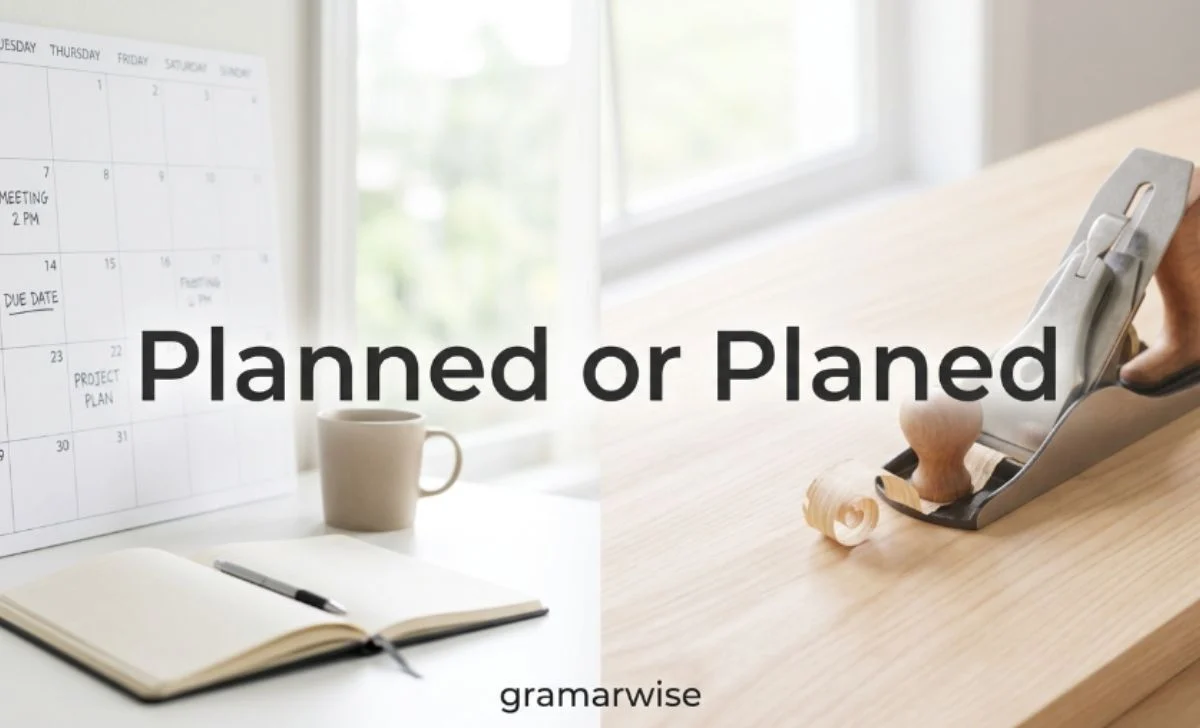
The correct past tense of plan is planned.
- I planned a meeting for Monday.
- She planned her vacation carefully.
- They planned the project months ago.
The word planed is different. It comes from the verb plane, which means to smooth or shape wood with a plane tool.
- The carpenter planed the board.
- He planed the door so it would close properly.
Correct Example
We planned the event weeks in advance.
She planned her study schedule carefully.
The team planned a successful marketing campaign.
The carpenter planed the wooden surface.
Incorrect Example
We planed the event weeks in advance.
She planed her study schedule carefully.
The company planed a new business strategy.
These examples show why choosing the correct spelling matters.
What Does Planned or Planed Mean?
Although the words look similar, they have very different meanings.
Common Meanings
| Word | Meaning | Part of Speech |
|---|---|---|
| Planned | Organized, arranged, or prepared in advance | Verb (past tense of plan) |
| Planed | Smoothed or shaped using a plane tool | Verb (past tense of plane) |
The word planned is common in everyday communication because people frequently discuss goals, meetings, schedules, projects, events, budgets, lessons, and travel plans.
The word planed is mainly used in woodworking, carpentry, furniture making, joinery, and construction.
Simple Usage Examples
Planned
- We planned the conference last month.
- She planned her wedding carefully.
- They planned a new product launch.
- The teacher planned the lesson.
- The city planned a development project.
Planed
- The carpenter planed the wood.
- He planed the rough surface.
- The cabinet maker planed the board.
- The worker planed the timber smoothly.
- The furniture maker planed the edges.
Planned Meaning
The word planned refers to something that was organized, arranged, prepared, or decided beforehand.
It comes from the verb plan.
Examples:
- A planned meeting
- A planned trip
- A planned project
- A planned budget
- A planned schedule
- A planned strategy
Planning is an important part of business, education, project management, financial planning, event planning, and travel planning.
Planned in Different Contexts
| Context | Example |
|---|---|
| Business Planning | The company planned a new expansion strategy. |
| Event Planning | They planned the wedding months ahead. |
| Travel Planning | We planned our vacation early. |
| Academic Writing | The research was carefully planned. |
| Financial Planning | She planned her retirement savings. |
Planed Meaning
The word planed belongs to woodworking and carpentry.
It comes from the verb plane.
A plane is a tool used to smooth, flatten, or shape wood.
Examples:
- The carpenter planed the board.
- The woodworker planed the timber.
- He planed the surface before painting.
Planed Wood Meaning
Planed wood is wood that has been smoothed using a plane.
Benefits include:
- Smoother surface
- Better appearance
- Easier painting
- Easier finishing
- Improved accuracy
Planed Board Meaning
A planed board is a wooden board that has been shaped and smoothed.
Examples:
- The carpenter used a planed board.
- The planed board was ready for installation.
- Furniture makers prefer planed timber for many projects.
Planned or Planed Past Tense
This is one of the most searched questions.
Which Is the Correct Past Tense of Plan?
The correct past tense of plan is planned.
Examples:
- I planned the meeting.
- She planned the trip.
- We planned the project.
The spelling follows a common English grammar rule.
The Double Consonant Rule
When a short verb ends in:
Consonant + Vowel + Consonant
the final consonant is often doubled before adding -ed.
Examples:
| Base Verb | Past Tense |
|---|---|
| Plan | Planned |
| Stop | Stopped |
| Drop | Dropped |
| Beg | Begged |
| Fit | Fitted |
Because plan follows this pattern, the correct spelling is planned, not planed.
Why Is Planned Spelled With Two N’s?
Many writers ask this question.
The answer is simple:
- Plan → Planned
- The final n is doubled before adding ed
This follows the standard consonant-vowel-consonant spelling rule used in English grammar.
Without doubling the letter, the word becomes planed, which has a completely different meaning.
Planned or Planed Synonym
Understanding synonyms helps reinforce meaning.
Planned Synonyms
Common synonyms include:
- Organized
- Arranged
- Prepared
- Scheduled
- Designed
- Intended
- Coordinated
- Structured
- Programmed
- Developed
Examples:
- The meeting was planned.
- The meeting was organized.
- The project was planned.
- The project was arranged.
Planed Synonyms
Common synonyms include:
- Smoothed
- Shaped
- Trimmed
- Flattened
- Leveled
- Finished
- Refined
Examples:
- The carpenter planed the wood.
- The carpenter smoothed the wood.
- The worker planed the surface.
- The worker flattened the surface.
Planned or Planed Pronunciation
Another reason for confusion is pronunciation.
Planned Pronunciation
Planned is pronounced:
/plænd/
It sounds similar to:
- Land
- Hand
- Stand
Example:
- Planned the project.
- Planned the event.
Planed Pronunciation
Planed is pronounced:
/pleɪnd/
It sounds similar to:
- Gained
- Trained
- Chained
Example:
- Planed the board.
- Planed the timber.
Pronunciation Comparison
| Word | Pronunciation |
|---|---|
| Planned | Pland |
| Planed | Playnd |
Unlike many confused word pairs, these two words do not sound exactly the same.
The pronunciation difference can help you remember the correct spelling.
Planned or Planed in a Sentence
Seeing complete sentences makes the distinction clearer.
Planned Sentences
- We planned the meeting for Friday.
- She planned her career carefully.
- They planned a family vacation.
- The teacher planned the lesson.
- The company planned a new campaign.
- The city planned a transportation project.
- He planned every detail of the event.
- We planned our budget early.
- The researchers planned the study.
- They planned a successful launch.
Planed Sentences
- The carpenter planed the board.
- He planed the rough wood.
- The worker planed the timber smooth.
- The cabinet maker planed the edges.
- The craftsman planed the surface carefully.
- She planed the material before painting.
- The woodworker planed the tabletop.
- They planed the wooden frame.
- The board was planed perfectly flat.
- He planed the wood before assembly.
Planned or Planed Examples
Everyday Examples Using Planned
- We planned the birthday party months ago.
- She planned a detailed schedule.
- The business planned future growth.
- They planned a new marketing strategy.
- I planned my weekend activities.
Everyday Examples Using Planed
- The carpenter planed the old door.
- He planed the timber for the project.
- The furniture maker planed the surface.
- The board was carefully planed.
- The woodworker planed the edges smooth.
The Origin of Planned or Planed
The history of these words helps explain why they are different.
Word History
The word plan comes from Latin and French roots related to designs, layouts, and diagrams.
Over time, English speakers began using the word to describe arranging or organizing future actions.
That eventually produced forms such as:
- Plan
- Planning
- Planned
- Planner
The word plane comes from a different historical path.
It originally referred to something flat.
Later, it became the name of a woodworking tool used to smooth surfaces.
From this meaning came:
- Plane
- Planes
- Planing
- Planed
Why the Confusion Happens
Several factors cause confusion:
- Similar spelling
- Shared letters
- Fast typing
- Spellcheck limitations
- Lack of knowledge about the double consonant rule
Many people write:
✘ I planed the meeting.
because they forget to double the final n.
However, the correct sentence is:
✔ I planned the meeting.
British English vs American English
Many spelling differences exist between British English and American English.
Examples include:
- Colour vs Color
- Organise vs Organize
- Centre vs Center
However, planned and planed follow the same rules in both versions of English.
Comparison Table
| Word | American English | British English |
|---|---|---|
| Planned | Planned | Planned |
| Planed | Planed | Planed |
| Planning | Planning | Planning |
| Planing | Planing | Planing |
This means writers in:
- United States
- United Kingdom
- Canada
- Australia
- India
all use the same spelling rules for these words.
Planned or Planed vs Other Variations
Many users search for spelling variations because they are unsure which form is correct.
Spelling Comparison Table
| Word | Correct? | Usage | Region |
|---|---|---|---|
| Planned | ✔ Yes | Past tense of plan | All English regions |
| Planed | ✔ Yes | Woodworking term | All English regions |
| Planing | ✔ Yes | Smoothing wood | All English regions |
| Planning | ✔ Yes | Organizing activities | All English regions |
| Planing a meeting | ✘ No | Incorrect usage | None |
| Planned wood | ✘ Usually incorrect | Context mismatch | None |
Which Spelling Should You Use?
US Audience
American English writers should use planned when discussing organization, preparation, schedules, goals, events, meetings, and projects.
Use planed only when discussing woodworking or carpentry.
Which Spelling Should You Use?
Choosing the correct spelling becomes easy when you focus on the meaning of the sentence.
If you are talking about arranging, organizing, preparing, scheduling, or deciding something ahead of time, use planned.
If you are talking about smoothing, shaping, or flattening wood with a plane tool, use planed.
A simple question can help:
Are you discussing an idea or a piece of wood?
- Idea, event, project, trip, budget, or strategy = planned
- Wood, timber, board, surface, or carpentry = planed
UK Audience
British English follows the same rule.
Examples:
- The meeting was carefully planned.
- The carpenter planed the timber.
No alternative spelling exists in British English.
International Writing
Writers in Canada, Australia, New Zealand, India, and other English-speaking regions also follow the same spelling rule.
Examples:
- The conference was planned months ago.
- The wood was planed before painting.
Academic Writing
In academic writing, planned is far more common.
Examples:
- The experiment was carefully planned.
- Researchers planned the study design.
- The project was strategically planned.
The word planed appears only in subjects related to woodworking, construction, manufacturing, carpentry, and engineering.
Social Media Usage
Social media users often make this mistake because they type quickly.
Incorrect:
- We planed everything perfectly.
Correct:
- We planned everything perfectly.
Incorrect:
- I planed my vacation already.
Correct:
- I planned my vacation already.
Planned or Planed Quiz
Test your understanding.
Choose the correct word.
Question 1
We ______ the event six months ago.
A. Planned
B. Planed
Answer: A. Planned
Question 2
The carpenter ______ the wooden board.
A. Planned
B. Planed
Answer: B. Planed
Question 3
The company ______ a new marketing campaign.
A. Planned
B. Planed
Answer: A. Planned
Question 4
The worker ______ the timber before installation.
A. Planned
B. Planed
Answer: B. Planed
Question 5
The teacher ______ the lesson carefully.
A. Planned
B. Planed
Answer: A. Planned
Question 6
The cabinet maker ______ the rough edges.
A. Planned
B. Planed
Answer: B. Planed
Question 7
We ______ our travel schedule months ahead.
A. Planned
B. Planed
Answer: A. Planned
Question 8
The woodworker ______ the surface smooth.
A. Planned
B. Planed
Answer: B. Planed
Question 9
The researchers ______ the project timeline.
A. Planned
B. Planed
Answer: A. Planned
Question 10
The carpenter ______ the door so it would close correctly.
A. Planned
B. Planed
Answer: B. Planed
Common Mistakes with Planned or Planed
This spelling mistake is common because both words are legitimate English words.
Frequent Errors
| Incorrect | Correct |
|---|---|
| I planed a meeting. | I planned a meeting. |
| She planed her trip. | She planned her trip. |
| We have planed everything. | We have planned everything. |
| The company planed a strategy. | The company planned a strategy. |
| He planned the board smooth. | He planed the board smooth. |
Why These Mistakes Happen
The main reasons include:
- Forgetting the double consonant rule
- Typing too quickly
- Spellcheck limitations
- Similar spelling patterns
- Lack of familiarity with woodworking terms
Corrected Examples
Incorrect:
- The team planed the project.
Correct:
- The team planned the project.
Incorrect:
- She planed her wedding for June.
Correct:
- She planned her wedding for June.
Incorrect:
- The carpenter planned the timber.
Correct:
- The carpenter planed the timber.
Planned or Planed in Everyday Examples
Real-world examples make the difference easier to remember.
Emails
Correct:
- We planned the meeting for Thursday.
- The project was carefully planned.
- Our team planned the launch schedule.
Incorrect:
- We planed the meeting for Thursday.
Social Media
Correct:
- We planned this surprise for months.
- Everything went exactly as planned.
- The trip was well planned.
Incorrect:
- Everything went exactly as planed.
News Writing
Correct:
- Officials planned new safety measures.
- The city planned a transportation project.
- Leaders planned emergency responses.
Woodworking Context:
- The carpenter planed the damaged surface.
School Writing
Correct:
- The students planned their science project.
- The lesson was carefully planned.
- The teacher planned classroom activities.
Business Writing
Correct:
- The company planned a growth strategy.
- Executives planned the expansion.
- Management planned next year’s budget.
Professional writers almost always use planned because business communication focuses on preparation and organization.
Google Trends & Usage Data
Popular Countries
Search interest for planned or planed commonly comes from:
| Country | Search Interest |
|---|---|
| United States | Very High |
| United Kingdom | High |
| Canada | High |
| Australia | Moderate |
| India | Growing |
Why People Search This Keyword
People search for this topic because:
- Both words are real English words.
- Spellcheck does not always catch the mistake.
- Students need help with grammar.
- Professionals want accurate business writing.
- Writers want the correct past tense of plan.
- English learners struggle with the double consonant rule.
- People need examples and sentence usage.
Usage Frequency
The word planned appears much more often than planed in books, articles, business documents, websites, and news reports.
This is because planning is part of daily life, while planing wood is a specialized activity.
Related Grammar Rules
Understanding related grammar rules helps prevent future mistakes.
Similar Spelling Mistakes
Many English learners confuse these pairs:
| Word Pair | Common Issue |
|---|---|
| Stopped vs Stoped | Missing double consonant |
| Begged vs Beged | Missing double consonant |
| Fitted vs Fited | Missing double consonant |
| Travelled vs Traveled | Regional spelling differences |
| Principal vs Principle | Similar spelling |
| Affect vs Effect | Similar meaning |
| Complement vs Compliment | Frequently confused |
Helpful Grammar Tips
Tip 1: Remember the Double Consonant Rule
Short verbs ending in consonant-vowel-consonant usually double the final consonant before adding -ed.
Examples:
- Plan → Planned
- Stop → Stopped
- Beg → Begged
- Drop → Dropped
Tip 2: Think About the Subject
If the sentence discusses:
- Meetings
- Goals
- Projects
- Events
- Strategies
- Travel
Use planned.
If the sentence discusses:
- Wood
- Timber
- Carpentry
- Furniture
- Boards
Use planed.
Tip 3: Use the Memory Trick
Planned = Planning
Both contain double letters.
Planed = Plane Tool
Both relate to woodworking.
This simple memory trick helps many writers avoid mistakes.
(FAQs)
1. What is the difference between planned and planed?
Planned means organized or prepared. Planed means smoothed using a plane tool.
2. Is planned or planed the correct past tense of plan?
Planned is the correct past tense of plan.
3. Why is planned spelled with two n’s?
It follows the English double consonant spelling rule.
4. Is planed a real word?
Yes. It is the past tense of plane.
5. What does planned mean?
Planned means arranged, organized, or prepared in advance.
6. What does planed mean?
Planed means smoothed or shaped with a woodworking plane.
7. How do you use planned in a sentence?
We planned the event months ago.
8. How do you use planed in a sentence?
The carpenter planed the board.
9. Is planed wood correct?
Yes. Planed wood refers to wood that has been smoothed.
10. Is planned a verb?
Yes. It is the past tense and past participle of plan.
11. Is planed a verb?
Yes. It is the past tense and past participle of plane.
12. Which word is more common?
Planned is much more common.
13. Do British and American English use different spellings?
No. Both use the same spellings.
14. Is planned used in business writing?
Yes. It is very common in business writing.
15. Is planed used in business writing?
Only when discussing woodworking or manufacturing.
16. What is a plane tool?
A hand tool used to smooth and shape wood.
17. What is planed timber?
Timber that has been smoothed using a plane.
18. What is planed board?
A wooden board that has been shaped and smoothed.
19. Why do writers confuse planned and planed?
Because the words look similar and both are correct English words.
20. Does spellcheck always catch the error?
No. Both spellings are valid words.
21. What is a planned project?
A project organized and prepared beforehand.
22. What is a planned event?
An event arranged in advance.
23. What is strategic planning?
The process of creating long-term goals and plans.
24. What is event planning?
The process of organizing events and activities.
25. How can I remember the difference?
If it involves organizing, use planned. If it involves woodworking, use planed.
Conclusion
The difference between planned and planed is simple once you know what each word means. Planned is the correct past tense of plan and refers to organizing, arranging, preparing, or deciding something in advance.
It appears in business writing, academic work, travel planning, project management, and everyday communication. Planed, on the other hand, belongs to woodworking and carpentry.
It means smoothing or shaping wood with a plane tool. Many writers make this mistake because both words are real and look similar.
Remember the double consonant rule: plan becomes planned. If your sentence discusses meetings, goals, events, budgets, trips, or strategies, choose planned. If it discusses timber, boards, or woodworking, choose planed.
Discover More Blog :
- Apologise or Apologize: Which Spelling Is Right for Every Situation
- Appendixes or Appendices: Which Plural Is Correct
- Tonite or Tonight: Which Spelling Is Accepted in Standard English?
- Micheal or Michael: Solving the Spelling Mix-Up Once and for All