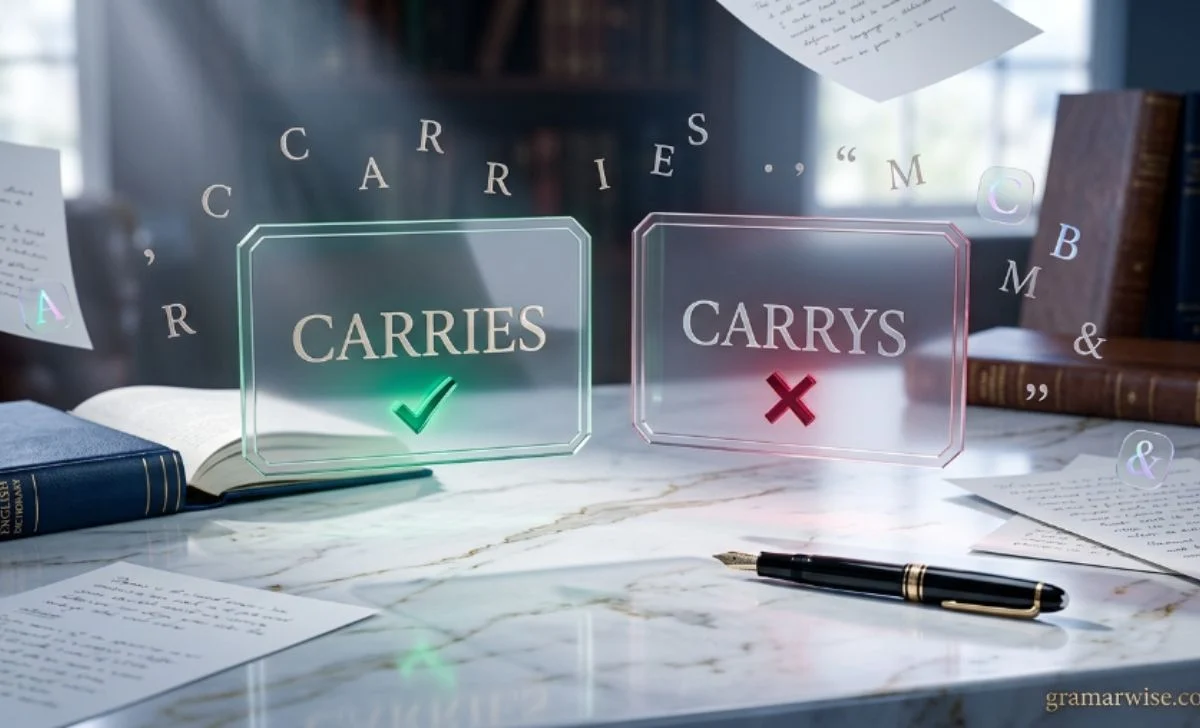
Many English learners wonder whether carrys or carries is the correct spelling. The confusion happens because the verb carry ends with the letter y, and English spelling rules change some words before adding endings.
As a result, many people mistakenly write carrys, even though it is not a correct English word. Knowing the right spelling helps you write better emails, assignments, social media posts, and professional documents.
In this guide, you will learn the correct spelling, the meaning of carries, grammar rules, pronunciation, common examples, synonyms, and the difference between carrys, carries, and caries. By the end, you will know exactly when and how to use carries with confidence.
Carries or Carrys – Quick Answer
Quick Answer: Carries is the correct spelling. Carrys is incorrect and is not accepted in standard English.
The verb carry follows a common English spelling rule. When a verb ends with a consonant + y, the y changes to i before adding -es for the third-person singular form. Therefore:
- Carry → Carries ✅
- Carry → Carrys ❌
You use carries with singular subjects such as he, she, it, or any singular noun.
Examples:
- She carries her laptop every day.
- He carries heavy boxes at work.
- The truck carries fresh vegetables to the market.
The spelling carrys is considered a spelling mistake and should never appear in formal or academic writing.
Correct Examples
- She carries a backpack to school.
- My father carries his phone everywhere.
- The company carries many products.
- The bridge carries thousands of cars each day.
- John carries the team during important matches.
Incorrect Examples
- ❌ She carrys a backpack.
- ❌ He carrys heavy bags.
- ❌ The company carrys electronics.
- ❌ My brother carrys groceries home.
- ❌ The train carrys passengers every morning.
Carries is the correct spelling. It is the third-person singular form of the verb carry. Carrys is a misspelling and is not recognized in standard English grammar.
What Does Carries Mean?
The word carries is the third-person singular present tense of the verb carry. It describes a person, animal, machine, or object that holds, moves, supports, transports, brings, or contains something.
Because carry has several meanings, carries can be used in many different situations.
Common Meanings
Here are the most common meanings of carries.
| Meaning | Example |
|---|---|
| Holds something | She carries a handbag. |
| Transports something | The truck carries food across the country. |
| Supports weight | The bridge carries heavy traffic. |
| Contains | This store carries famous brands. |
| Delivers | The newspaper carries today’s headlines. |
| Passes something | Mosquitoes can carry diseases. |
| Continues | The meeting carries on until noon. |
| Bears responsibility | He carries great responsibility. |
Although the situations change, the basic idea remains the same: to move, hold, support, or have something.
Carries Meaning
Many users search for “carries meaning.”
In simple English, carries means:
- takes something from one place to another,
- holds something,
- supports something,
- includes something,
- bears responsibility,
- transports people or goods.
Examples:
- She carries her books to class.
- The airline carries millions of passengers each year.
- This shop carries organic food.
- The river carries water to nearby farms.
- He carries the family business with pride.
The exact meaning depends on the sentence.
Carries in a Sentence
Here are simple examples showing how carries is used correctly.
People
- She carries an umbrella every day.
- My mother carries groceries home.
- The teacher carries extra books for students.
- He carries a camera while traveling.
Transportation
- The bus carries hundreds of passengers.
- The ship carries containers across the ocean.
- The train carries workers into the city.
- The airplane carries medical supplies.
Business
- Our store carries international brands.
- The supermarket carries fresh vegetables.
- The pharmacy carries many medicines.
- The company carries a wide range of products.
Nature
- The wind carries leaves across the road.
- The river carries rainwater to the sea.
- Smoke carries tiny particles into the air.
Simple Usage Examples
Understanding different sentence patterns makes the word easier to use.
School
- Emma carries her homework every morning.
- The student carries a notebook.
Work
- Sarah carries important documents.
- The manager carries many responsibilities.
Home
- My father carries firewood.
- My sister carries the baby carefully.
Travel
- The pilot carries passengers safely.
- The ferry carries cars across the river.
Sports
- The captain carries the team during difficult games.
- The runner carries the flag proudly.
The Origin of Carries
The spelling carries comes from the verb carry, which has been part of the English language for hundreds of years. Understanding its history also explains why the spelling changes from carry to carries instead of carrys.
English spelling follows patterns that developed over centuries. One of these patterns affects words ending with the letter y.
Word History
The verb carry entered English during the Middle English period. It developed from the Old Northern French word carier, meaning to transport in a vehicle or to move something from one place to another.
Over time, the meaning expanded.
Today, carry can mean:
- transport,
- hold,
- support,
- bear,
- deliver,
- contain,
- continue,
- spread.
As English grammar became standardized, verbs ending in consonant + y followed the same spelling rule when forming the third-person singular.
Examples:
| Base Verb | Third-Person Singular |
|---|---|
| carry | carries |
| study | studies |
| worry | worries |
| cry | cries |
| fly | flies |
| reply | replies |
Notice that y changes to i before adding -es.
This is why carrys never became a correct English spelling.
Why the Confusion Happens
Many learners accidentally write carrys because they apply the wrong spelling pattern.
Several factors cause this confusion.
1. Adding only “s”
People often think every verb simply adds s.
Examples:
- run → runs
- eat → eats
- read → reads
However, verbs ending in consonant + y follow a different rule.
2. Confusion with plural nouns
Some writers believe carries is plural because it ends in -es.
In reality, carries is a singular verb used with:
- he
- she
- it
- John
- my sister
- the company
3. Not knowing the Y spelling rule
The rule is simple:
Consonant + Y → Change Y to I + ES
Examples:
- carry → carries
- cry → cries
- hurry → hurries
- marry → marries
- worry → worries
4. Mixing up “caries” and “carries”
Another common mistake is confusing caries with carries.
They are completely different words.
| Word | Meaning |
|---|---|
| carries | Third-person singular form of carry |
| caries | A medical term meaning tooth decay or dental cavities |
For example:
- The dentist treated the patient’s caries.
- She carries a water bottle every day.
Even though the words look similar, their meanings are completely unrelated.
5. Auto-correct and typing errors
Typing quickly on a phone or computer can produce carrys. Spell check usually corrects it to carries, but not every writing app catches the mistake.
Learning the spelling rule helps you avoid this error in exams, emails, assignments, and professional writing.
Key Grammar Rule to Remember
If a verb ends with a consonant + y, change y to i and add -es for the third-person singular present tense.
Examples:
- Carry → Carries
- Study → Studies
- Hurry → Hurries
- Worry → Worries
- Cry → Cries
This simple rule will help you spell carries correctly every time.
British English vs American English
Unlike word pairs such as colour/color or travelling/traveling, carries is not a British English versus American English spelling difference. Both countries use carries because it follows the same English grammar rule.
Whether you write in the United States, the United Kingdom, Canada, Australia, or India, the correct third-person singular form of carry is always carries.
The incorrect spelling carrys is not accepted in any standard English dictionary or style guide.
The spelling rule remains the same everywhere:
- I carry
- You carry
- We carry
- They carry
- He carries
- She carries
- It carries
Comparison Table
| Feature | British English | American English |
|---|---|---|
| Correct spelling | Carries | Carries |
| Incorrect spelling | Carrys | Carrys |
| Grammar rule | Same | Same |
| Dictionary spelling | Carries | Carries |
| Third-person singular | Carries | Carries |
| Meaning | Same | Same |
Key Takeaway
There is no regional spelling difference between carries and carrys. English grammar uses carries worldwide.
Carries or Carrys vs Other Variations
Several words look similar to carries, but they do not all have the same meaning. Some are correct English words, while others are spelling mistakes.
Knowing the difference helps you avoid confusion in writing.
Spelling Comparison Table
| Spelling | Correct? | Usage | Region |
|---|---|---|---|
| carries | ✅ Yes | Third-person singular verb | Worldwide |
| carry | ✅ Yes | Base verb | Worldwide |
| carried | ✅ Yes | Past tense and past participle | Worldwide |
| carrying | ✅ Yes | Present participle | Worldwide |
| carrys | ❌ No | Misspelling | None |
| caries | ✅ Yes | Medical term meaning tooth decay | Worldwide |
Remember that caries is not another spelling of carries. It belongs to medical and dental vocabulary.
Carries or Caries
Many people accidentally search for caries or carries because the words look alike.
Here is the difference:
| Carries | Caries |
|---|---|
| Verb | Noun |
| Means holds, transports, supports, or contains | Means tooth decay or dental cavities |
| Used in grammar | Used in dentistry and medicine |
| Related to carry | Unrelated to the verb carry |
Examples:
- The bus carries students to school.
- The dentist treated several caries in the patient’s teeth.
Although they differ by only one letter, they have completely different meanings.
Which Spelling Should You Use?
The answer is simple.
Use carries whenever you need the third-person singular present tense of carry.
Never write carrys because it is grammatically incorrect.
US Audience
American English always uses carries.
Examples:
- She carries her books.
- The company carries electronics.
- The truck carries fresh fruit.
UK Audience
British English follows exactly the same grammar rule.
Examples:
- He carries an umbrella.
- The train carries passengers.
- The school carries out inspections.
There is no British spelling carrys.
International Writing
Whether your audience is in Canada, Australia, India, or another English-speaking country, carries remains the correct spelling.
This makes it a safe choice for international communication.
Academic Writing
Schools, colleges, universities, and research papers all require carries.
Using carrys may reduce marks because it is considered a spelling error.
Example:
✅ The research carries important implications.
❌ The research carrys important implications.
Social Media Usage
Social media often contains spelling mistakes because people type quickly.
Even so, carries is still the correct spelling.
Using proper spelling makes posts easier to read and more professional.
Common Mistakes with Carries or Carrys
Many learners understand the meaning of carry, but spelling mistakes still happen.
Most errors come from misunderstanding the consonant + y rule.
Frequent Errors
Mistake 1: Writing carrys
❌ She carrys a bag.
✅ She carries a bag.
Mistake 2: Using carry with singular subjects
❌ She carry a backpack.
✅ She carries a backpack.
Mistake 3: Thinking carries is plural
Many learners believe carries is plural because it ends in -es.
Actually, carries is a singular verb.
Examples:
- He carries.
- She carries.
- John carries.
- The company carries.
Mistake 4: Confusing carries with caries
These words have different meanings.
- Carries = verb
- Caries = tooth decay
Mistake 5: Forgetting the spelling rule
Incorrect:
Carry + s = carrys
Correct:
Carry → Carries
Corrected Examples
| Incorrect | Correct |
|---|---|
| She carry school books. | She carries school books. |
| He carrys heavy boxes. | He carries heavy boxes. |
| The shop carrys fresh fruit. | The shop carries fresh fruit. |
| My sister carry groceries. | My sister carries groceries. |
| The bridge carry thousands of cars. | The bridge carries thousands of cars. |
Carries or Carrys in Everyday Examples
Learning through real-life examples makes grammar easier to remember.
Emails
- Our warehouse carries all available sizes.
- The courier carries your package today.
- She carries the project documents safely.
- The department carries full responsibility for the report.
Social Media
- She carries herself with confidence.
- This store carries amazing products.
- The team carries strong momentum into the finals.
- Every smile carries kindness.
News Writing
- The airline carries millions of passengers every year.
- The bridge carries heavy traffic daily.
- The charity carries out food distribution programs.
- The company carries new safety equipment.
School Writing
- Sarah carries her books to class.
- The river carries water to nearby villages.
- My brother carries his lunch every day.
- The bus carries students safely.
Business Writing
- Our company carries premium products.
- The supplier carries replacement parts.
- The manufacturer carries international certifications.
- This agreement carries legal obligations.
These examples show that carries is used naturally in education, business, transportation, daily conversation, and professional writing. It is the only correct spelling when referring to a singular subject in the present tense.
Google Trends & Usage Data
The keyword “carrys or carries” is searched by thousands of English learners because they are unsure which spelling follows standard English grammar.
Students, teachers, ESL learners, bloggers, and professional writers often search this topic while writing emails, assignments, reports, or articles.
Searches also increase during school terms, grammar lessons, and English language exams.
Most users want to know whether carrys is a real word, why carries changes the y to i, and how to use the verb correctly in a sentence.
Popular Countries
| Country | Why People Search |
|---|---|
| United States | Grammar, spelling, and writing improvement |
| United Kingdom | English language learning and education |
| Canada | ESL learning and academic writing |
| Australia | Grammar practice and school assignments |
| India | Competitive exams, English learning, and business writing |
The search intent is mainly informational, with users looking for grammar explanations, sentence examples, and spelling rules.
Why People Search This Keyword
People usually search this keyword to find answers to questions like:
- Is it carries or carrys?
- Why is carrys incorrect?
- What does carries mean?
- How do you use carries in a sentence?
- Is she carry or she carries correct?
- What is the plural of carry?
- What are the synonyms of carry?
- What is the grammar rule for verbs ending in y?
- What is the difference between caries and carries?
- How do you spell carries correctly?
Related Grammar Rules
Understanding the grammar behind carries makes it much easier to avoid spelling mistakes.
Similar Spelling Mistakes
Many English verbs ending with a consonant followed by y follow the same spelling pattern.
| Base Verb | Correct Form |
|---|---|
| carry | carries |
| study | studies |
| worry | worries |
| cry | cries |
| fly | flies |
| hurry | hurries |
| marry | marries |
| reply | replies |
The same rule applies every time:
Consonant + y → Change y to i + es
Helpful Grammar Tips
Keep these grammar tips in mind:
- Use carry with I, you, we, they.
- Use carries with he, she, it, and singular nouns.
- Never write carrys.
- Remember the consonant + y spelling rule.
- Proofread your writing before publishing.
- Use a dictionary if you are unsure about a spelling.
- Learn common verb patterns instead of memorizing individual words.
She Carry or Carries?
One of the most searched grammar questions is:
She carry or carries?
The correct answer is:
✅ She carries.
Because she is a third-person singular subject, the verb changes from carry to carries.
Correct examples:
- She carries a school bag.
- She carries her baby carefully.
- She carries important files.
- She carries groceries home every evening.
Incorrect examples:
- ❌ She carry a school bag.
- ❌ She carry groceries.
Carry Plural
Many learners ask whether carry is plural.
The answer is no.
Carry is the base form of the verb, not a plural word.
Verb conjugation:
| Subject | Verb |
|---|---|
| I | carry |
| You | carry |
| We | carry |
| They | carry |
| He | carries |
| She | carries |
| It | carries |
The plural subjects use carry, while singular third-person subjects use carries.
Carries Synonyms
Depending on the sentence, carries can have different synonyms.
| Carries | Possible Synonyms |
|---|---|
| Carries a bag | holds, bears |
| Carries goods | transports, delivers, moves |
| Carries passengers | transports, conveys |
| Carries responsibility | bears, accepts |
| Carries products | stocks, offers, sells |
| Carries news | reports, publishes, includes |
Always choose a synonym that matches the context of your sentence.
FAQs
Is carries or carrys correct?
Carries is correct. Carrys is a spelling mistake.
Is carrys a real English word?
No. Standard English dictionaries do not recognize carrys.
Why is it carries instead of carrys?
Because verbs ending in a consonant plus y change y to i before adding -es.
What does carries mean?
Carries means holds, transports, supports, contains, or bears something.
What is the grammar rule for carries?
Change y to i and add -es when a verb ending in a consonant plus y is used with a third-person singular subject.
She carry or carries?
The correct form is she carries.
He carry or carries?
The correct form is he carries.
It carry or carries?
The correct form is it carries.
What is the base form of carries?
The base form is carry.
What is the past tense of carry?
The past tense is carried.
What is the past participle of carry?
The past participle is carried.
What is the present participle of carry?
The present participle is carrying.
Is carries singular or plural?
Carries is the verb used with singular third-person subjects.
What is the plural of carry?
Carry is a verb, so it does not have a plural form.
Is carries used in present tense?
Yes. It is the simple present tense form used with singular subjects.
Can carries describe transportation?
Yes. It often means to transport people or goods.
Can carries mean holds?
Yes. It can mean to hold or support something.
Can carries mean contains?
Yes. For example, “The store carries organic products.”
What is the difference between carries and carrying?
Carries is a present tense verb, while carrying is the present participle.
What is the difference between carries and carried?
Carries is present tense, while carried is the past tense and past participle.
Is caries another spelling of carries?
No. Caries is a medical term meaning tooth decay.
Is carries used in business English?
Yes. Businesses often say they carry products, brands, or services.
Can carries be used in academic writing?
Yes. It is standard English and suitable for academic writing.
How do I remember the correct spelling?
Remember the rule:
Consonant + y = change y to i + es
Should I ever write carrys?
No. Always write carries.
Conclusion
The difference between carrys and carries is simple once you know the spelling rule. Carries is the correct third-person singular form of the verb carry, while carrys is always incorrect.
Whenever a verb ends with a consonant followed by y, change the y to i before adding -es. This rule also applies to words like studies, worries, and cries.
Whether you are writing school assignments, business emails, blog posts, or social media updates, using carries correctly improves your grammar and makes your writing more professional.
Remember the rule, practice with real examples, and proofread your work carefully. With regular practice, spelling carries correctly will become natural and effortless.
Discover More Blog :
- Inportant or Important : Learn the Correct Spelling
- Tomatoe or Tomato: Clear Up the Spelling Confusion
- Judgements or Judgments: Which Is Correct in British and American English?
- Reciept or Receipt :Never Misspell This Word Again