Have you ever typed “useage” and wondered if your spell checker was wrong? You are not alone. Thousands of people search for useage or usage every month because the two words look similar.
However, only one spelling is correct in standard English. This small spelling mistake can affect school assignments, business emails, blog posts, and professional writing. In this guide, you’ll learn the correct spelling, understand why the confusion happens, and see plenty of real-life examples.
By the end, you’ll know when to use usage, why useage is incorrect, and how to avoid making this common English spelling mistake with confidence.
Useage or Usage – Quick Answer
If you’re wondering whether useage or usage is correct, the answer is simple:
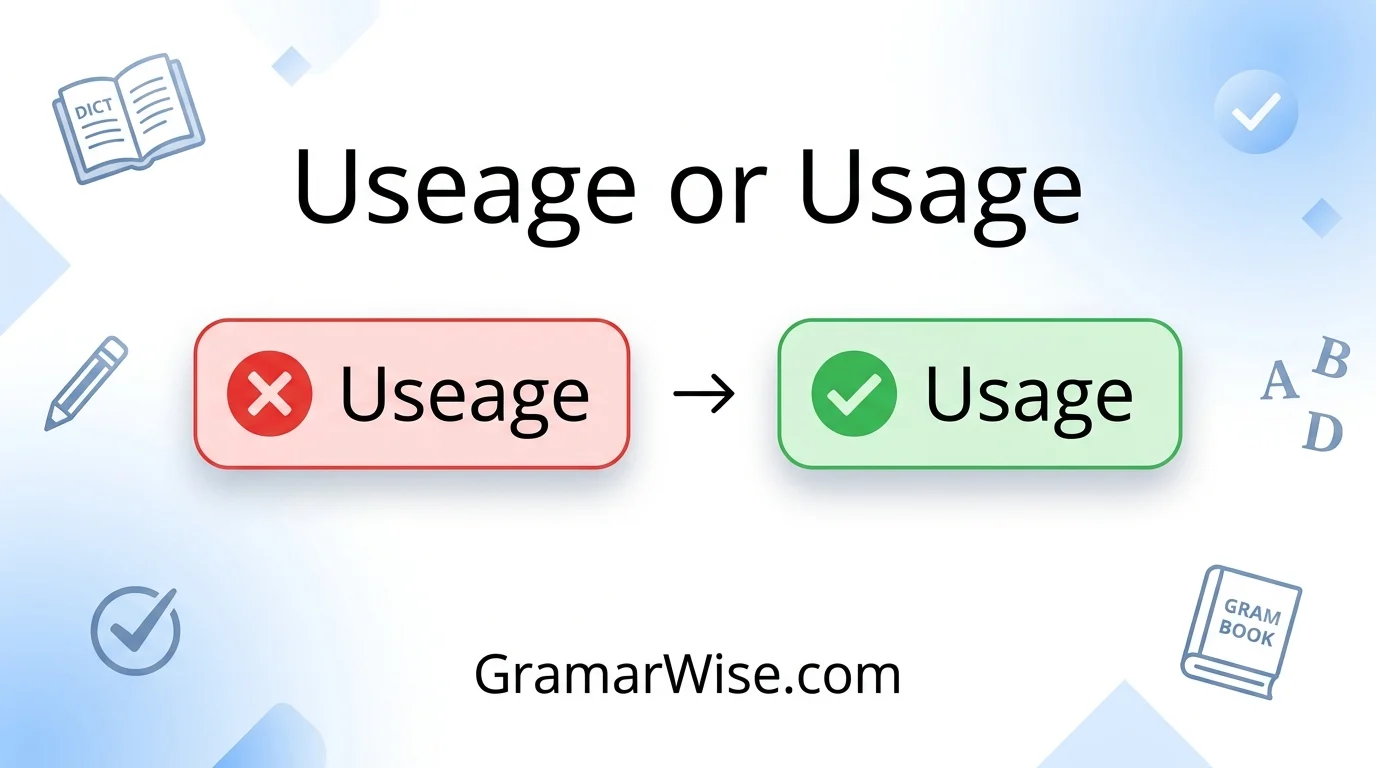
Usage is the correct spelling in both British English and American English. Useage is a common misspelling and is not recognized by standard English dictionaries.
The word usage refers to the way something is used or the accepted way a word, phrase, or action is used in a language or situation.
Quick Examples
✅ Correct: The usage of this software is explained in the manual.
✅ Correct: Proper word usage improves your writing.
❌ Incorrect: The useage of this software is explained in the manual.
❌ Incorrect: His English useage has improved.
Always choose usage in academic writing, professional communication, websites, social media, and everyday English.
Correct Example
Here are examples that use usage correctly.
- The usage instructions are printed on the label.
- Good usage of punctuation makes writing easier to read.
- Mobile phone usage has increased over the last decade.
- Teachers often explain the correct usage of confusing words.
- Dictionary examples help students understand proper usage.
These sentences follow standard English grammar and spelling rules.
Incorrect Example
The following sentences contain a spelling mistake.
- ❌ The useage instructions are easy to follow.
- ❌ Her useage of English has improved.
- ❌ The report explains internet useage.
- ❌ Check the useage guide before installing the app.
In every example above, useage should be replaced with usage.
What Does Usage Mean?
The word usage is a noun. It describes the way something is used or the accepted way a word, phrase, or expression is used in a language. You will often see it in education, technology, business, healthcare, and everyday communication.
In simple terms, usage tells us how people use something or how something should be used correctly.
Common Meanings
The word usage has several common meanings depending on the context.
| Meaning | Example |
|---|---|
| The way something is used | Water usage increased during summer. |
| The correct use of language | Her grammar and word usage are excellent. |
| A customary practice or habit | Local usage varies from one region to another. |
| The amount something is used | Daily internet usage continues to grow. |
Although the meanings change slightly with context, the spelling always remains usage.
Simple Usage Examples
These examples show how usage appears in everyday English.
- Please reduce your electricity usage to save energy.
- The teacher explained the correct usage of the word.
- Smartphone usage has become part of daily life.
- The company tracks internet usage every month.
- Proper usage of grammar makes your writing more professional.
- Reading books improves vocabulary and word usage.
- Software usage is monitored for security reasons.
- The dictionary includes examples of correct usage in sentences.
These examples show that usage fits naturally in many situations, from casual conversations to academic and professional writing. Using the correct spelling helps your writing appear clear, accurate, and trustworthy.
Is “Useage” a Real Word?
Many people ask, “Is useage a real word?” The short answer is no.
Useage is not a standard English word. It is a common spelling mistake of usage. If you type useage in a document, most spell checkers and dictionaries will mark it as incorrect.
Featured Snippet Answer
No, “useage” is not a real English word. The correct spelling is usage, which refers to the way something is used or the accepted way language is used. Major English dictionaries recognize usage, not useage.
The confusion usually happens because the base word is use. Many learners naturally think adding -age creates useage. However, English spelling does not follow that pattern here.
For example:
- ✅ Correct: Internet usage has increased every year.
- ✅ Correct: Correct word usage improves your writing.
- ❌ Incorrect: Internet useage has increased every year.
- ❌ Incorrect: Correct word useage improves your writing.
Whether you’re writing an email, an academic paper, a blog post, or a business report, always use usage.
Why Dictionaries Reject “Useage”
Leading English dictionaries list usage as the correct spelling because it has been part of the English language for centuries. The spelling useage has never become an accepted standard.
Most dictionaries define usage as:
- The way something is used.
- The accepted way words or expressions are used.
- A customary practice or habit.
Because useage has no accepted dictionary entry, it is treated as a misspelling rather than an alternative spelling.
Why Spell Check Marks It Wrong
Modern spell-check tools compare your writing with standard dictionary entries. Since useage is not recognized, writing software automatically suggests usage instead.
You’ll notice this correction in:
- Microsoft Word
- Google Docs
- Grammarly
- Apple Pages
- Most web browsers
- Mobile keyboards
This is another strong sign that usage is the only correct spelling in modern English.
The Origin of the Word “Usage”
Understanding where the word usage comes from makes it easier to remember its spelling.
The word entered English hundreds of years ago through Middle French, where usage already referred to a custom, habit, or the act of using something. Over time, English kept both the meaning and the spelling.
Although English has changed in many ways, the spelling usage has remained the accepted standard in dictionaries, schools, publishing, and professional writing.
Today, the word appears in almost every type of writing, including:
- Academic articles
- Business documents
- Legal writing
- Newspapers
- Books
- Government publications
- Technical manuals
No respected style guide recommends the spelling useage.
Word History
The history of usage stretches back several centuries.
| Time Period | Development |
|---|---|
| Middle French | Usage referred to custom, habit, or practice. |
| Middle English | The word entered English with nearly the same spelling. |
| Modern English | Usage became the standard spelling in dictionaries and writing. |
One interesting fact is that the spelling has stayed remarkably stable. While many English words changed over time, usage has remained almost unchanged.
This long history explains why language experts, editors, teachers, and publishers all recognize usage as the correct form.
Why People Misspell It as “Useage”
At first glance, useage seems logical because it combines the word use with the ending -age. However, English spelling often follows historical patterns instead of simple rules.
Here are the most common reasons people write useage instead of usage:
- The base word is “use.” People assume they should keep the final e before adding -age.
- Pronunciation is misleading. Both spellings sound almost identical when spoken.
- Typing mistakes happen quickly. Many people write fast and don’t notice the extra e.
- English learners apply regular spelling patterns. Since many words keep the final e, learners expect use to do the same.
- People rarely check the dictionary. They rely on memory instead of confirming the correct spelling.
Quick Tip to Remember
A simple trick is to remember:
Use → Usage (drop the extra “e”)
Think of it this way:
- Use ➜ Usage ✅
- Use ➜ Useage ❌
If you remember that usage has only one e—the one in use—you’ll avoid this mistake every time.
British English vs American English
Many spelling differences exist between British English and American English, such as colour/color or organise/organize. However, usage is not one of them.
Both varieties of English use the same spelling: usage.
Whether you’re writing for readers in the United States, the United Kingdom, Canada, Australia, or India, usage is always the correct choice.
There is no accepted regional spelling called useage.
Comparison Table
| Country/Region | Correct Spelling | Is “Useage” Accepted? | Notes |
|---|---|---|---|
| United States | Usage | ❌ No | Standard American English spelling |
| United Kingdom | Usage | ❌ No | Standard British English spelling |
| Canada | Usage | ❌ No | Follows standard English dictionaries |
| Australia | Usage | ❌ No | Used in education and professional writing |
| India | Usage | ❌ No | Standard spelling in schools, media, and business |
Key Takeaway
If your audience is international, you don’t need to change the spelling based on location. Unlike many English words, usage is spelled the same everywhere English is written.
That makes it one of the easiest spelling rules to remember:
- 🇺🇸 American English → Usage
- 🇬🇧 British English → Usage
- 🇨🇦 Canadian English → Usage
- 🇦🇺 Australian English → Usage
- 🇮🇳 Indian English → Usage
No matter where your readers are, usage is always correct, and useage is always a spelling mistake.
Useage vs Usage
The confusion between useage and usage is easy to understand because both words look similar. However, only one is accepted in standard English.
If you want to write correctly, remember this simple rule:
Usage is the correct spelling. Useage is a misspelling.
Whether you’re writing an essay, an email, a blog post, or a business report, you should always use usage. No major dictionary, grammar guide, or style manual accepts useage as an alternative spelling.
Using the correct spelling makes your writing more professional and helps readers trust your work.
Spelling Comparison Table
| Word | Correct? | Meaning | Dictionary Status | Region |
|---|---|---|---|---|
| Usage | ✅ Yes | The way something is used; accepted language practice | Recognized by all major dictionaries | Worldwide |
| Useage | ❌ No | No accepted meaning | Considered a spelling mistake | Not accepted in any English-speaking country |
Quick Comparison
| Feature | Usage | Useage |
|---|---|---|
| Correct English spelling | ✅ | ❌ |
| Found in dictionaries | ✅ | ❌ |
| Accepted in schools | ✅ | ❌ |
| Used in business writing | ✅ | ❌ |
| Used in academic papers | ✅ | ❌ |
| Accepted in British English | ✅ | ❌ |
| Accepted in American English | ✅ | ❌ |
Remember This Rule
If you’re unsure which spelling to choose, ask yourself:
Does the word appear in a dictionary?
- Usage → Yes ✅
- Useage → No ❌
This simple check can prevent one of the most common English spelling mistakes.
Which Spelling Should You Use?
The answer is straightforward: always use “usage.”
Unlike words that have different spellings in British and American English, usage stays the same everywhere. You don’t need to change the spelling based on your audience or location.
US Audience
If you’re writing for readers in the United States, always use usage.
Examples:
- The app tracks data usage every day.
- Proper word usage improves communication.
- Internet usage has increased over the past decade.
American dictionaries, schools, universities, and businesses all use usage.
Never write: useage
UK Audience
British English also uses usage.
Examples:
- The teacher explained the correct usage of the new vocabulary.
- Water usage should be reduced during dry seasons.
- Correct usage of punctuation improves readability.
British dictionaries do not recognize useage as a valid spelling.
International Writing
If your content is read around the world, choosing usage is the safest option.
International organizations, educational websites, publishers, and news outlets all use the same spelling.
Examples include:
- Educational articles
- User manuals
- Technical documentation
- Online courses
- Government publications
Using usage ensures your writing is understood and accepted by readers in every English-speaking country.
Academic Writing
Accuracy matters in academic writing. Teachers, professors, editors, and examiners expect correct spelling in essays, research papers, and assignments.
Examples:
- The study examined smartphone usage among teenagers.
- Correct language usage is essential in academic essays.
- Students should learn proper grammar and word usage.
Writing useage in academic work may lead to spelling errors being marked by your instructor or grading software.
Academic Tip: Always proofread your work before submitting it.
Business Writing
Professional writing reflects your credibility. A simple spelling mistake can make reports, proposals, or emails look less polished.
Use usage in business communication.
Examples:
- Monthly electricity usage decreased by 15%.
- The report includes customer usage statistics.
- Software usage is monitored for security purposes.
- Please review the data usage policy before signing the agreement.
Correct spelling helps create a professional impression with clients, colleagues, and employers.
Social Media Usage
Social media is more casual, but correct spelling still matters. Well-written posts appear more trustworthy and are easier to read.
Examples:
- 📱 Daily screen usage has become a hot topic.
- 📊 Check your mobile data usage before streaming videos.
- ✍️ Good word usage makes every post clearer.
Although people sometimes type useage by mistake on social media, it remains an incorrect spelling. Using usage helps your content look more professional and can improve audience confidence.
Quick Writing Tip
Before you publish any content, remember this easy rule:
Use “usage” every time. Ignore “useage.”
Whether you’re writing for school, work, a website, or social media, usage is the only correct spelling. Choosing it consistently will make your writing clearer, more accurate, and more credible.
Usage in Everyday Examples
The word usage appears in almost every type of writing. Whether you’re sending an email, posting on social media, writing a school essay, or preparing a business report, usage is always the correct spelling.
The examples below show how usage fits naturally into different situations.
Everyday Conversation
People often use usage when talking about how something is used or how much it is used.
Examples:
- My phone usage has increased since I started working remotely.
- The hotel monitors water usage to reduce waste.
- Good word usage makes conversations easier to understand.
- Daily internet usage continues to grow around the world.
- Parents often limit their children’s screen usage.
These examples show that usage is common in everyday English.
Emails
Professional emails should always use the correct spelling.
Example 1
Please review the software usage guidelines before installing the application.
Example 2
Your monthly data usage has exceeded the plan limit.
Example 3
The attached report summarizes electricity usage for the last quarter.
Example 4
We have updated our acceptable usage policy.
Using the correct spelling helps your emails look clear and professional.
Social Media
The word usage also appears frequently in social media posts.
Examples:
- Screen usage has become a major health topic.
- Check your mobile data usage before watching HD videos.
- Proper hashtag usage can improve post visibility.
- Daily app usage keeps increasing every year.
- Smart device usage is changing the way people work.
Even on casual platforms, correct spelling improves credibility.
News Writing
Journalists use usage to report statistics, research, and public information.
Examples:
- Water usage reached a record high this summer.
- Internet usage increased after the new service launched.
- Fuel usage dropped due to higher prices.
- The survey measured smartphone usage among adults.
- Public transport usage has recovered since last year.
News writing values accuracy, so usage is always spelled correctly.
School Writing
Students often use usage in essays, assignments, and research projects.
Examples:
- Correct word usage improves academic writing.
- The teacher explained the proper usage of transition words.
- Dictionary examples help students understand English usage.
- Proper punctuation usage makes essays easier to read.
- Grammar lessons focus on correct language usage.
Learning the correct spelling early helps students avoid common mistakes.
Business Writing
Businesses regularly use usage in reports, contracts, manuals, and policies.
Examples:
- Customer usage data helps improve our services.
- Monthly electricity usage has decreased.
- Software usage is monitored for security.
- The company tracks internet usage across all offices.
- Read the acceptable usage policy before using company devices.
Correct spelling creates a more professional image and prevents confusion.
Usage Synonyms
Although usage is the best word in many situations, sometimes another word fits the sentence better. Choosing the right synonym can make your writing more varied and natural.
The table below lists common synonyms and explains when to use them.
| Synonym | Best Used For | Example |
|---|---|---|
| Use | General situations | The use of solar energy is increasing. |
| Application | Technology or methods | The application of AI is expanding rapidly. |
| Practice | Habits or routines | Safe driving is a common practice. |
| Custom | Traditions or culture | It is a local custom to remove shoes indoors. |
| Consumption | Resources like water or electricity | Water consumption should be reduced. |
| Utilization | Formal or technical writing | Efficient resource utilization saves money. |
Example Sentences
Here are a few examples showing these synonyms in context.
- Proper usage of grammar improves communication.
- The use of renewable energy is growing every year.
- The application of technology has transformed education.
- Water consumption increases during the summer.
- Efficient resource utilization benefits every organization.
- Following local customs shows respect for different cultures.
Remember that these words are related but not always interchangeable. Usage specifically refers to how something is used or the accepted way language is used.
Common Mistakes with Usage
Many writers make small mistakes with the word usage. Most of these errors happen because people rely on pronunciation instead of checking the correct spelling.
Knowing these mistakes will help you write with greater confidence.
Frequent Errors
Here are some of the most common mistakes.
Writing useage instead of usage
- Incorrect: Internet useage is increasing.
- Correct: Internet usage is increasing.
Assuming British English uses useage
Many people believe useage is the British spelling.
Fact: Both British English and American English use usage.
Confusing use with usage
These words have different meanings.
- Use is usually a verb or sometimes a noun.
- Usage is always a noun referring to the way something is used.
Example:
- I use this laptop every day. ✅
- Laptop usage has increased this year. ✅
❌ Using “usage” in the wrong context
Sometimes another word fits better.
Instead of:
- The usage of this tool is very easy.
A more natural sentence is:
- The use of this tool is very easy.
Choosing the right word improves clarity.
Corrected Examples
The following sentences show common mistakes and their corrected versions.
| Incorrect Sentence | Correct Sentence |
|---|---|
| The useage guide is helpful. | The usage guide is helpful. |
| Mobile useage has increased. | Mobile usage has increased. |
| Her English useage is excellent. | Her English usage is excellent. |
| Check your internet useage today. | Check your internet usage today. |
| The useage policy has changed. | The usage policy has changed. |
Quick Grammar Reminder
Whenever you write about how something is used, accepted language practices, or the amount something is used, the correct spelling is always usage.
Keep this simple rule in mind:
If you’re tempted to write “useage,” remove the extra “e.” The correct spelling is always “usage.”
Following this rule will help you avoid one of the most common spelling mistakes in English and make your writing look more accurate and professional.
Related Grammar Rules
Good spelling is only one part of good writing. Understanding a few basic grammar rules will help you avoid common mistakes like useage and improve your overall English. These simple tips are useful for students, professionals, bloggers, and anyone learning English.
Similar Spelling Mistakes
Like useage, many English words are frequently misspelled because they sound correct or follow confusing spelling patterns.
| Incorrect Spelling | Correct Spelling | Explanation |
|---|---|---|
| Useage | Usage | The extra e should not be added. |
| Seperate | Separate | The correct spelling uses a in the middle. |
| Recieve | Receive | Follow the rule: i before e, except after c. |
| Occured | Occurred | Double the r before adding -ed. |
| Arguement | Argument | The extra e is incorrect. |
| Definately | Definitely | A very common spelling mistake. |
| Untill | Until | The correct spelling has only one l. |
| Goverment | Government | Do not omit the n. |
| Begining | Beginning | Double the n before -ing. |
| Maintanance | Maintenance | This word follows a different spelling pattern from maintain. |
Learning these words together can help you recognize similar spelling errors more quickly.
Helpful Grammar Tips
Follow these simple grammar and spelling tips to improve your writing.
Read Quality English Content
Reading books, newspapers, and trusted websites helps you become familiar with correct spelling and natural word usage.
Use a Reliable Dictionary
If you are unsure about a word, check a trusted dictionary instead of guessing. This habit improves both spelling and vocabulary.
Proofread Every Document
Before sending an email, publishing a blog post, or submitting an assignment, take a few minutes to proofread. You can easily catch mistakes like useage before others see them.
Learn Word Families
Understanding related words makes spelling easier.
| Word | Part of Speech |
|---|---|
| Use | Verb / Noun |
| Usage | Noun |
| Useful | Adjective |
| User | Noun |
| Usually | Adverb |
Seeing these words together makes it easier to remember that usage is the correct noun.
Easy Memory Trick
Use → Usage (Never Useage)
Whenever you type the word, remember that usage never includes an extra e.
Google Trends & Search Intent
The keyword “useage or usage” is searched by thousands of English learners, students, teachers, writers, and professionals. Most people search this phrase because they are unsure which spelling is correct or they notice that spell check marks useage as an error.
Since spelling mistakes can affect academic work, business communication, and online content, users often look for a clear and trustworthy explanation before using the word.
Popular Countries
People commonly search this keyword in countries where English is widely spoken or taught.
| Country | Common Search Intent |
|---|---|
| United States | Confirm the correct spelling for school, work, and professional writing. |
| United Kingdom | Check whether British English uses a different spelling. |
| Canada | Compare British and American spelling rules. |
| Australia | Improve English grammar and avoid spelling mistakes. |
| India | Learn correct English spelling for education and workplace communication. |
Although the reasons may differ, the correct spelling is the same in every country: usage.
Why People Search “Useage or Usage”
People search this keyword for many reasons, including:
- To find out whether useage is a real English word.
- To learn the correct spelling before writing an essay or report.
- To understand the meaning of usage.
- To see examples of usage in sentences.
- To check if British English uses useage.
- To improve grammar and writing skills.
- To avoid spelling mistakes in emails, blogs, and business documents.
This search intent is simple: users want a quick, accurate answer so they can write with confidence.
FAQs
1. Is it useage or usage?
The correct spelling is usage. Useage is a misspelling and should never be used in standard English writing.
2. Is useage a real word?
No. Useage is not recognized by major English dictionaries. The accepted spelling is usage.
3. What does usage mean?
Usage is a noun that refers to the way something is used or the accepted use of words and expressions in a language.
4. How do you spell usage correctly?
The correct spelling is usage. Do not add an extra e after use.
5. Why do people write useage instead of usage?
People often assume the word is formed by adding -age to use, but this spelling is incorrect.
6. Is usage correct in British English?
Yes. Usage is the standard spelling in British English.
7. Is usage correct in American English?
Yes. American English also uses the spelling usage.
8. Is useage accepted in the UK?
No. Useage is considered a spelling mistake in the United Kingdom as well.
9. Can I use useage in formal writing?
No. Always use usage in academic, business, and professional writing.
10. How do I use usage in a sentence?
Example: Proper word usage improves clear communication.
11. What is the difference between use and usage?
Use is usually a verb or noun, while usage is a noun that describes how something is used.
12. Is usage a noun or a verb?
Usage is always a noun.
13. What is the plural of usage?
The plural form is usages, although it is used less frequently than the singular form.
14. What is a synonym for usage?
Common synonyms for usage include use, application, practice, utilization, consumption, and custom. The best synonym depends on the context of your sentence.
15. Why is usage spelled without an extra “e”?
The spelling usage comes from its historical development in English and French. Although it is related to the word use, the correct spelling has always been usage.
16. Does Grammarly correct useage?
Yes. Grammarly identifies useage as a spelling mistake and recommends usage as the correct spelling.
17. Does Microsoft Word mark useage as incorrect?
Yes. Microsoft Word flags useage as a spelling error and suggests usage instead.
18. Is usage used in academic writing?
Yes. Usage is widely used in essays, research papers, textbooks, and academic journals, especially when discussing language, grammar, or how something is used.
19. Is usage used in business English?
Yes. Businesses frequently use usage in reports, manuals, contracts, policies, and customer communications.
20. What does word usage mean?
Word usage refers to the correct and accepted way of using words in speaking or writing. Good word usage makes communication clearer and more effective.
21. What does data usage mean?
Data usage is the amount of internet or mobile data consumed during a specific period. Internet service providers often measure monthly data usage.
22. What does language usage mean?
Language usage describes how words, grammar, and expressions are used in real communication by speakers and writers.
23. Is usage the same in all English-speaking countries?
Yes. Usage is the standard spelling in the United States, the United Kingdom, Canada, Australia, India, and other English-speaking regions.
24. How can I remember the correct spelling?
A simple trick is to remember:
Use → Usage
Never add an extra e. If you type useage, remove the extra letter to make it usage.
25. What is the final answer to useage or usage?
The answer is simple: usage is the only correct spelling in modern English. Useage is a common misspelling and should never be used in formal or informal writing.
Conclusion
If you’ve ever wondered whether useage or usage is correct, the answer is clear. Usage is the only accepted spelling in modern English, while useage is a common misspelling.
This rule applies to British English, American English, and every other major variety of English. Whether you’re writing an essay, business email, blog post, or social media update, always choose usage for clear and professional communication.
Remember the simple trick: Use → Usage—never add an extra e. By understanding the meaning, origin, examples, and grammar rules explained in this guide, you can avoid this mistake with confidence and improve your English writing skills every time.