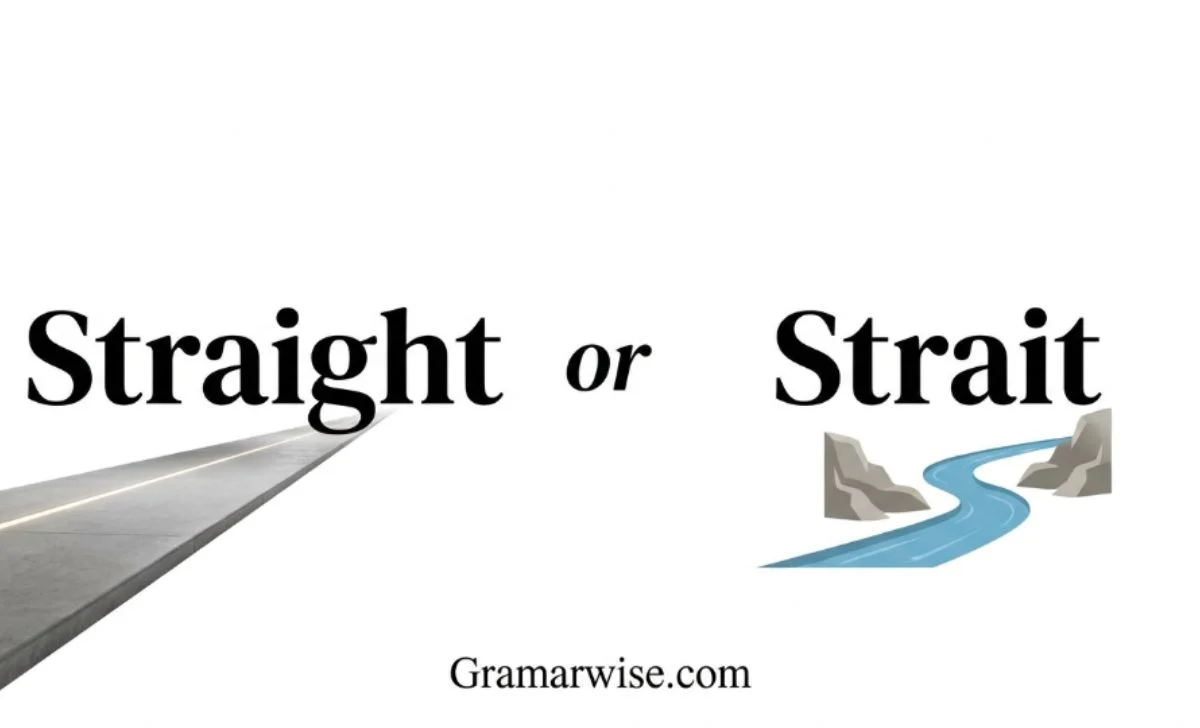
Straight and strait sound the same, but they have different meanings and uses. Straight usually means direct, uncurved, level, or frank.
Strait usually means a narrow passage of water between larger bodies of water. It can also appear in the expression “in dire straits,” which means being in serious difficulty.
| Word | Main meaning | Example |
|---|---|---|
| Straight | Direct, uncurved, level, or frank | Walk straight ahead. |
| Strait | A narrow passage of water | The ship entered the strait. |
So, if you mean a direct road, straight line, straight answer, or straightforward idea, use straight. If you mean a narrow waterway, use strait.
Straight vs. Strait: Meaning and Main Difference
Straight is the much more common word in everyday English. Its basic idea is something that does not bend or move away from a direct course.
For example:
Draw a straight line.
The road is straight for several miles.
Go straight ahead.
But the word is not limited to physical direction. Straight can also mean direct or honest:
I want a straight answer.
Here, straight means clear and direct rather than curved.
It can also describe something immediate:
She went straight home after work.
The meaning changes slightly from sentence to sentence, but the general idea of directness remains.
Strait, in contrast, is mainly a noun used for a narrow passage of water connecting two larger bodies of water.
The ship sailed through the strait.
Famous geographical names include the Strait of Gibraltar, Bering Strait, and Strait of Hormuz.
There is also a figurative use of strait. In the expression “in dire straits,” it means being in a very difficult situation:
The company is in dire straits after losing its biggest client.
This distinction gives you a simple starting point:
Straight = direct or uncurved. Strait = narrow passage or difficult circumstances.
Can a Strait Be a River?
A strait is not simply another name for a river. The two are different geographical features.
A river generally flows from a source toward a lake, sea, or ocean. A strait is a narrow natural passage that connects larger bodies of water. Both are waterways, but their functions and geographical definitions are different.
How to Use Straight and Strait
The easiest way to choose the right spelling is to consider what the sentence is describing.
Use straight for a line, route, direction, position, or something direct:
Keep the picture straight.
Take the straight road.
Walk straight to the entrance.
She gave me a straight answer.
The arrow flew straight toward the target.
Use strait when referring to a narrow water passage:
The boat crossed the strait.
The island lies near a busy strait.
Several ships were waiting to enter the strait.
The word strait can also describe a difficult condition when used in the plural expression “dire straits.”
The family was in dire straits after the sudden loss of income.
This is one reason you should not treat strait as simply an alternative spelling of straight. They developed different meanings and are used in different contexts.
Strait vs. Straight Pronunciation
One reason this pair causes confusion is that straight and strait are homophones. They are pronounced the same in standard English but have different spellings and meanings.
That means you cannot always know which word someone means simply by hearing it. Context provides the answer.
Compare:
Walk straight ahead.
and:
The ship entered the strait.
The pronunciation is the same, but the first sentence concerns direction while the second concerns geography.
Common Fixed Phrases and Spelling Confusions
Rather than learning every phrase separately, it helps to group the most common expressions together.
Straightforward
The correct spelling is straightforward.
The instructions are straightforward.
It means simple, clear, or easy to understand. Straitforward is incorrect. The word uses straight because it carries the sense of being direct and uncomplicated.
Straitjacket
The standard spelling is straitjacket.
The new regulations became a financial straitjacket for small businesses.
A straitjacket can refer to a restrictive garment. It can also be used figuratively for something that severely limits freedom or flexibility. The spelling can be confusing because straight jacket may seem logical when heard aloud. However, straitjacket is the established word.
Home Straight
The correct expression is home straight.
The runners are entering the home straight.
It refers to the final straight section of a racecourse before the finish line. It is also commonly used in a broader sense for the final stage of a project or process:
We are in the home straight with the renovation.
Home strait is not the standard expression.
Strait or Straits?
Both strait and straits are correct words, but they have different grammatical forms.
Strait is singular:
The Strait of Gibraltar is an important waterway.
Straits is plural:
The region contains several narrow straits.
Some geographical names use strait, while others use straits. Proper names should be written in their established form. For example, the recognized name is Strait of Hormuz, not Straits of Hormuz.
Common Errors
| Incorrect | Correct |
|---|---|
| The road is strait. | The road is straight. |
| The ship crossed the straight. | The ship crossed the strait. |
| straitforward | straightforward |
| straight jacket | straitjacket |
| home strait | home straight |
| Straits of Hormuz | Strait of Hormuz |
These mistakes usually happen because the two words sound identical. Looking at the meaning before choosing the spelling is the safest approach.
Strait: Etymology and Related Words
The history of strait helps explain some of its meanings today. The word is associated with the idea of something being narrow, tight, or restricted.
That meaning fits a narrow passage of water. It also connects naturally with the figurative sense found in “in dire straits,” where a person or organization is in a restricted or difficult position.
This older sense also appears in straitjacket, which describes something restrictive.
For a geographical strait, related words include:
- channel
- passage
- waterway
- narrow passage
- sea passage
These words can be useful when explaining the concept, although they are not always exact replacements. A specific geographical feature officially called a strait should keep its established name.
Straight has more possible synonyms because it has several meanings. Depending on the context, alternatives can include:
- direct
- level
- linear
- upright
- frank
- honest
- straightforward
- immediate
For example, “She gave me a straight answer” can become “She gave me a direct answer.” But you cannot replace straight with direct in every situation , “Draw a straight line” describes physical shape, so direct would change the meaning.
Straight and Strait Examples
Examples with “straight”
The road ahead is straight.
Walk straight to the front desk.
He drew a straight line across the paper.
She gave me a straight answer.
The train went straight to the station.
Please go straight home after school.
Examples with “strait”
The ship entered the narrow strait.
The map shows the strait between the islands.
Several vessels passed through the strait.
The island is separated from the mainland by a strait.
Examples with “dire straits”
The business was in dire straits after months of losses.
Without financial support, the organization could be in dire straits.
A Simple Way to Remember the Difference
If you often confuse these words, remember the central idea behind each one.
Straight is connected with directness: straight line, straight road, straight ahead, straight answer, straightforward.
Strait is connected with narrowness or restriction: narrow strait, Strait of Gibraltar, Strait of Hormuz, straitjacket, dire straits.
Ask yourself one quick question: Am I talking about something direct or something narrow/restricted? If the answer is direct, straight is probably right. If the answer is a narrow passage or a difficult situation, strait is the word you need.
FAQs
1. What do you mean by a strait? A strait is a narrow natural passage of water connecting two larger bodies of water. It is a geographical term used for waterways such as the Strait of Gibraltar.
2. Is “home straight” or “home strait” correct? Home straight is correct. It describes the final straight section of a racecourse and can also refer to the final stage of a project or process.
3. Is it a straight or strait jacket? The standard spelling is straitjacket, written as one word. It can describe a restrictive garment or something that severely limits freedom or flexibility.
4. Which is correct: “Strait of Hormuz” or “Straits of Hormuz”? The established geographical name is Strait of Hormuz.
5. What is another word for strait? Depending on the context, channel, passage, or waterway can describe a similar geographical feature. They are not always exact synonyms.
6. What does “strait” mean in the Bible? In some older English Bible translations, strait can mean narrow, restricted, or difficult. This is an older sense of the word and differs from its modern geographical meaning.
7. Are straight and strait pronounced the same? Yes. They are homophones, meaning they have the same pronunciation but different spellings and meanings.
Conclusion
The difference between straight and strait is much easier to remember when you connect each spelling with its main idea.
Straight is the everyday choice for a direct route, an uncurved line, a level position, or a frank answer.
Strait is mainly a narrow passage of water, although you will also see it in expressions such as “in dire straits” and “straitjacket.”
Fixed phrases such as straightforward, home straight, and Strait of Hormuz are worth learning as complete forms.
Since both words sound alike, pronunciation cannot tell you which spelling to choose. Meaning and context are the real clues.