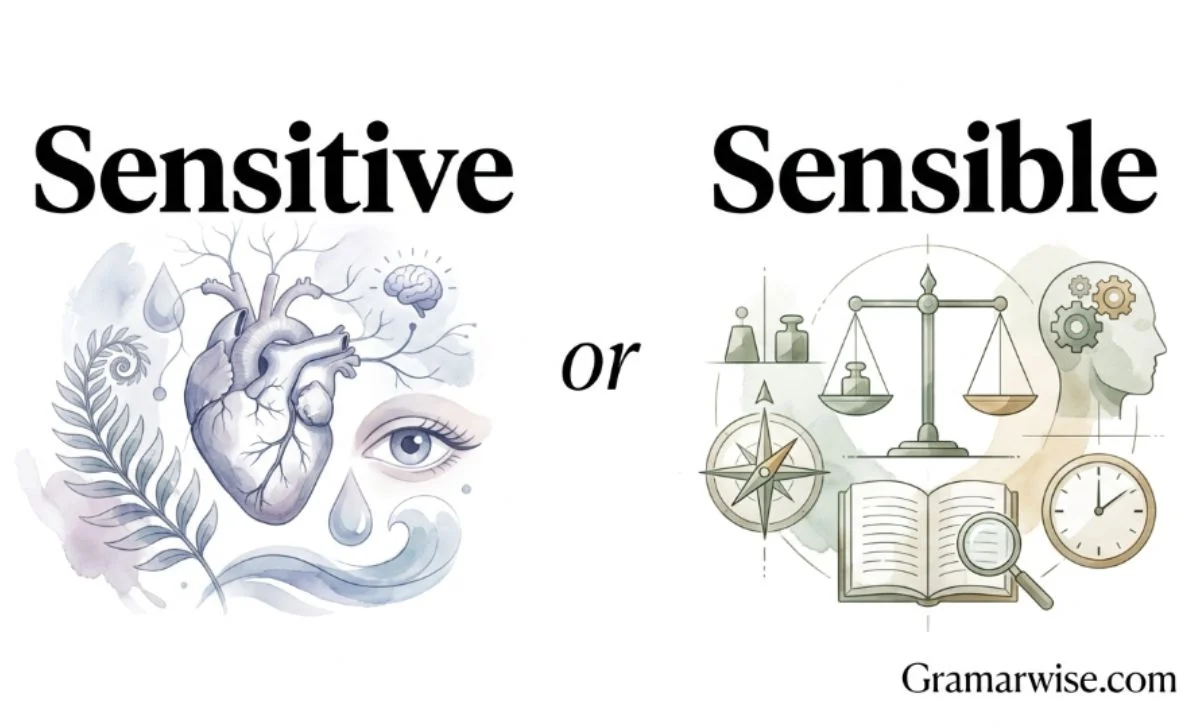
You might say, “She’s very sensitive,” and mean that she gets hurt easily. But if you say, “She made a sensible choice,” you are talking about something completely different.
Sensitive and sensible are easy to mix up because they look almost the same. Their meanings, however, go in different directions. Sensitive is usually about how someone or something reacts, while sensible is about good judgment and practical choices.
So, if a friend takes criticism personally, they may be sensitive. If that same friend saves money instead of spending it all, they may be sensible.
Quick Answer
Use sensitive when you mean easily affected, especially by emotions, criticism, physical changes, or delicate subjects.
Use sensible when you mean practical, reasonable, or showing good judgment.
- He is sensitive to criticism.
- He made a sensible decision.
- I have sensitive skin.
- It would be sensible to leave early.
A useful way to keep them apart is to think about reaction versus judgment. Sensitive often describes a reaction; sensible often describes a choice or way of dealing with something.
What Does “Sensitive” Mean?
Sensitive has several common uses, so context matters.
When it describes a person, it often means that the person is easily affected by words, criticism, rejection, or other people’s behavior.
Maya is sensitive about her appearance.
This does not necessarily mean Maya is weak. She may simply care deeply about the subject and react strongly when people comment on it.
Sensitive can also describe physical reactions:
I have sensitive skin, so some soaps irritate it.
It can describe things that respond to very small changes too:
This equipment is sensitive to temperature.
And then there is another common use:
The company handles sensitive information.
Here, sensitive means information that needs care because it may be private, confidential, or otherwise important to protect.
So the word is not limited to feelings. Sensitive can describe emotional reactions, physical reactions, delicate subjects, or information that needs careful handling.
What Does “Sensible” Mean?
Sensible is about using good judgment.
If someone looks at a situation, thinks about what is likely to happen, and makes a practical choice, that choice can be called sensible.
Taking a jacket was a sensible idea because it was getting cold.
Or:
She gave me some sensible advice about saving money.
Sensible does not mean “brilliant” or “genius.” A sensible decision is simply one that makes good sense in the situation.
You can talk about:
- a sensible decision
- a sensible choice
- sensible advice
- a sensible plan
- a sensible solution
- a sensible approach
For example:
Buying the cheaper option was sensible because both products worked equally well.
The focus is on the quality of the decision, not on someone’s feelings.
Sensitive vs. Sensible in Real Life
The quickest way to understand these words is to put them into situations where only one naturally fits.
When someone reacts strongly
Tom is sensitive to criticism.
Tom may feel hurt or upset when someone points out his mistakes.
When someone makes a practical choice
Tom made a sensible decision.
Here, the focus is on his judgment.
When talking about skin
She has sensitive skin.
Her skin reacts easily to certain products or conditions.
When talking about a difficult subject
Money can be a sensitive topic.
The subject may cause discomfort, embarrassment, disagreement, or strong emotions.
When talking about advice
That sounds like sensible advice.
The advice seems reasonable and practical.
Notice how the same person could be both:
Tom is sensitive about criticism, but he is sensible when making financial decisions.
There is no contradiction. The two words describe different things.
Sensitive or Sensible Information?
This is one place where the wrong choice can change the meaning.
Sensitive information is the normal phrase when you mean private or confidential information.
For example:
Don’t share sensitive information with strangers online.
This might include personal or confidential details.
Sensible information does not normally mean private information. If you use sensible here, you would be suggesting that the information itself is reasonable or useful, which is a different idea.
Compare:
The file contains sensitive information.
The information needs protection.
The report contains sensible advice.
The advice is practical.
So when you mean information that should be kept private, sensitive is the word you want.
Sensitive or Sensible Skin?
If your skin reacts easily to products, weather, heat, or other conditions, the correct phrase is sensitive skin.
This cream is suitable for sensitive skin.
You would not normally say sensible skin.
That is because sensible is connected with judgment and practicality, not physical reactions.
This is a good example of why similar-looking words cannot be chosen by appearance alone. The surrounding noun often gives you the clue.
Sensitive vs. Delicate
Sensitive and delicate sometimes overlap, especially when talking about subjects or situations, but they are not identical.
A sensitive subject may involve strong emotions, personal matters, or controversy.
The interviewer avoided a sensitive subject.
A delicate subject also requires careful handling.
They had to discuss a delicate family matter.
But delicate has other meanings that sensitive does not always have. It can describe something fragile or easily damaged:
These flowers are delicate.
You would not normally replace delicate with sensitive here.
Likewise, if someone is easily hurt by criticism, sensitive is much more natural:
She is sensitive to criticism.
So there is some overlap, but the words are not interchangeable in every sentence.
Sensitivity vs. Sensibility
The nouns sensitivity and sensibility create another layer of confusion.
Sensitivity is the quality of being sensitive. It can refer to emotional awareness or the ability to react to something.
His sensitivity to criticism made the conversation difficult.
It can also describe physical responsiveness:
The test has high sensitivity.
Sensibility, on the other hand, is linked to good judgment, awareness, and practical understanding.
Her sensibility helped her handle the situation calmly.
In everyday English, you will often see sensible much more directly:
That was a sensible choice.
The related noun is sensibility, not “sensibleness” in ordinary usage.
Common Mistakes
Because the spellings are so close, these words can slip into the wrong sentence.
Wrong for the intended meaning:
He is sensible to criticism.
If you mean that criticism affects him easily, say:
He is sensitive to criticism.
Another common mistake is using sensitive when you mean practical:
It was a sensitive decision to take an umbrella.
The natural choice is:
It was a sensible decision to take an umbrella.
And remember the familiar phrase:
sensitive skin
not:
sensible skin
The best approach is not to memorize dozens of rules. Think about what you are actually trying to describe: a reaction or a judgment.
A Simple Way to Remember Them
If you are talking about feelings, reactions, skin, criticism, or delicate subjects, start by considering sensitive.
If you are talking about choices, advice, plans, solutions, or good judgment, sensible is usually the better choice.
For example:
She is sensitive about her job.
Her feelings are easily affected.
She made a sensible plan for her career.
Her plan is practical and reasonable.
That small distinction will solve most cases where the two words get mixed up.
Sensitive or Sensible: More Examples
Here are a few natural examples that show the contrast without changing the basic meaning each time:
- He is sensitive about his weight.
- He made a sensible choice about his diet.
- The patient has sensitive skin.
- Wearing protective clothing was sensible.
- That is a sensitive question.
- That is a sensible question.
- The microphone is sensitive to quiet sounds.
- It would be sensible to check the equipment first.
The two words can even appear in the same conversation:
“I know you’re sensitive about the subject, so let’s talk about it carefully.”
“That sounds sensible.”
The first speaker is concerned about feelings. The second response is about whether the approach is reasonable.
FAQs
1. What is the difference between “sensible” and “sensitive”?
Sensitive usually means easily affected or responsive, while sensible means practical, reasonable, or guided by good judgment.
2. What’s the difference between sensitivity and sensibility?
Sensitivity relates to being easily affected or responsive. Sensibility relates to judgment, awareness, and practical understanding.
3. What is the difference between sensitive and delicate?
Sensitive often focuses on reactions or emotional responsiveness. Delicate can mean fragile or requiring careful handling. They overlap in some contexts but are not always interchangeable.
4. What does “sensible” mean?
Sensible means practical, reasonable, or showing good judgment.
5. What is another word for “sensitive”?
Depending on the context, alternatives include emotional, responsive, perceptive, vulnerable, and easily affected.
6. What does “sensitive” mean?
Sensitive means easily affected or responsive to something. It can refer to emotions, physical reactions, information, or difficult subjects.
7. What is a better word for sensible?
Depending on the sentence, you could use practical, reasonable, wise, rational, prudent, or sound.
8. What is a sensible person?
A sensible person generally uses good judgment and makes practical, reasonable choices.
9. What is the opposite of sensible?
Depending on the context, opposites include foolish, unreasonable, impractical, irrational, and reckless.
10. What is an example of sensitive?
“She is sensitive to criticism” is a simple example. It means criticism affects her easily.
Conclusion
Sensitive and sensible may look like close relatives, but they do different jobs in a sentence. Sensitive is the word for things that are easily affected or require careful handling, from feelings and skin to difficult subjects and private information.
Sensible is the word for practical judgment, such as a sensible decision, plan, or piece of advice.
When you are unsure, ask yourself one question: Am I talking about how something reacts, or whether something makes good sense? That simple check will usually point you to the right word.