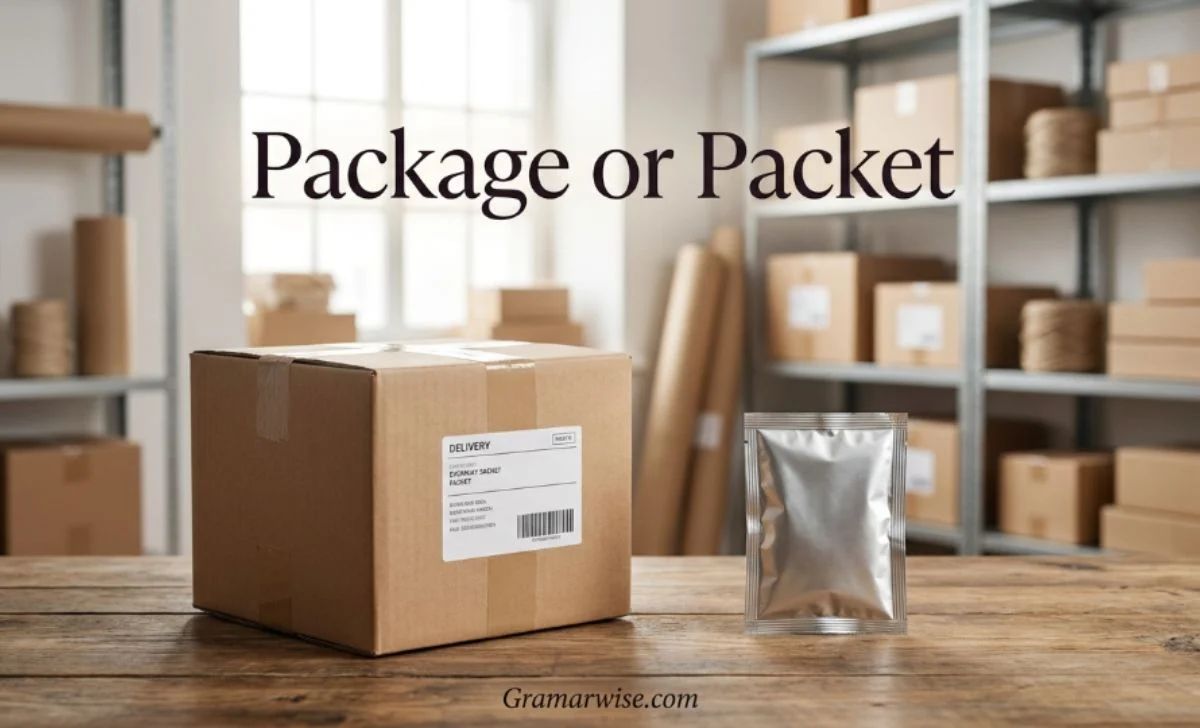
Choosing between package and packet can be confusing because both words describe something that contains or carries other things.
However, they are not always interchangeable. The best choice depends on what you are talking about, how large the item is, and the context.
In everyday American English, package is the more common word for something prepared for shipping or delivery.
Packet often suggests a smaller collection or container, such as a packet of documents, a packet of seeds, or a small amount of food. In computing, however, a packet has a completely different meaning: a small unit of data sent across a network.
Quick Answer
A package is usually a wrapped, boxed, or otherwise prepared item that is sent, delivered, or sold.
A packet usually means a small container, small quantity, or small collection of something. It can also mean a unit of data transmitted over a computer network.
For example:
- The package arrived this morning.
- She gave me a packet of documents.
- I bought a packet of seeds.
- The network sends data in small packets.
So, if you are talking about an item being shipped to someone, package is often the safest choice in American English.
Package Meaning
Package has several related meanings, but the most common one is a collection of things that has been wrapped, boxed, or prepared as one unit.
You might receive a package from an online store. It could contain clothes, books, electronics, or household items.
For example:
My package was delivered while I was at work.
Here, package refers to the physical item sent to the recipient.
The word also has meanings beyond shipping. A package can be a group of products or services sold together:
The hotel offers a weekend package.
In computing, package can also refer to a collection of software or files distributed together.
Because of these broad uses, package is a very flexible word.
What Does “A Packet” Mean?
A packet usually refers to a relatively small collection, amount, or container of something.
For example:
I need a packet of tea.
He handed me a packet of papers.
She planted a packet of flower seeds.
The exact meaning depends on the noun that follows it. A packet can contain physical goods, documents, food, seeds, or other small items.
The word also has a technical meaning in networking. A network packet is a formatted unit of data that travels across a computer network.
Therefore, context matters. A packet of seeds and a network packet have very different meanings.
Package or Packet of Documents?
Both expressions can be possible, but they can suggest slightly different things.
Packet of documents usually sounds natural when you mean a collection of papers gathered together for a particular purpose.
Please review this packet of documents before the meeting.
This wording works well for forms, application papers, legal documents, or information provided as a set.
Package of documents can also be used, especially when the documents are physically wrapped, boxed, shipped, or treated as one delivery.
The company sent a package of documents by courier.
The key difference is the focus. Packet often emphasizes a small collection of documents, while package can emphasize the physical shipment or container.
Package vs Packet vs Parcel
These three words overlap, but they are not identical.
| Word | Common meaning | Typical context |
|---|---|---|
| Package | An item prepared for carrying, shipping, or delivery | Online orders, shipping, delivery |
| Packet | A small container, quantity, collection, or unit | Documents, food, seeds, data |
| Parcel | An item wrapped or packed for transportation | Postal services, shipping, British English |
In American English, package is especially common for something delivered through the mail or a shipping company.
Parcel is also understood in the United States, but it is strongly associated with postal and shipping terminology. In British English, parcel is a very common everyday word for a delivered item.
Packet usually has a stronger sense of something small or a small collection.
Compare these examples:
My package arrived today.
I received a packet of documents.
The parcel was delivered to her office.
All three are correct, but the natural choice changes with the situation.
Package vs Parcel in USPS Usage
The United States Postal Service uses package and parcel in its mailing terminology, although they are not simply interchangeable in every technical context.
For everyday American English, people commonly say:
I’m waiting for a package.
You are also likely to hear parcel when discussing postal classifications, shipping services, or formal mailing terminology.
The important point is that package is the more natural everyday choice for many American speakers when referring to something they are expecting in the mail.
For example:
Did you get my package?
sounds more conversational than:
Did you get my parcel?
The second sentence is understandable, but it can sound more formal or less typical in ordinary American conversation.
Packet vs Package in Networking
In computer networking, packet is the correct technical term.
A network packet is a small unit of data sent through a network. Large amounts of information can be divided into smaller units so they can travel between devices.
For example:
The computer sends the data in packets.
Here, replacing packet with package would change the technical meaning and would not be standard networking terminology.
This is one of the clearest cases where the two words should not be treated as synonyms.
Packet is a networking term, while package has other computing meanings, such as a collection of software or files.
Is “Pack” Short for Package or Packet?
Pack is related to both words, but it is not simply an abbreviation for either one in every situation.
A pack is a group or quantity of things gathered together.
For example:
I bought a pack of batteries.
He opened a pack of cards.
She carried a pack of notebooks.
Package can sometimes be shortened informally to pack, especially in commercial or shipping contexts, but the two words can have different meanings.
Similarly, packet and pack are closely related, but a packet often suggests a smaller container or quantity.
Think of them this way:
- pack = a group or quantity
- packet = a small container, quantity, collection, or data unit
- package = something prepared as a unit, especially for shipping or delivery
The correct word depends on the object and context.
Is It Pack or Packet?
Use pack when you mean a group or quantity sold or kept together.
a pack of cards
a pack of batteries
a pack of pencils
Use packet when you mean a small container or small amount.
a packet of seeds
a packet of sauce
a packet of documents
There are cases where both can sound natural, but they may create a slightly different image. Pack often focuses on the number or group, while packet often focuses on the small container or portion.
Pack or Packet of Cigarettes?
The usual expression is a pack of cigarettes in American English.
For example:
He bought a pack of cigarettes.
Packet of cigarettes is also used in some varieties of English, particularly British English.
So the choice can depend on regional usage:
- American English: a pack of cigarettes
- British English: a packet of cigarettes
This is a useful example of why context and regional English matter when choosing between closely related words.
What Is a Packet in Shipping?
In shipping, packet can refer to a small mailed or transported item, especially in postal terminology. However, everyday usage varies by country and shipping system.
If you are talking about an ordinary item ordered online in the United States, package is usually the more natural word:
Your package is out for delivery.
If the item is small or the context uses postal terminology, packet may appear instead.
For general writing, package is the safer choice when you simply mean something being shipped or delivered.
What Is a Packet in Packaging?
In packaging, a packet is generally a small container or small sealed portion of a product.
Common examples include:
- a packet of seeds
- a packet of sugar
- a packet of sauce
- a packet of spices
- a packet of tea
- a packet of biscuits
The word often suggests a relatively small amount enclosed in paper, plastic, foil, or another material.
For instance:
Add one packet of seasoning to the mixture.
Here, packet tells the reader that the seasoning comes in a small packaged portion.
What Comes in a Packet?
Almost anything that is commonly sold or distributed in a small portion can come in a packet.
Examples include:
- documents
- seeds
- tea
- spices
- sauce
- sugar
- snacks
- tissues
- small craft materials
The word does not describe one particular product. Instead, it describes the way something is grouped or contained.
That is why packet is common with phrases such as packet of documents and packet of seeds.
Another Word for “Packet”
The best synonym depends on the context.
Possible alternatives include:
- pack
- pouch
- sachet
- bundle
- parcel
- container
- small package
- collection
For example, a small sealed food container might be called a sachet, while a collection of papers might be called a bundle or set.
In networking, however, packet should generally remain packet because it is a specific technical term.
Another Word for “Package”
Depending on the meaning, package can be replaced by:
- parcel
- pack
- box
- container
- bundle
- shipment
- consignment
- wrapping
These are not perfect substitutes in every sentence.
For example:
The package arrived today.
can become:
The parcel arrived today.
But shipment may refer to the goods being transported rather than the physical box itself.
Likewise, box describes the container, while package can describe the entire prepared item.
What Is the Abbreviation for Package?
There is no single universal abbreviation for package that works in every context.
In some business, shipping, inventory, or technical systems, organizations may use their own shortened forms. However, in normal writing, it is usually better to write package in full.
The same principle applies to packet. Unless a particular industry, form, database, or style guide specifies an abbreviation, spelling the word out avoids confusion.
Is There an Abbreviation for Packet?
There is no universally required abbreviation for the ordinary English word packet.
In technical contexts, abbreviations may appear in specialized systems, but their meanings depend on the field.
If you are writing a normal sentence, use packet rather than creating your own abbreviation.
For example:
The packet contains the application forms.
is clearer than using an unexplained shortened form.
What Is the Three-Letter Abbreviation?
There is no universal three-letter abbreviation that should automatically replace package or packet in ordinary English.
Some industries and organizations use short codes for products, shipping units, or inventory categories. Those codes are usually system-specific rather than standard English abbreviations.
Therefore, if you are writing an article, email, report, or ordinary sentence, write package or packet in full unless your specific style guide gives you an accepted abbreviation.
Why Were Ships Called Packets?
Historically, packet was also used in connection with ships that carried mail, passengers, or goods on a regular route.
The term developed from the idea of a packet of letters or mail. A ship carrying such mail became known as a packet boat or simply a packet in historical contexts.
This older use is different from the modern everyday meaning of packet as a small container or the computer-networking meaning of packet.
So when you see packet ship in historical writing, it does not mean that the ship itself was a small package. It refers to its role in carrying mail and other goods.
Common Mistakes With Package and Packet
One common mistake is assuming that the two words are always interchangeable.
For example:
I am waiting for my packet from Amazon.
This may be understood, but package is generally more natural in American English:
I am waiting for my package from Amazon.
Another mistake is using package in networking:
The computer sent the data in packages.
In technical networking language, packets is the standard term:
The computer sent the data in packets.
A third mistake is choosing package when describing a small portion of something:
Add one package of seeds.
If the seeds come in a small sealed container, packet is often the more natural choice:
Add one packet of seeds.
Package vs Packet: Simple Rule
A quick way to remember the difference is to focus on the situation.
package for:
- shipped items
- delivered orders
- wrapped goods
- boxes or prepared shipments
- groups of products or services
Use packet for:
- small portions
- small containers
- small collections
- documents gathered together
- network data
Use pack for:
- groups or quantities sold together
For example:
Package: My package arrived today.
Packet: I opened a packet of seeds.
Pack: I bought a pack of pencils.
Network packet: The router received a data packet.
This simple distinction will cover most everyday situations.
Which Should You Use?
If you mean something being sent or delivered, package is usually the best choice in American English.
If you mean a small container or small collection, packet may be better.
For documents, both can work, but packet of documents often sounds natural when the papers are collected as a set. If they are physically shipped, package of documents may be more appropriate.
For networking, use packet, not package.
For cigarettes, regional usage matters: pack of cigarettes is common in American English, while packet of cigarettes is common in British English.
The main idea is simple: package is broader and strongly associated with shipping and prepared goods, while packet often refers to something smaller, a small collection, or a unit of data.
FAQs
1. Are packet and package the same?
No. They overlap in some contexts, but package usually refers to a prepared item for shipping or delivery, while packet often means a small container, amount, collection, or network data unit.
2. Is pack short for package or packet?
Pack is a separate word related to both. It means a group or quantity of things and can sometimes be used informally where package might otherwise appear.
3. What does “a packet” mean?
A packet is usually a small container, quantity, or collection of something. In networking, it means a unit of data sent across a network.
4. What is a packet in shipping?
A packet can refer to a small mailed or transported item in postal terminology. However, package is often the more natural everyday term in American English.
5. Is it pack or packet?
Use pack for a group or quantity, such as a pack of cards. Use packet for a small container or portion, such as a packet of seeds.
6. What is the abbreviation for package?
There is no single universal abbreviation for package in ordinary English. Write the full word unless a specific industry or system provides an accepted abbreviation.
7. What is another word for “packet”?
Depending on context, alternatives include pack, pouch, sachet, bundle, parcel, container, and small package.
8. What is a packet in packaging?
A packet is a small container or sealed portion of a product, such as a packet of tea, seeds, sugar, or sauce.
9. Why were ships called packets?
Historically, packet ships carried mail, passengers, and goods on regular routes. The name was connected with their role in carrying packets of mail.
10. What is another word for a package?
Depending on context, you could use parcel, pack, box, container, bundle, shipment, or consignment.
11. Is there an abbreviation for packet?
There is no universally accepted abbreviation for the ordinary word packet. Specialized fields may use their own codes or abbreviations.
12. What is the 3-letter abbreviation for package or packet?
There is no universal three-letter English abbreviation for either word. Industry-specific systems may use their own codes.
13. What is the definition of packet?
A packet is a small container, quantity, or collection of something. In computing, it is a unit of data transmitted over a network.
14. What comes in a packet?
Packets can contain things such as seeds, tea, spices, sauce, sugar, snacks, or documents, depending on the context.
15. What are the 7 types of packaging?
Common packaging categories include primary, secondary, tertiary, flexible, rigid, protective, and specialty packaging. The exact classification can vary by industry and source.
16. What do you call a package?
A package can also be called a parcel, pack, box, container, bundle, or shipment, depending on what you mean.
17. What are some other words for “packaging”?
Related words include wrapping, packing, container, casing, covering, packing material, and presentation. The best choice depends on the context.
Final Takeaway
Package and packet are related words, but they serve different purposes. Use package when you mean a prepared item, especially one being shipped or delivered.
Use packet for a small container, portion, collection, or unit of network data. Pack usually refers to a group or quantity.
When in doubt, think about the context rather than treating the three words as interchangeable.
In American English, package is usually the natural choice for deliveries, while packet works well for small portions, document collections, and technical networking.