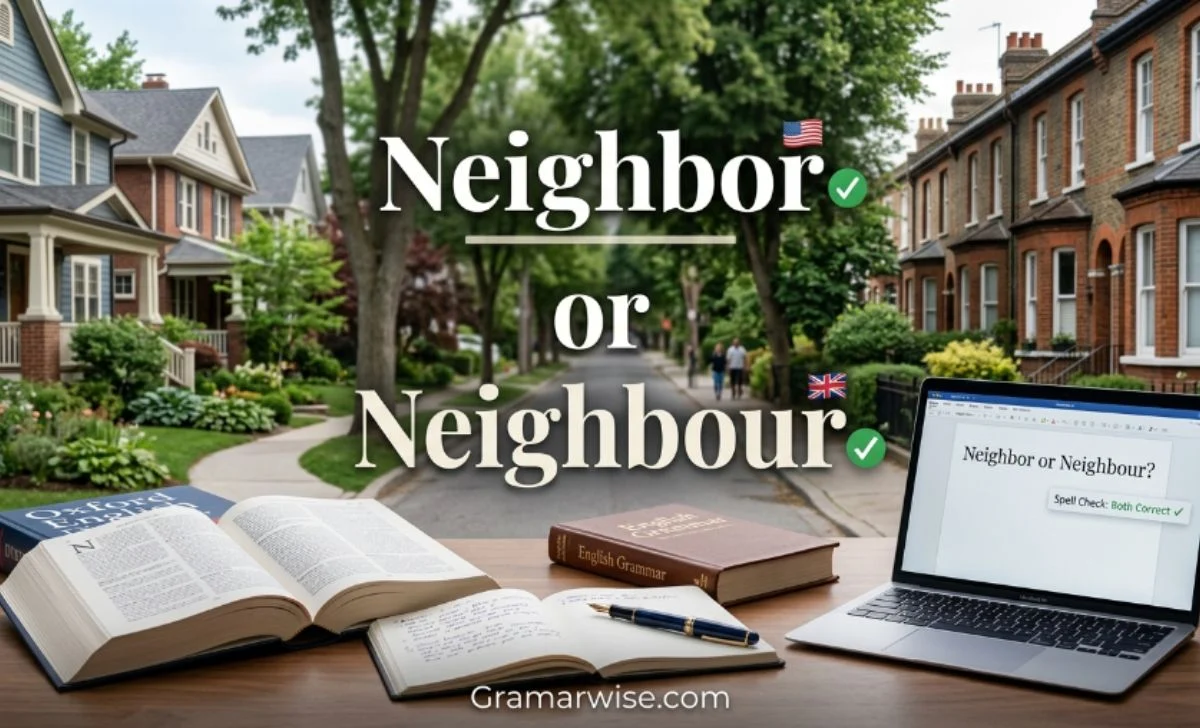
Have you ever stopped while writing because you were unsure whether to use neighbor or neighbour? You are not alone.
Many English learners, students, writers, and professionals face this spelling question. The good news is that both words are correct.
However, the right choice depends on the type of English you use. Neighbor is the standard spelling in American English, while neighbour is preferred in British English and many other English-speaking countries.
This guide explains the difference, meaning, history, regional usage, and real-life examples. By the end, you will know exactly which spelling fits your audience and when to use each one.
Neighbor or Neighbour – Quick Answer
Neighbor and neighbour have the same meaning. The only difference is the spelling.
- Use neighbor in American English.
- Use neighbour in British English, Canadian English (commonly), Australian English, and New Zealand English.
Neither spelling is more correct than the other. The best choice depends on your audience and the English variety you are following.
Correct Example
✔ My neighbor helped me fix my fence yesterday. (American English)
✔ My neighbour brought us homemade cookies after we moved in. (British English)
✔ Our new neighbor is very friendly.
✔ Every neighbour joined the community meeting.
Incorrect Example
❌ My neighbour lives in Texas. (Incorrect if following American English style.)
❌ My neighbor lives in London. (Incorrect if following British English style guide.)
Quick Tip: Keep your spelling consistent throughout your writing. Avoid mixing neighbor and neighbour in the same document unless you are comparing the two spellings.
What Does Neighbor or Neighbour Mean?
The words neighbor and neighbour refer to a person who lives near another person. They can also describe someone, a place, or even a country that is close to another.
Both spellings come from the same English word and carry the same definition. Only the regional spelling changes.
Common Meanings
Depending on the context, neighbor or neighbour can mean:
- A person living next door.
- Someone living in the same street, building, or community.
- A nearby country or region.
- A person who shows kindness and support within a community.
- Someone who is close in position or location.
For example:
- Pakistan is a neighbor of India.
- France is a neighbour of Belgium.
- Our neighbor always waters our plants when we travel.
- Every neighbour attended the local festival.
The word is also used in technology and science. For example:
- Nearest neighbor algorithm in machine learning.
- Neighbor discovery in computer networking.
- Neighborhood and neighbourhood in urban planning and geography.
These uses still reflect the core idea of being close or nearby.
Simple Usage Examples
Here are everyday examples that show the correct usage.
American English
- My neighbor owns a beautiful garden.
- We invited every neighbor to the barbecue.
- Our neighbor returned the lost package.
British English
- My neighbour looks after our cat during holidays.
- Every neighbour welcomed the new family.
- Our neighbour planted flowers along the fence.
Is “neighbor” or “neighbour” correct?
Both spellings are correct. Neighbor is the standard spelling in American English, while neighbour is the preferred spelling in British English, Australian English, and commonly Canadian English.
They have the same meaning and pronunciation. Choose the spelling that matches your audience and use it consistently throughout your writing.
The Origin of Neighbor or Neighbour
The story behind neighbor and neighbour goes back hundreds of years. Although the two spellings look different today, they share the same history and meaning.
The difference appeared because British and American English developed different spelling standards over time, not because the words changed in meaning.
Understanding the origin helps explain why both spellings are accepted and why neither is considered wrong.
Word History
The English word neighbor comes from the Old English word nēahgebūr.
This word was made from two parts:
- nēah – meaning near
- gebūr – meaning dweller, farmer, or resident
Together, the original word meant someone who lives nearby.
Over time, the spelling changed as the English language evolved.
Historical timeline
| Period | Spelling | Notes |
|---|---|---|
| Old English | nēahgebūr | Original form meaning “near dweller” |
| Middle English | neighbore, neighebour | Several spellings existed because English had no standard rules. |
| Early Modern English | neighbour | Printing presses helped make this spelling common in Britain. |
| Modern American English | neighbor | American spelling reforms removed the silent u. |
Even though the spelling changed, the meaning stayed almost identical for centuries.
How the Spelling Changed
In early English writing, there was no official dictionary. Writers often spelled words differently depending on their region.
For example, you might find these historical forms:
- neighbore
- neighbur
- neighebour
- neighbour
Once dictionaries became popular, British English settled on neighbour.
Later, American English adopted neighbor as the standard spelling.
This change was part of a broader movement to simplify English spelling.
Noah Webster’s Influence
One of the biggest reasons Americans write neighbor instead of neighbour is Noah Webster.
Webster believed American English should have its own identity. He wanted spelling to be simpler and more consistent.
When he published An American Dictionary of the English Language, he promoted spellings without the extra u in many words.
Examples include:
| British English | American English |
|---|---|
| neighbour | neighbor |
| colour | color |
| favour | favor |
| honour | honor |
| labour | labor |
| behaviour | behavior |
| humour | humor |
| rumour | rumor |
| savour | savor |
These spellings gradually became standard across the United States.
Meanwhile, Britain continued using the traditional forms.
Why Does British English Keep the “U”?
Many British English words ending in -our came into English through Anglo-French and later French influence.
Because of this historical connection, Britain kept spellings such as:
- neighbour
- colour
- favourite
- honour
- behaviour
These spellings remain the official standard in:
- United Kingdom
- Australia
- New Zealand
- Ireland
- South Africa
- Most Canadian publications
So, the extra u is not random. It reflects the historical development of British spelling.
Why the Confusion Happens
Many English learners become confused because they see both spellings online.
Several factors contribute to this confusion.
1. The Internet Mixes Both Styles
Websites from the United States usually write neighbor.
Websites from the United Kingdom usually write neighbour.
Since search engines show results from many countries, readers often see both spellings together.
2. Movies, TV Shows, and Social Media
American movies, television programs, and streaming platforms mostly use neighbor.
British news websites, schools, and publishers usually write neighbour.
As a result, people become familiar with both forms.
3. Different School Systems
Students in the United States learn:
- neighbor
- neighborhood
Students in Britain learn:
- neighbour
- neighbourhood
Both are correct because each follows its national spelling rules.
4. Spell Checkers
Modern writing software changes spelling based on language settings.
For example:
- Microsoft Word (US English) suggests neighbor.
- Microsoft Word (UK English) suggests neighbour.
- Google Docs behaves the same way.
- Most grammar checkers follow the selected English variety.
If your document language changes, the suggested spelling changes too.
Does the Meaning Ever Change?
No.
Whether you write neighbor or neighbour, the meaning stays exactly the same.
Both words describe:
- someone living nearby
- nearby countries
- nearby places
- someone within the same community
- someone close in location
For example:
American English
- Our neighbor helped us move into our new house.
- Mexico is a neighboring country of the United States.
British English
- Our neighbour invited us for dinner.
- France is a neighbouring country to Belgium.
The only difference is spelling—not pronunciation, grammar, or meaning.
Interesting Fact
The word also appears in many modern fields beyond everyday English.
For example:
- Nearest Neighbor Search in artificial intelligence
- K-Nearest Neighbors (KNN) in machine learning
- Neighbor Discovery Protocol (NDP) in computer networking
- Neighborhood Watch programs in community safety
- Neighbourhood planning in urban development
In all these cases, the idea remains the same: something or someone that is close or nearby.
British English vs American English
One of the most common questions is whether neighbor or neighbour is correct. The answer depends on the variety of English you are using.
American English prefers neighbor, while British English uses neighbour. This spelling difference follows a broader pattern found in many English words ending in -or and -our.
The meaning, pronunciation, and grammar remain the same. Only the spelling changes.
Although neighbor and neighbour have the same meaning, each spelling follows a different regional standard. Knowing which version to use makes your writing look more professional and consistent.
The table below gives a quick comparison.
Comparison Table
| Feature | Neighbor | Neighbour |
|---|---|---|
| Correct spelling | ✅ Yes | ✅ Yes |
| English variety | American English | British English |
| Used in the United States | ✅ Standard | ❌ Rare |
| Used in the United Kingdom | ❌ Rare | ✅ Standard |
| Used in Australia | ❌ No | ✅ Yes |
| Used in New Zealand | ❌ No | ✅ Yes |
| Used in Ireland | ❌ Rare | ✅ Yes |
| Used in Canada | Accepted but less common | More commonly preferred in official and educational writing |
| Meaning | A person living nearby | A person living nearby |
| Pronunciation | Same | Same |
Why Does American English Use Neighbor?
American English adopted neighbor after spelling reforms in the early 1800s. The goal was to simplify words by removing letters that did not affect pronunciation.
As a result, many -our words became -or words.
Examples include:
| British English | American English |
|---|---|
| neighbour | neighbor |
| colour | color |
| favour | favor |
| honour | honor |
| labour | labor |
| humour | humor |
| rumour | rumor |
| behaviour | behavior |
Today, these spellings are standard in American newspapers, schools, universities, businesses, and government publications.
Why Does British English Use Neighbour?
British English continues to use the traditional spelling neighbour because it follows historical spelling conventions that developed before American spelling reforms.
You will normally see neighbour in:
- British books
- UK newspapers
- Government websites
- Schools and universities
- Business documents
- Academic publications
Countries that generally follow British spelling also use neighbour.
These include:
- United Kingdom
- Australia
- New Zealand
- Ireland
- South Africa
- Many Canadian publications
Does Canada Use Neighbor or Neighbour?
Canada is unique because both American and British English influence Canadian writing.
However, neighbour is generally preferred in:
- Canadian schools
- Government documents
- Newspapers
- Formal writing
Some businesses and digital platforms use neighbor, especially when writing for American audiences. Therefore, both spellings appear in Canada, but neighbour remains the more traditional choice.
Do They Sound Different?
No.
Neighbor and neighbour are pronounced the same way.
The extra u changes the spelling only. It does not change the pronunciation.
Common pronunciation:
NEIGH-bər
The first syllable rhymes with day, while the second syllable sounds like ber.
Because the pronunciation is identical, native speakers usually notice the difference only in writing.
Is One Spelling More Correct?
No.
Both spellings are correct.
The important rule is to stay consistent throughout your document.
For example:
✅ Use neighbor throughout an article written in American English.
✅ Use neighbour throughout an article written in British English.
❌ Avoid mixing both spellings in the same document unless you are explaining the difference between them.
Neighbor vs Neighbour vs Other Variations
Many people accidentally create incorrect spellings because they mix American and British English rules. Others simply misspell the word while typing.
Learning the correct forms helps you avoid common writing mistakes.
Spelling Comparison Table
| Spelling | Correct or Incorrect | Meaning | Common Usage | Region |
|---|---|---|---|---|
| Neighbor | ✅ Correct | Person living nearby | Everyday writing | United States |
| Neighbour | ✅ Correct | Person living nearby | Everyday writing | United Kingdom, Australia, New Zealand, Ireland, commonly Canada |
| Neigbor | ❌ Incorrect | Misspelling | Avoid | None |
| Neighber | ❌ Incorrect | Misspelling | Avoid | None |
| Neibor | ❌ Incorrect | Misspelling | Avoid | None |
| Neghbor | ❌ Incorrect | Misspelling | Avoid | None |
| Neighboor | ❌ Incorrect | Misspelling | Avoid | None |
Common Related Words
The spelling pattern also changes in related words.
| American English | British English |
|---|---|
| neighbor | neighbour |
| neighborhood | neighbourhood |
| neighboring | neighbouring |
| neighboring country | neighbouring country |
| neighboring house | neighbouring house |
| neighboring city | neighbouring city |
Notice that every related word follows the same regional spelling rule.
Words That Follow the Same Pattern
If you already understand neighbor and neighbour, you can easily recognize many similar spelling differences.
| American English | British English |
|---|---|
| color | colour |
| favor | favour |
| honor | honour |
| labor | labour |
| behavior | behaviour |
| humor | humour |
| rumor | rumour |
| savior | saviour |
| flavor | flavour |
| endeavor | endeavour |
This pattern is one of the easiest ways to identify whether a piece of writing follows American or British English.
Neighbor and Neighbour in Everyday Writing
Understanding the correct spelling is important, but knowing how to use it in real situations is even more valuable. The examples below show how each spelling fits different types of writing.
Emails
Use the spelling that matches your audience.
American English
Hello,
My neighbor found a package that belongs to you. Please let me know when you can collect it.
British English
Hello,
My neighbour received a parcel for you yesterday. Please collect it at your convenience.
Social Media
People usually follow the spelling style of their country.
American English
- My neighbor surprised us with homemade cookies today.
British English
- Our neighbour always helps during community events.
News Writing
News organizations keep their spelling consistent with their editorial style.
American English
Police thanked a neighbor who reported the incident.
British English
A neighbour helped firefighters reach the family safely.
School Writing
Students should follow the spelling style required by their school or teacher.
American English
- My neighbor has lived next door for ten years.
British English
- My neighbour has lived next door for ten years.
Business Writing
Professional communication should always use one spelling style from start to finish.
American English
We appreciate our neighbors for supporting the local business community.
British English
We value our neighbours for supporting local businesses.
Related Grammar Rules
Learning this spelling difference also helps you recognize other regional spelling patterns.
Similar Spelling Differences
Many words follow the same American and British English pattern.
| American English | British English |
|---|---|
| color | colour |
| favor | favour |
| honor | honour |
| labor | labour |
| behavior | behaviour |
| humor | humour |
| flavor | flavour |
| rumor | rumour |
| savior | saviour |
| endeavor | endeavour |
Helpful Grammar Tips
- Choose either American or British English before you begin writing.
- Keep the same spelling style throughout your document.
- Follow your publisher’s or client’s style guide when writing professionally.
- Match related words with the same spelling style, such as neighbor/neighborhood or neighbour/neighbourhood.
- Remember that the meaning does not change, only the spelling does.
FAQs
Which is correct, neighbor or neighbour?
Both spellings are correct. Neighbor is the standard spelling in American English, while neighbour is used in British English and several other English-speaking countries.
What is the American spelling of neighbour?
The American spelling is neighbor. It removes the letter “u”, following American English spelling conventions.
How do British people spell neighbor?
British English spells the word as neighbour. This spelling is standard in the UK and follows traditional British conventions.
Why are there two spellings?
The difference comes from the development of American and British English. American English simplified many words by dropping the “u”, while British English kept the traditional spelling.
Is neighbour correct in American English?
It is understandable, but it is not the standard American spelling. Most US publications and style guides use neighbor.
Is neighbor correct in British English?
People in the UK will understand it, but neighbour is the preferred spelling in British English.
How does Canada spell neighbor?
Canadian English generally prefers neighbour, although neighbor may appear in some digital content influenced by American English.
What does neighbour mean?
It refers to a person who lives nearby, such as someone next door or within the same community. It can also describe a nearby country or place.
What is the plural of neighbour?
The plural is neighbours in British English and neighbors in American English.
How do you pronounce neighbor?
Neighbor is pronounced NAY-bər. The pronunciation is the same for neighbour.
Is there a pronunciation difference between neighbor and neighbour?
No. Both spellings have the same pronunciation. The difference exists only in writing.
Which spelling should I use in academic writing?
Use the spelling required by your institution or publisher. Once you choose one style, keep it consistent throughout your work.
Which spelling is better for international writing?
Neither is better. Choose the spelling that matches your target audience or follows your organization’s style guide.
Do neighbor and neighbour have the same meaning?
Yes. Both words describe a person, place, or country that is nearby.
When should I use neighbor instead of neighbour?
Use neighbor when writing for an American audience. Use neighbour when writing for readers who follow British English.
Why does British English use -our while American English uses -or?
American English adopted simplified spellings during spelling reforms, while British English retained many traditional forms.
Is neighborhood spelled differently in the US and the UK?
Yes. American English uses neighborhood, while British English uses neighbourhood.
How do you spell neighbor in Spanish?
The English word neighbor translates to vecino (male) or vecina (female) in Spanish. It is not simply spelled differently.
What is the difference between neighbor and neighbour?
There is no difference in meaning or pronunciation. The only difference is regional spelling.
Is neighbor accepted in Canadian English?
Yes, it is understood. However, neighbour is generally preferred in formal Canadian writing.
Why did American English remove the “u”?
American spelling reforms aimed to simplify English words and create a consistent national spelling system.
Are neighbor and neighbour interchangeable?
Yes, they have the same meaning. However, you should avoid mixing both spellings in the same document.
What are common spelling mistakes?
Common mistakes include neigbor, neighber, neibor, and neighboor. None of these spellings are correct.
How can I remember the correct spelling?
Use neighbor for American English and neighbour for British English. Keeping your audience in mind makes the choice simple.
Is neighbor a noun or an adjective?
It is primarily a noun, meaning a person who lives nearby. In some contexts, neighboring or neighbouring functions as an adjective, such as neighboring town or neighbouring country.
Conclusion
Choosing between neighbor and neighbour is simple once you know your audience. Both spellings are correct and have the same meaning, pronunciation, and grammar. The only difference is regional usage.
Neighbor is the standard spelling in American English, while neighbour is preferred in British English and commonly used in Canada, Australia, and New Zealand.
For clear and professional writing, select the spelling that matches your style guide or target readers and use it consistently throughout your document.
Avoid mixing both forms unless you are comparing them directly. Following this simple rule will make your writing more accurate, polished, and easier for readers to understand.