
Many English learners and even writers get confused between “connector” and “connecter.” Both words look almost identical, but only one is correct in modern English.
This confusion appears in searches like connector or connecter meaning, connecter vs connector spelling, and what is a connector in English.
The issue happens because English spelling rules are not always obvious. People often assume both forms are acceptable, especially when they see the base verb “connect.”
However, in professional writing, only one form is considered correct and widely accepted.
In this guide, you will clearly understand the correct spelling, meaning, real-life usage, technical examples, grammar rules, and common mistakes so you can avoid errors in writing and SEO content.
Connector or Connecter – Quick Answer
The correct spelling is:
👉 Connector = correct and standard English
❌ Connecter = incorrect / outdated variant
Simple meaning:
- Connector = something that connects or joins things
- Connecter = not used in modern English
Examples:
- USB connector is not working properly.
- The cable connector is damaged.
- He is a great connector of people in business networks.
This also answers common searches like connector meaning, connector spelling, and connecter or connector difference.
Pronunciation of Connector
Connector
Pronounced as: kuh-NEK-tor
It clearly follows the standard pronunciation of the verb “connect.”
👉 Even in speech, there is no difference between connector and connecter, but spelling decides correctness.
Why People Confuse Connector or Connecter
This confusion happens due to simple reasons:
- The base word “connect” ends with “-ect”
- Learners assume noun should become “connecter”
- Similar-looking English patterns create misunderstanding
- Typing errors and autocorrect suggestions
- Lack of exposure to formal writing standards
This is why searches like:
- connector spelling correct or not
- connecter vs connector grammar
- what is connector in English
are very common among learners.
Easy Trick to Remember Connector or Connecter
Here is a simple rule:
👉 English nouns often use “-or” after verbs ending in “-ct”
Examples:
- connect → connector
- act → actor
- collect → collector
Memory shortcut:
👉 “Connector connects things, so it ends with OR.”
This makes it easy to remember forever.
The Origin of Connector
The word connector comes from the verb connect, which originates from Latin “connectere” meaning “to bind together.”
Over time, English standardized noun formation using “-or” instead of alternative endings like “-er” in many technical and professional words.
That is why “connector” became the accepted modern form.
British English vs American English Usage
There is no difference between British and American English for this word.
Both use:
✔ Connector (correct)
❌ Connecter (incorrect in both variants)
Comparison Table:
| Feature | Connector | Connecter |
|---|---|---|
| Usage | Standard English | Incorrect form |
| Dictionary approval | Yes | No |
| SEO usage | Recommended | Not recommended |
| Professional writing | Correct | Avoid |
Which Spelling Should You Use?
Always use connector in:
- Academic writing
- Technical documentation
- SEO content
- Engineering and IT contexts
- Professional emails
Avoid connecter completely because it is considered a spelling error in modern English systems like Grammarly, Microsoft Word, and Google Search indexing.
Connector in Real Life Usage
The word connector is widely used in different fields:
1. Technology
- HDMI connector
- USB connector
- Network connector
Used in computers, electronics, and hardware systems.
2. Grammar (Linguistics)
In grammar, connectors link ideas in sentences.
Examples:
- however
- therefore
- although
- moreover
Sentence:
- She worked hard; therefore, she succeeded.
3. Social & Business Use
A connector can also mean a person who connects others.
- He is a strong connector in the business industry.
- Networking skills help you become a better connector.
Common Mistakes with Connector or Connecter
Wrong → Correct
- connecter cable → connector cable
- USB connecters → USB connectors
- electrical connecters → electrical connectors
- write connecter → write connector
These mistakes usually come from spelling assumptions rather than grammar rules.
Data & Usage Trends
Language usage data shows:
- “connector” is used almost universally in modern English
- “connecter” is rarely found in formal writing
- Search engines and grammar tools consistently correct it
This confirms that connector is the only accepted professional form.
Connector vs Connecter Comparison Table
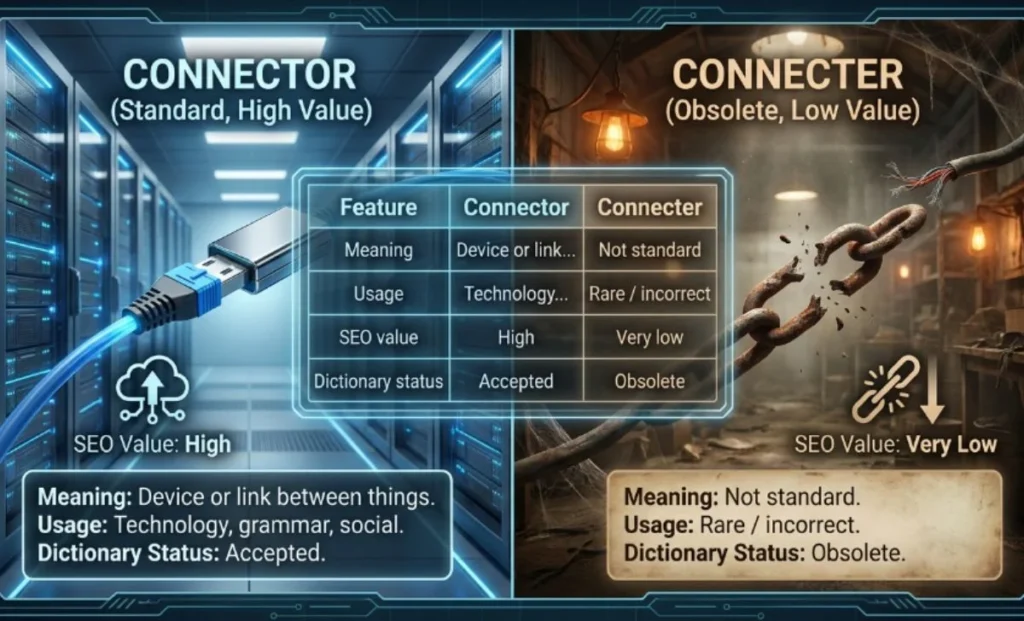
| Feature | Connector | Connecter |
|---|---|---|
| Meaning | Device or link between things | Not standard |
| Usage | Technology, grammar, social | Rare / incorrect |
| SEO value | High | Very low |
| Dictionary status | Accepted | Obsolete |
FAQs
What is connector or connecter meaning?
Connector means something that joins things together. Connecter is not correct English.
Is connecter a real word?
It exists in rare historical usage but is not accepted in modern English.
Why is connector correct?
Because English uses “-or” noun formation for words like connect → connector.
Does spelling matter in SEO?
Yes, incorrect spelling like connecter can reduce ranking and trust.
Is connector used in UK and US English?
Yes, both use connector only.
Conclusion
The difference between connector or connecter is very simple: only connector is correct in modern English.
It is widely used in technology, grammar, and everyday communication, while “connecter” is outdated and incorrect.
Most confusion happens because learners assume spelling follows pronunciation patterns, but English grammar rules are more standardized.
Once you remember that “connector connects things, so it ends with -or,” you will never make this mistake again.
For professional writing, SEO content, and academic work, always choose connector for clarity and correctness.