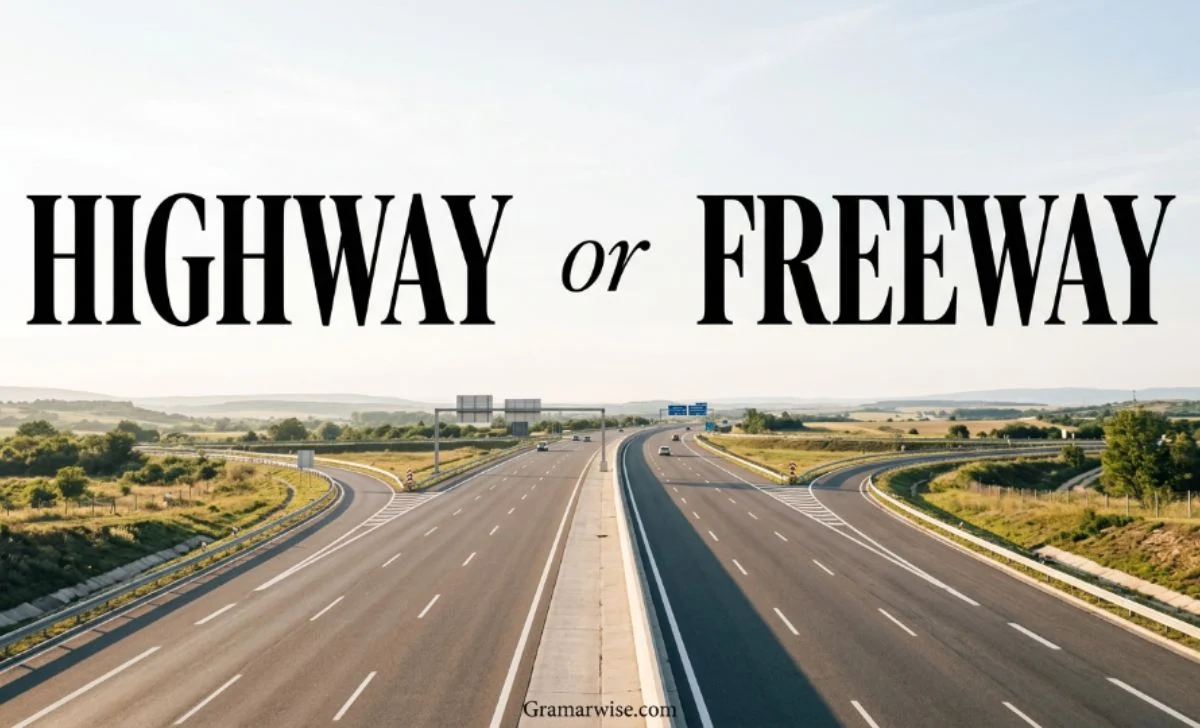
If you are driving in the U.S., you may hear people use highway and freeway for what seems like the same road. Sometimes they are talking about the same route, but the two words are not exact synonyms.
A highway is a broad term for an important road. A freeway is a type of highway built for controlled access and uninterrupted traffic flow.
That small distinction explains why someone can say they are driving on a highway, a freeway, and an Interstate at the same time.
Quick Answer
A highway is a general term for a major road that connects places. It can have traffic lights, intersections, driveways, and different speed limits.
A freeway is designed to keep traffic moving with limited access. Drivers normally enter and leave through ramps, while regular intersections and traffic lights are kept off the main roadway.
So the simplest rule is:
A freeway is a type of highway, but not every highway is a freeway.
| Feature | Highway | Freeway |
|---|---|---|
| Meaning | Broad term for a major road | Controlled-access type of highway |
| Regular intersections | May have them | Generally does not |
| Traffic lights | Possible | Not normally on the main road |
| Direct property access | May be allowed | Restricted |
| Entrance and exit | May be direct | Usually through ramps |
| Traffic flow | Varies | Designed for continuous movement |
What Is a Highway?
A highway is a major public road intended to carry traffic over relatively long distances.
The word does not tell you exactly how the road is designed. A highway may be a simple two-lane road through a rural area, a divided road between cities, or a large urban route with several lanes.
You might drive along a highway and encounter:
- traffic lights
- intersections
- turning lanes
- businesses beside the road
- direct entrances to properties
- slower sections
The important point is that highway describes the road in a broad sense. It does not automatically mean a controlled-access road.
That is why the word can cover many different road designs.
What Is a Freeway?
A freeway is built around one main idea: keep through traffic moving with as few interruptions as possible.
Instead of allowing drivers to turn directly onto the road from nearby properties or cross it at ordinary intersections, access is controlled.
A typical freeway uses:
- entrance ramps
- exit ramps
- interchanges
- separated directions of travel
- multiple lanes
- bridges or underpasses where roads cross
If you miss an exit, you usually cannot simply turn around at the next intersection. You have to continue until another designated exit or interchange.
The term is particularly common in American English, with California being one of the places where “freeway” is especially familiar in everyday speech.
Highway, Freeway, and Interstate Are Not the Same Thing
This is where the terminology gets confusing.
Highway is the broadest of the three terms.
Freeway describes the design and access of a road.
Interstate identifies a route that belongs to the U.S. Interstate Highway System.
These categories can overlap.
For instance, I-5 is an Interstate route. Much of it is also built as a freeway. Calling it an Interstate Highway and calling a particular section a freeway are both reasonable descriptions.
The same idea applies to routes such as I-15, I-75, and I-90. The Interstate number tells you which route it is; “freeway” tells you about the type of road you are traveling on.
A useful way to picture the relationship is:
Highway → broad road term
Freeway → controlled-access highway
Interstate → U.S. highway-system designation
An Interstate does not have to be treated as a completely separate category from a freeway.
Why Do Californians Say “Freeway”?
California is strongly associated with the word freeway, especially in everyday conversation about major roads.
A person in California might say:
“Take the freeway and get off at the next exit.”
Another speaker might simply say:
“Take the highway.”
Neither expression is automatically wrong. The choice depends on the road and the speaker’s usual terminology.
California’s extensive network of controlled-access roads helps explain why “freeway” is such a familiar word there. People often refer to major routes by their numbers as well, such as I-5, I-405, or 101.
Regional vocabulary matters too. Americans in different parts of the country may prefer freeway, expressway, highway, or other terms for roads with similar functions.
What Do Californians Call Highway 101?
U.S. 101 is officially U.S. Route 101, not an Interstate.
In everyday California speech, people commonly shorten the name to 101. Depending on the location, sections of U.S. 101 operate as freeways, while other sections have different road designs.
That gives us a useful example of why route designation and road type should not be confused.
“U.S. 101” tells you the route.
“Freeway” can describe how a particular section of that route is built.
So saying U.S. 101 is a highway and saying part of U.S. 101 is a freeway can both be correct.
What About I-5, I-15, I-75, and I-90?
These routes are all Interstate highways, but the word “Interstate” does not replace the word “freeway.”
I-5, for example, is commonly encountered as a controlled-access freeway. I-15, I-75, and I-90 also include extensive freeway sections.
If someone asks, “Is I-90 a freeway or highway?” the question creates a false choice. It can be described as an Interstate Highway while also having freeway characteristics.
The same applies to the question “Is I-75 a highway or freeway?”
A more precise answer is:
I-75 is an Interstate Highway, and its controlled-access sections are freeways.
This distinction also explains why US 101 can be a freeway in some places without being an Interstate.
Why Is US 101 Not an Interstate?
US 101 and I-5 can both be major roads, but they belong to different route systems.
U.S. Route 101 is part of the U.S. Highway System.
Interstate 5 belongs to the Interstate Highway System.
The difference is therefore about the route designation rather than simply whether the road is large, fast, or divided.
A U.S. Highway can have freeway sections. An Interstate can also be a freeway. Road classification and route numbering are two different things.
Which Is Faster: a Highway or a Freeway?
A freeway is generally better suited to fast, uninterrupted travel.
Its design removes many of the things that slow ordinary roads down: traffic lights, direct property access, and regular intersections.
But “freeway” does not guarantee a faster journey.
A crowded freeway during rush hour can be much slower than a lightly traveled highway. Construction, crashes, weather, and road closures can also change travel times.
So the better comparison is about design, not a guaranteed speed.
A freeway is designed for continuous traffic flow. A conventional highway may require drivers to stop or interact with local traffic more often.
Why Is It Called a Freeway?
The name refers to the freedom of movement provided by the road’s design.
Drivers do not normally have to stop at ordinary intersections or deal with frequent direct access from surrounding properties. Traffic can travel between interchanges with fewer interruptions.
“Free” in freeway should not be understood simply as “free of charge.” A freeway can be part of a toll system in some places, while a road without tolls is not automatically a freeway.
The important idea is free-flowing traffic with controlled access.
Highway or Freeway Map: How Can You Tell?
A map can give you useful clues about the type of road you are looking at.
A freeway usually appears with features such as:
- numbered exits
- ramps
- large interchanges
- separated directions
- connections that pass over or under other roads
A conventional highway may show more direct connections with local streets and intersections.
Still, a route can change character along its length. A numbered highway may be a freeway in one area and a conventional road farther along.
For that reason, the route number alone does not tell you whether every part of the road is a freeway.
What Do Brits Call a Highway?
British English uses motorway for major controlled-access roads.
For example, a British speaker would commonly talk about driving on a motorway rather than using the American term freeway.
The word highway exists in British English too, but its everyday use does not always match American usage.
This is one reason road vocabulary can sound different across English-speaking countries:
| American English | British English |
|---|---|
| Freeway | Motorway |
| Highway | Highway / road, depending on context |
| Sidewalk | Pavement |
| Interstate | No direct British equivalent |
The comparison is useful, but these terms should not be treated as perfect dictionary replacements. Road systems differ between countries.
Can a Highway Be a Freeway?
Yes.
This is probably the easiest way to resolve most of the confusion.
A route can be called a highway in the broad sense while a particular section is classified as a freeway because of its controlled-access design.
Think about a long numbered route passing through several regions. One part may have traffic lights and direct entrances, while another part may have ramps, interchanges, and no ordinary crossings.
The route has not necessarily changed its identity. Its road design has changed.
That is also why asking whether a road is “highway or freeway” is sometimes too limiting. The two descriptions can apply at different levels.
The Difference in Everyday Speech
In normal conversation, people are not always trying to give a technical road classification.
Someone may say:
“I’m on the highway.”
They may simply mean they are traveling on a major road.
Another person may say:
“I’m taking the freeway.”
They may be emphasizing that they are using a controlled-access road.
In casual speech, local habits often matter more than strict terminology. In technical writing, transportation planning, or road documentation, the exact classification becomes more important.
A Simple Way to Remember the Difference
If the road has controlled access, ramps, and no ordinary intersections, you are probably dealing with a freeway.
If you are using the word as a general name for a major road, highway is the safer broad term.
And if the road has an Interstate number such as I-5 or I-90, “Interstate” identifies its place in the U.S. highway system.
So these descriptions can overlap:
I-5 → Interstate Highway → freeway section
There is no contradiction between those terms.
FAQs
Is a freeway another word for a highway?
Not exactly. Highway is a broad term, while a freeway is a specific type of highway with controlled access.
Why do Californians say freeway instead of highway?
“Freeway” is a common California term for major controlled-access roads. Regional habits make the word especially familiar there.
Am I on a highway or a freeway?
You can be on both. A freeway is a type of highway, so the terms are not mutually exclusive.
Is I-90 a freeway or highway?
I-90 is an Interstate Highway. Its controlled-access sections can also be described as freeways.
What is the difference between a freeway and a highway?
A highway is a broad road term. A freeway is designed with controlled access, ramps, and limited direct entry or exit.
What do Brits call a highway?
For major controlled-access roads, British speakers commonly use motorway. The exact term depends on the type of road being discussed.
Which is faster, a highway or a freeway?
Freeways are designed for faster, more continuous traffic flow, but actual travel speed depends on traffic, road conditions, construction, and other factors.
What do Californians call Highway 101?
The official name is U.S. Route 101. In everyday conversation, Californians often shorten it to 101.
Why is it called a freeway?
The name refers to free-flowing movement with fewer interruptions from ordinary intersections and direct access points. It does not simply mean a road that is free to use.
Why is US 101 not an Interstate?
US 101 belongs to the U.S. Highway System, while Interstate routes belong to the Interstate Highway System. They use different route-designation systems.
What is the steepest highway in California?
There is no single answer without defining how “steepest” is measured. A maximum road grade, an entire route, or a particular section could produce different results.
What state has a 26-lane highway?
A claim about a 26-lane highway depends on what is included in the lane count. Some counts combine lanes from both directions with auxiliary or nearby roadway lanes, so the specific road section matters.
Conclusion
Highway and freeway are related terms, but they are not interchangeable in every situation.
Highway is the broader word for a major road. Freeway describes a highway designed for controlled access and continuous traffic. Interstate identifies a route within the U.S. Interstate Highway System.
Once you separate road design from route designation, the terminology becomes much easier. A road such as I-5 can be an Interstate Highway and a freeway at the same time, while U.S. 101 can be a U.S. Highway with freeway sections.