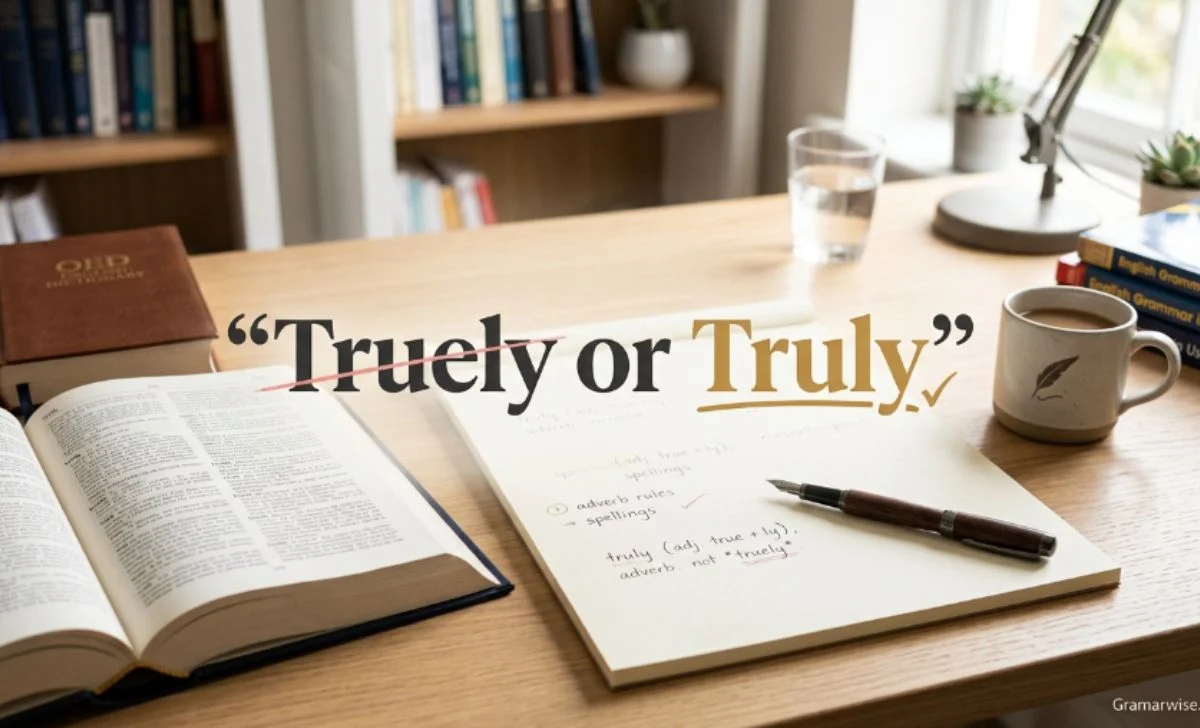
Have you ever typed “truely” and wondered whether it looks right? You are not alone. This is a common spelling mistake because the adjective true ends in e, so it can feel natural to write truely when adding -ly. However, the correct spelling is truly.
Truly is the standard English adverb. It means “really,” “genuinely,” “sincerely,” or “in a way that is true,” depending on the sentence. Oxford lists truly as an adverb and gives examples such as “truly sorry” and “truly remarkable.”
So, if you are choosing between truely or truly, always use truly in standard English.
Which One Is Correct?
Truly is correct. Truely is a misspelling and should not be used in standard English.
The confusion comes from the word true. When you see true, it may seem logical to add -ly and write truely. However, English spelling does not always work by simply attaching a suffix to the full original word. In this case, the final e in true is removed before -ly is added.
The result is:
true + ly → truly
Not:
true + ly → truely
For example:
- She is truly happy.
- I am truly grateful for your help.
- He truly believes what he says.
- This is a truly beautiful place.
If you write truely in these sentences, the meaning may still be understood, but the spelling is incorrect.
What Does Truly Mean?
Truly is an adverb used to show that something is real, sincere, true, or genuine. It can also add strong emphasis to an adjective, statement, or feeling.
Oxford gives several uses for truly, including emphasizing that a statement or feeling is sincere or real, emphasizing a quality, and emphasizing that a description is accurate.
In simple English, truly can often mean:
- really
- genuinely
- sincerely
- honestly
- actually
- certainly
- in truth
The exact meaning depends on the sentence.
For example, “I truly appreciate your help” means that the speaker sincerely appreciates the help. In “It is truly beautiful,” the word truly strongly emphasizes the adjective beautiful.
Truly Meaning in Different Contexts
The word truly can express slightly different ideas depending on how it is used.
When it describes a sincere feeling, it means genuinely or sincerely:
I am truly sorry for my mistake.
Here, the speaker is emphasizing that the apology is sincere.
When it emphasizes a description, it can mean really or extremely:
The view from the mountain was truly amazing.
The speaker strongly emphasizes how amazing the view was.
When it emphasizes truth or accuracy, it can mean actually or in reality:
The plan is truly effective.
This suggests that the plan is genuinely effective, rather than merely appearing effective.
Cambridge similarly defines truly as an adverb used to emphasize truth, sincerity, reality, or exactness.
Why Is It Truly and Not Truely?
The spelling truly follows an English spelling pattern in which the final e of true is not retained before -ly.
The base word is:
true
The adverb is:
truly
This is why truely is not the standard spelling.
A useful way to remember it is to treat truly as a word that must be learned in its established form rather than trying to build it letter by letter every time.
Think:
TRUE → TRULY
not:
TRUE → TRUELY
This small spelling difference is easy to miss, especially when writing quickly.
Is Truely a Word?
Truely is not the standard spelling of the English adverb. If you are writing an essay, email, article, application, business message, or other formal text, use truly.
You may see truely online because people sometimes make spelling mistakes. Its appearance in user-generated content does not make it the accepted spelling.
The standard dictionary form is truly. Oxford includes truly in its dictionary and identifies it as an adverb.
Therefore:
Correct: I truly understand you.
Incorrect: I truely understand you.
What Type of Word Is Truly?
Truly is an adverb.
It commonly modifies a verb, adjective, or another part of a sentence by adding emphasis or showing how sincerely or accurately something is meant.
Consider these examples:
- I truly believe you.
- She is truly talented.
- We are truly grateful.
- He truly understands the problem.
In “I truly believe you,” truly adds emphasis to believe. In “She is truly talented,” it strengthens the description talented.
Oxford places truly in the word family of true, alongside words such as truth, truthful, and truthfully.
Truly or True: What Is the Difference?
True and truly are related, but they have different grammatical jobs.
True is mainly an adjective. It describes a person, thing, statement, or idea.
The story is true.
Truly is an adverb. It adds emphasis or explains the sincerity or truth of an action or description.
I truly believe the story.
Compare these examples:
| Word | Part of speech | Example |
|---|---|---|
| True | Adjective | The statement is true. |
| Truly | Adverb | I truly believe the statement. |
The easiest rule is simple: true describes; truly modifies or emphasizes.
Truly or Truely in a Sentence
The correct form is truly. Here are some natural examples from everyday English:
- I truly appreciate everything you have done.
- She was truly excited about the opportunity.
- He truly believes that the plan will work.
- We are truly grateful for your support.
- This was a truly unforgettable experience.
- I am truly sorry for what happened.
- They truly care about their customers.
- The result was truly remarkable.
- She truly deserves this award.
- I truly enjoyed our conversation.
Notice that truly works naturally with feelings, opinions, beliefs, descriptions, and statements.
Is “Truly Grateful” Correct?
Yes, “truly grateful” is completely correct.
The phrase means that someone feels genuine or sincere gratitude. It is common in personal messages, thank-you notes, professional emails, speeches, and formal writing.
For example:
I am truly grateful for your support.
This means:
I am genuinely or sincerely grateful for your support.
You can also say:
We are truly grateful for your kindness.
She was truly grateful for the opportunity.
I am truly grateful to everyone who helped me.
In these examples, truly emphasizes the sincerity of the feeling.
Truly or Truely Synonyms
The best synonym for truly depends on the context. There is no single replacement that works perfectly in every sentence.
When truly means really, you can often use:
- really
- genuinely
- actually
- certainly
When it means sincerely, you can use:
- sincerely
- honestly
- genuinely
When it means in truth, you can use:
- in fact
- actually
- truthfully
For example:
I truly appreciate your help.
Possible alternatives include:
I genuinely appreciate your help.
I sincerely appreciate your help.
I really appreciate your help.
However, these words are not always interchangeable. Sincerely focuses more on honest feeling, while actually focuses more on fact or reality. Oxford also lists genuinely as an adverb meaning truly or in a sincere and honest way.
When Should You Use the Word Truly?
Use truly when you want to emphasize that something is real, sincere, accurate, or strongly true.
It is especially natural before adjectives and verbs:
She is truly talented.
I truly understand your concern.
He truly wants to help.
This is truly important.
You can also use truly to express sincerity:
I am truly sorry.
We are truly grateful.
I truly appreciate your kindness.
It works in both everyday and formal English. However, because it adds emphasis, you do not need to use it in every sentence.
Why Do People Say “Yours Truly”?
Yours truly is a traditional closing used at the end of a letter. It is especially associated with formal or conventional correspondence.
For example:
I look forward to hearing from you.
Yours truly,
Daniel
Oxford lists Yours truly as a formal letter closing and also notes an informal use in which it can refer humorously to the speaker or writer.
Cambridge also recognizes yours truly as a formal way to end a letter.
In modern everyday emails, closings such as Best regards, Kind regards, or Sincerely are often more natural. Still, Yours truly remains a correct expression.
Is “Yours Truly” the Same as “Truly Yours”?
They are similar, but their use can differ by context.
Yours truly is commonly used as a letter closing:
Yours truly,
Michael
Truly yours can also be used as a closing, although it is less common in many modern contexts.
The important point is that truly is the correct spelling in both expressions.
Correct:
Yours truly
Truly yours
Incorrect:
Yours truely
Truely yours
Truly in UK English and the Oxford Dictionary
Truly is the standard spelling in UK English as well as American English. Oxford’s English dictionary lists truly as an adverb and gives the pronunciation /ˈtruːli/.
Oxford also gives the word family:
true → truth → truthful → truthfully → truly
The dictionary’s examples show truly being used with words such as sorry, remarkable, global, and believe.
Cambridge also lists truly in both UK and US English and gives several meanings, including emphasizing truth, sincerity, reality, and exactness.
So there is no UK-versus-US spelling difference here:
UK English: truly
US English: truly
Truely is not the standard alternative.
Common Mistakes With Truly
The most common mistake is adding the e from true when forming the adverb.
Incorrect:
I am truely sorry.
Correct:
I am truly sorry.
Another common mistake is assuming that truly and true can be used in exactly the same places.
Incorrect:
I am truly about the story.
Correct:
The story is true.
Correct:
I truly believe the story.
Remember that true and truly have different grammatical roles. Learning the spelling together with the grammar makes the distinction much easier to remember.
Quick Memory Trick for Truly
If you often forget whether to write truly or truely, remember this simple pattern:
TRUE → TRULY
The e disappears.
You can also remember the phrase:
Truly = true without the e + ly
This is not a rule you need to apply to every English word ending in e, but it is a useful memory aid for this particular spelling.
Whenever you are unsure, choose truly.
FAQs
Is it truely or truly correct?
Truly is correct. Truely is a common misspelling. Use truly in standard English.
What does truly mean?
Truly means really, genuinely, sincerely, or in a way that is true. Its exact meaning depends on the sentence.
Is truely a word?
Truely is not the standard spelling. The correct English word is truly.
Is it correct to say “truly”?
Yes. Truly is a correct and standard English adverb listed by major dictionaries, including Oxford and Cambridge.
What’s a better word for truly?
Depending on the context, alternatives include really, genuinely, sincerely, honestly, actually, and certainly. The best choice depends on the intended meaning.
What does “truly” mean in a sentence?
In a sentence, truly usually adds emphasis. It can show that something is genuinely true, sincerely felt, or especially strong.
When should you use the word “truly”?
Use truly when you want to emphasize truth, sincerity, reality, or a strong quality. For example, “I truly appreciate your help.”
Why do people say “yours truly”?
Yours truly is a traditional letter closing. It can also be used informally to mean “me” or “I,” sometimes in a humorous way.
Is “truly grateful” correct?
Yes. Truly grateful is correct and means genuinely or sincerely grateful.
What type of word is truly?
Truly is an adverb. It commonly modifies verbs or emphasizes adjectives and descriptions.
What is the antonym of truly?
The best antonym depends on the context. Possible opposites include falsely, untruthfully, dishonestly, or incorrectly.
Final Answer
The correct spelling is truly, not truely. Although truely may look logical because the base word is true, standard English drops the final e before forming truly.
Truly is an adverb meaning really, genuinely, sincerely, or in truth. You can use it in phrases such as truly grateful, truly sorry, and truly amazing. It is also found in the traditional expression Yours truly.
So, whenever you are choosing between the two, remember:
Correct: Truly
Incorrect: Truely