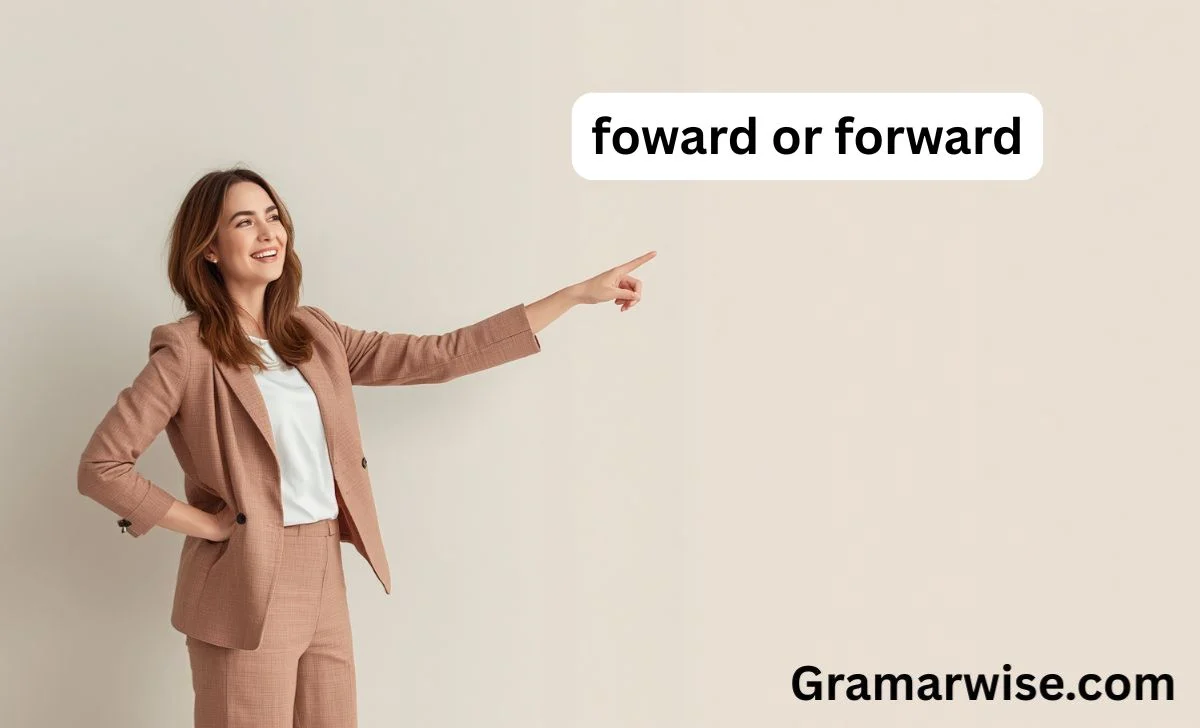
Foward or forward is one of the most common spelling confusions in English writing today. Many students, writers, professionals, and English learners often type foward or forward while unsure which form is correct.
This confusion appears in emails, academic writing, and everyday messages. In this guide, you will clearly understand the correct spelling, meaning, usage, and rules behind it using simple explanations based on modern English usage standards.
The explanation reflects updated guidance from modern usage in English grammar, American English, and British English, so you can confidently avoid this mistake in real writing situations.
Quick Answer
The correct spelling is “forward.” The word “foward” is incorrect and is considered a common spelling mistake in English.
Only forward is accepted in both American English and British English. Example: “Move forward in your career” and “Please send the email forward.” Always avoid “foward” in formal and informal writing.
Quick Comparison Table
| Feature | Forward | Foward |
|---|---|---|
| Correct spelling | ✔ Yes | ❌ No |
| Accepted in English | ✔ Yes | ❌ No |
| Meaning | Direction / progress | No meaning |
| Usage | Formal & informal writing | Common typo |
| Dictionary support | ✔ Oxford, Cambridge, Merriam-Webster | ❌ Not listed |
What Does Forward Mean?
Meaning
The word forward means movement ahead, progress, or direction toward the front. It is widely used in English grammar and everyday communication to describe movement in time, space, or progress.
It is recognized in major dictionaries like the Oxford English Dictionary and Cambridge Dictionary.
Usage
Forward can be used in physical, emotional, and professional contexts.
Examples:
- We are moving forward with the project.
- Please step forward and introduce yourself.
Why People Confuse These Words
Many users type foward or forward incorrectly because of fast typing and pronunciation habits. When spoken quickly, the “r” sound is subtle, causing spelling mistakes.
Another reason is lack of attention to spelling conventions in digital communication. Autocorrect sometimes fails to catch the missing “r,” especially in informal messaging.
In American English and British English, pronunciation is similar, but spelling rules remain strict: only “forward” is correct.
Are Both Spellings Correct?
No, only forward is correct.
The form foward is not accepted in any standard form of English, including academic writing, business communication, or publishing standards like the AP Stylebook and Chicago Manual of Style.
Key Points:
- Forward = correct
- Foward = incorrect typo
- Only one standard exists in global English usage
British English vs American English
There is no difference between British and American English for this word.
| Usage | American English | British English |
|---|---|---|
| Correct form | forward | forward |
| Incorrect form | foward | foward |
| Meaning | same | same |
| Usage frequency | very high | very high |
Both variants follow the same spelling convention under modern English grammar rules.
Grammar Rule Behind the Difference
The word forward comes from Old English roots combining “fore” (ahead) and “ward” (direction). The correct structure includes the “r” after “fo-”.
The missing “r” in foward breaks standard orthography rules in spelling conventions and English language structure.
According to modern linguistic principles studied in Linguistics, correct spelling must preserve root phonemes and morphological structure.
Examples:
- Move forward with confidence.
- The company is looking forward to expansion.
Which One Should You Use?
US Audience
Always use forward in all writing contexts.
UK Audience
Same rule applies, use forward only.
International Writing
Use forward universally in all global communication.
Academic Writing
Follow strict standards from dictionaries like Merriam-Webster Dictionary and Cambridge guidelines.
Professional Writing
Emails, reports, and business documents must always use forward for clarity and correctness.
Real-World Usage Examples
Emails
- Please forward this message to the manager.
- I am looking forward to your reply.
Business Writing
- The company is moving forward with expansion plans.
- We will forward the proposal for approval.
Academic Writing
- Research is moving forward in this field.
- Students should move forward step by step.
Social Media
- Keep moving forward no matter what happens.
- Looking forward to the weekend!
Everyday Conversations
- Let’s move forward together.
- I forwarded the message to you.
Common Mistakes to Avoid
| Incorrect | Correct | Explanation |
|---|---|---|
| foward the email | forward the email | Missing “r” |
| moving foward | moving forward | Spelling error |
| look foward to it | look forward to it | Standard phrase |
Usage Trends
The correct form forward is consistently dominant in global usage.
- US usage: Extremely high in business and academic writing
- UK usage: Standard and formal usage in all contexts
- Global trend: Unified spelling across all English variants
Modern digital writing tools and grammar checkers strongly enforce correct spelling under English grammar systems.
Related Words Readers May Also Confuse
- Foreword vs Forward
- Foward vs Forward
- Froward vs Forward
- Towards vs Toward
- Backward vs Backwards
These confusion pairs often appear in spelling conventions and writing mistakes.
Synonyms for Forward
- Ahead
Meaning: In front or forward direction
When to Use: Physical movement
Example: Move ahead slowly. - Onward
Meaning: Continuing forward
When to Use: Progress situations
Example: We move onward. - Progress
Meaning: Development forward
When to Use: Growth contexts
Example: The project progresses well. - Advance
Meaning: Move forward
When to Use: Formal writing
Example: Advance your career. - Proceed
Meaning: Continue forward
When to Use: Instructions
Example: Please proceed. - Continue
Meaning: Keep moving
When to Use: Ongoing actions
Example: Continue forward. - Go ahead
Meaning: Move forward
When to Use: Permission context
Example: Go ahead with plan. - Push forward
Meaning: Force progress
When to Use: Motivation contexts
Example: Push forward despite challenges. - Move on
Meaning: Leave behind and progress
When to Use: Emotional or situational change
Example: Move on from mistakes. - Carry on
Meaning: Continue action
When to Use: Ongoing tasks
Example: Carry on working.
FAQs
1. Is “foward” correct spelling?
No, “foward” is incorrect. The correct spelling is “forward.”
2. What is the correct spelling of forward?
The correct spelling is forward in all forms of English.
3. Why do people write foward instead of forward?
It happens due to typing mistakes and missing the letter “r.”
4. Is forward British or American English?
It is used the same in both British and American English.
5. Can I use foward in formal writing?
No, it is not accepted in formal or academic writing.
6. What does forward mean in English?
It means direction ahead or progress in time or action.
7. Is forward a verb or adjective?
It can be both depending on sentence structure.
8. How do I avoid this spelling mistake?
Use spell check tools or remember the correct structure “for + ward.”
Conclusion
The correct and only accepted spelling is forward, while foward is always incorrect. There is no difference between British and American English usage for this word.
Understanding this simple rule helps improve your writing accuracy in emails, academic work, and professional communication.
Always remember: forward = correct progress word, and foward = common typo to avoid.
With consistent practice and attention to spelling conventions, you can eliminate this mistake and write with confidence in any English context.
Read More Blog :
- Moneys or Monies: Correct Plural Explained with Easy Examples
- Hastle or Hassle: Which One Should You Use and Why?