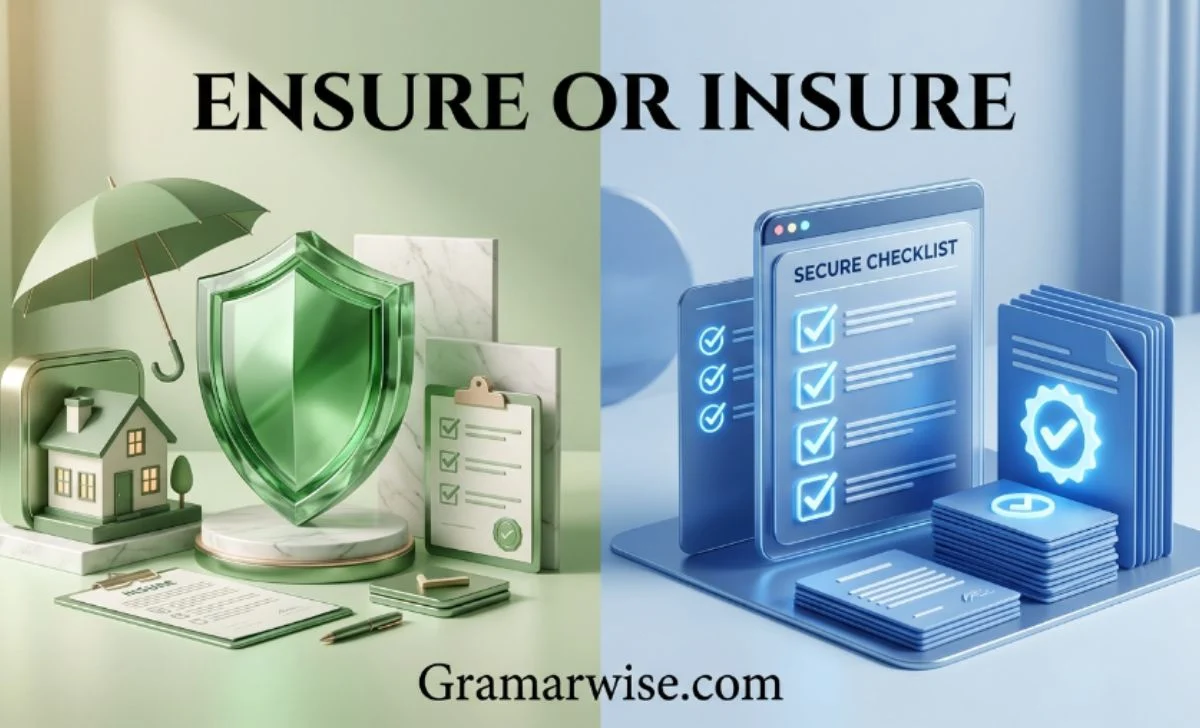
Ensure means “make sure.”
Insure means “protect against financial loss, usually through insurance.”
Have you ever stopped while writing a sentence and wondered whether ensure or insure is the right word?
You are not alone. The two words look and sound similar, but they do not usually mean the same thing. The easiest way to remember the difference is this:
So, you ensure that a package arrives on time, but you insure a package against loss or damage.
The confusion becomes even bigger because assure is another similar word. It has a different job too.
Let’s break down ensure vs. insure with simple meanings, clear examples, and practical rules you can use in everyday writing.
Quick Answer
Use ensure when you mean make certain that something happens or is true.
Please ensure that all doors are locked before leaving.
Use insure when you mean protect someone or something against financial loss through insurance.
We decided to insure the car against theft.
A simple memory trick is:
Ensure = make sure
Insure = insurance
There is also assure, which usually means to tell someone something confidently so they feel less worried.
I assured her that everything would be fine.
What Does “Ensure” Mean?
Ensure means to make something certain or to make sure that something happens.
It is commonly used when talking about actions, results, conditions, safety, quality, accuracy, or successful completion.
Examples of “ensure”
- Please ensure the door is locked.
- We checked the figures to ensure accuracy.
- The manager arrived early to ensure everything was ready.
- Follow these steps to ensure a smooth process.
- Please ensure that your payment details are correct.
In each sentence, ensure means something close to make sure.
For example:
Please ensure that your application is complete.
This means:
Please make sure that your application is complete.
That is why ensure is common in instructions, workplace communication, formal emails, notices, and business writing.
What Does “Insure” Mean?
Insure generally means to protect a person, property, vehicle, or another valuable thing against financial loss by obtaining insurance.
For example:
We need to insure the new car.
This means you arrange insurance coverage for the car.
Other examples include:
- They insured their home against fire.
- She wants to insure her car before driving it.
- The company insured its equipment against damage.
- You should insure valuable property against certain risks.
Here, insure is connected with insurance, coverage, risk, and financial protection.
A useful memory trick
Look at the first four letters:
INSUre → INSUrance
It is not a perfect spelling rule for every context, but it is a useful reminder when you are deciding between the two words.
Ensure vs. Insure vs. Assure
The third word in this group is assure.
These three words are related in appearance, but their meanings are different.
| Word | Basic meaning | Example |
|---|---|---|
| Ensure | Make certain | Please ensure the form is complete. |
| Insure | Protect against financial loss | We insure our house. |
| Assure | Give someone confidence or remove doubt | I assure you that everything is fine. |
Think of them as three different actions:
Ensure → make something certain
Insure → provide financial protection
Assure → make a person feel certain
Compare them in context
The checklist helps ensure accuracy.
The checklist makes accuracy more certain.
The company insured the equipment.
The company obtained insurance protection for the equipment.
The manager assured the customer that the problem would be fixed.
The manager gave the customer confidence.
This distinction is especially useful because people sometimes use assure when they actually need ensure, or use insure when they simply mean make sure.
When Should I Use “Ensure”?
Use ensure when you are talking about making something happen, making something certain, or checking that a condition is met.
A very common structure is:
ensure + that + clause
For example:
Please ensure that everyone has received the email.
We tested the system to ensure that it was working correctly.
Make sure you ensure that all required fields are completed.
The first two examples are natural. The third is grammatically possible but awkward because make sure and ensure repeat the same idea. Good writing usually chooses one.
“Ensure” in everyday situations
At work:
Please ensure that the report is submitted by Friday.
In an email:
Please ensure all attachments are included.
At home:
Ensure the oven is switched off before you leave.
In customer service:
We have updated the process to ensure faster responses.
In instructions:
Ensure the device is fully charged before use.
In all these examples, there is no insurance involved. The meaning is simply make certain.
When Should I Use “Insure”?
Use insure when the sentence is about insurance or protection against a financial risk.
Common things that can be insured include:
- cars
- homes
- businesses
- property
- equipment
- valuable items
- shipments
- people, depending on the type of insurance
For example:
We need to insure the vehicle before taking it on the road.
The business insured its building against fire.
They insured the shipment against damage during transportation.
The key idea is insurance protection, not simply making something happen.
Is It “Please Ensure” or “Please Insure”?
The correct phrase is usually:
Please ensure.
For example:
Please ensure that all documents are attached.
Please ensure your information is correct.
Here, the writer means please make sure.
Please insure would only make sense when asking someone to arrange or provide insurance.
For example:
Please insure the vehicle before delivery.
That means the vehicle needs insurance coverage.
So if you are writing an instruction, notice, email, or workplace message and you mean “please make sure,” choose ensure.
“Ensure Delivery” or “Insure Delivery”?
Both can be correct, but they communicate completely different ideas.
Ensure delivery
We changed the shipping process to ensure delivery on time.
Here, ensure delivery means make certain that delivery happens.
Insure delivery
Customers can insure delivery against loss or damage.
Here, insure refers to insurance protection.
The difference is easy when you replace the words:
Ensure delivery = make sure delivery happens.
Insure delivery = provide insurance protection for the delivery.
This is a good example of why the two words should not be treated as interchangeable.
Ensure or Insure: Common Mistakes
The most common mistake is using insure when the intended meaning is simply make sure.
Incorrect for the intended meaning:
Please insure that the information is correct.
If you mean “make sure,” use ensure:
Please ensure that the information is correct.
Another common mistake is using ensure when talking about an insurance policy.
We need to ensure the car against theft.
If the meaning is to obtain insurance protection, use:
We need to insure the car against theft.
The surrounding words usually reveal which word you need.
Ask yourself:
Am I making something certain?
→ Use ensure.
Am I providing or obtaining insurance protection?
→ Use insure.
Am I giving someone confidence?
→ Use assure.
What Is Another Word for “Ensure”?
The best synonym depends on the sentence, but common alternatives include:
- make sure
- make certain
- guarantee
- confirm
- secure
For example:
Please ensure the door is locked.
You could write:
Please make sure the door is locked.
In everyday English, make sure is often more conversational, while ensure can sound more concise and formal.
However, these words are not always perfect replacements. Guarantee, for example, can suggest a stronger promise than ensure.
What Is Another Word for “Insure”?
Depending on the context, possible alternatives include:
- cover
- protect
- provide insurance for
- indemnify
But these words do not work in every sentence.
For example:
We insured the house against fire.
A natural alternative might be:
We obtained insurance coverage for the house against fire.
Simply replacing insure with protect may change the meaning because insure specifically relates to insurance arrangements and financial protection.
A Simple Test: “Make Sure” or “Insurance”?
When you are unsure, replace the word mentally.
If make sure fits, use ensure.
Please, that the window is closed.
Try:
Please make sure that the window is closed.
It works, so ensure is correct.
Now try:
We need to the house against flooding.
“Make sure the house against flooding” does not work.
But insurance does:
We need to insure the house against flooding.
So insure is the right choice.
This quick substitution test can solve most ensure or insure questions in seconds.
Ensure or Insure in Health Insurance
When insurance is the subject, insure is usually the word you need.
For example:
You should insure yourself against unexpected medical expenses.
However, everyday English more often uses have health insurance, get health insurance, or take out health insurance than the verb insure.
For example:
She has health insurance through her employer.
They decided to get health insurance for their family.
The company provides health insurance to its employees.
So, if you see a phrase such as “ensure or insure health insurance,” remember that the natural wording often depends on what you are trying to say.
Ensure health coverage means make certain that coverage exists.
The employer took steps to ensure health coverage for all eligible workers.
Insure a person or risk means arrange insurance protection.
The policy helps insure the family against certain medical costs.
More Real-Life Examples
The easiest way to understand these words is to see how they behave in different situations.
At work
Please ensure that the report reaches the manager today.
The writer means make sure.
The company insured its office equipment against theft.
The company arranged insurance protection.
In an email
Please ensure that you have attached the correct file.
Please insure the equipment before shipping it.
The first sentence is about checking something. The second is about insurance.
In customer service
We have changed our system to ensure faster delivery.
Customers can insure valuable shipments against loss.
Again, ensure focuses on making an outcome certain, while insure focuses on protection against risk.
In everyday conversation
Make sure you lock the door.
You could also say:
Ensure that you lock the door.
But if you are talking about insurance:
We should insure the car before the trip.
These examples show why the words cannot simply replace each other.
Insure vs. Ensure Examples
Here are some quick pairs that show the difference clearly:
| Ensure | Insure |
|---|---|
| Ensure the door is locked. | Insure the house against theft. |
| Ensure the form is complete. | Insure the vehicle before using it. |
| Ensure everyone receives a copy. | Insure the shipment against damage. |
| Ensure the machine is switched off. | Insure the equipment against loss. |
| Ensure accurate results. | Insure the property against fire. |
| Ensure timely delivery. | Insure the package against damage. |
Notice the pattern: ensure is normally followed by an outcome, condition, or action that you want to make certain.
Insure is normally connected with an object, person, risk, or type of insurance protection.
Can “Insure” Mean “Ensure”?
Historically and in some dictionary contexts, insure has had a broader sense related to making something certain. However, in modern standard English, it is much safer to keep the distinction clear.
When you mean make certain, use ensure.
When you mean provide insurance, use insure.
For example:
The new rules will ensure safer working conditions.
This is the normal modern usage.
Using insure here may confuse readers because they are likely to associate it with insurance.
There is therefore little reason to choose insure when ensure clearly expresses the intended meaning.
Why the Third Word Matters
The confusion does not stop at ensure and insure. Assure is another important word in the same family.
Use assure when you are giving a person confidence or removing their doubts.
I assured him that the meeting was still scheduled.
The person is being reassured.
Compare that with:
I ensured that the meeting was scheduled.
Now the meaning is that I made certain the meeting was arranged.
And:
The company insured the event against certain risks.
That means insurance protection was arranged.
A useful three-word rule
Assure a person.
Ensure an outcome.
Insure against a risk.
This is not a rule that covers every possible historical or specialized use, but it is an excellent practical guide for modern everyday writing.
Common Expressions With “Ensure”
Some combinations with ensure are especially common:
- ensure accuracy
- ensure safety
- ensure quality
- ensure success
- ensure compliance
- ensure consistency
- ensure availability
- ensure privacy
- ensure security
- ensure proper use
- ensure timely delivery
- ensure that something happens
For example:
Double-check the figures to ensure accuracy.
The company introduced new procedures to ensure safety.
Please ensure that your contact details are correct.
These phrases all involve making a condition or result certain.
Common Expressions With “Insure”
Because insure relates to insurance, it commonly appears with words connected to risk and coverage.
- insure a car
- insure a house
- insure property
- insure equipment
- insure a shipment
- insure against theft
- insure against fire
- insure against damage
- insure against loss
- insure against certain risks
For example:
They decided to insure the house against fire.
The company insured its equipment against damage.
The word against is particularly useful because insurance is often described in terms of the risk being covered.
Which One Should You Use?
Use this quick decision guide:
Choose ensure if you mean:
- make sure
- make certain
- guarantee an outcome
- check that something happens
- make a condition certain
Example:
Please ensure that all information is accurate.
Choose insure if you mean:
- arrange insurance
- provide insurance coverage
- protect against financial loss
- cover a person, property, or asset through insurance
Example:
We need to insure the property against fire.
Choose assure if you mean:
- reassure someone
- remove someone’s doubts
- tell someone confidently that something is true
Example:
I assure you that we are working on the problem.
Is “Ensure” More Formal Than “Make Sure”?
In many contexts, ensure sounds more formal or professional than make sure.
Compare:
Make sure the document is signed.
Ensure that the document is signed.
Both are correct. The first sounds more conversational. The second is common in formal instructions, business writing, policies, academic writing, and professional communication.
However, formal does not automatically mean better. If you are writing a friendly message, make sure may sound more natural.
Good writing chooses the word that fits the audience rather than replacing every simple phrase with a more formal one.
What Should You Remember?
You do not need a complicated grammar rule to remember the difference.
Think about the action:
Ensure → make sure
Ensure that the door is locked.
Insure → arrange insurance
Insure the car against theft.
Assure → reassure a person
Assure the customer that the issue will be resolved.
If you can replace the word with make sure, ensure is probably right. If the sentence involves an insurance policy, coverage, or financial risk, insure is usually the better choice.
FAQs
Is it correct to say “ensure” or “insure”?
Both are correct words, but they have different meanings. Ensure means make certain, while insure usually means provide or obtain insurance protection.
What does “ensure” mean?
Ensure means to make something certain or to make sure that something happens.
Please ensure that the door is locked.
What does “insure” mean?
Insure usually means to arrange financial protection through an insurance policy.
They insured their house against fire.
When should I use ensure instead of insure?
Use ensure when you mean make sure or make certain. For example:
Please ensure that the payment is made on time.
Is it “please ensure” or “please insure”?
If you mean please make sure, the correct phrase is please ensure.
Please ensure that all documents are attached.
Use please insure only when you are talking about arranging insurance.
Is “ensure delivery” correct?
Yes. Ensure delivery means make sure delivery happens.
The company changed its process to ensure timely delivery.
What is another word for ensure?
Depending on the context, alternatives include make sure, make certain, guarantee, and confirm. The best choice depends on the sentence.
What is another word for insure?
Depending on context, alternatives can include cover or provide insurance for. However, these are not interchangeable in every sentence.
How do you use “insure” in a sentence?
Use insure when referring to insurance protection.
We decided to insure the car against theft.
Final Verdict
Ensure and insure are both correct, but they serve different purposes.
Use ensure when you want to say make sure:
Please ensure that your application is complete.
Use insure when you are talking about insurance or financial protection:
We insured the car against theft.
And remember assure when you are giving someone confidence:
I assure you that everything is under control.
The simplest memory trick is ensure = make sure, insure = insurance, assure = reassure a person.
Once you connect each word with its main purpose, the difference becomes much easier to recognize in emails, schoolwork, business writing, and everyday English.