Choosing between a and an looks easy, but many English learners get confused by words such as hour, university, and European. The reason is simple: the choice depends on the sound that comes next, not just the first letter.
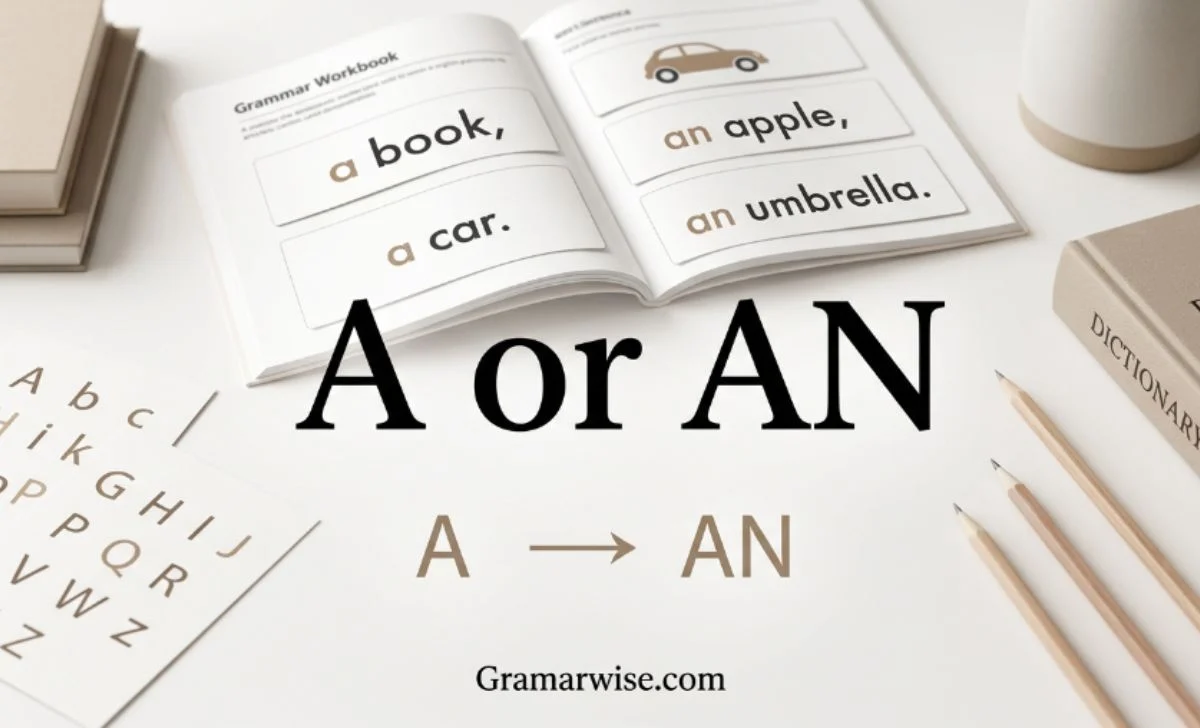
Use a before a consonant sound and an before a vowel sound. For example, we say a hotel, a university, and a lion, but an apple, an egg, and an hour.
This guide explains when to use a or an, gives clear examples in sentences, and shows why some words break the pattern you may expect from their spelling.
Quick Answer
Use a before a word that begins with a consonant sound.
- a book
- a car
- a hotel
- a teacher
- a university
- a European country
Use an before a word that begins with a vowel sound.
- an apple
- an egg
- an orange
- an umbrella
- an hour
- an honest person
The key rule is:
A and an are chosen by sound, not simply by the first letter.
That is why a university is correct even though university begins with the vowel letter u. The word starts with a /y/ sound, which is a consonant sound: you-niversity.
Likewise, an hour is correct because the h is silent. The word begins with an ow vowel sound.
What Is the Difference Between A and An?
Both a and an are indefinite articles. They are normally used before a singular countable noun when we are talking about one person, place, thing, or idea in a general way.
The difference is their sound:
| Article | Used before | Examples |
|---|---|---|
| a | Consonant sound | a dog, a house, a university |
| an | Vowel sound | an apple, an egg, an hour |
Compare these sentences:
- I saw a dog in the park.
- She bought an apple.
- He stayed at a hotel.
- We waited for an hour.
In each case, the article matches the first sound of the following word.
When to Use A
Use a before a singular countable noun that starts with a consonant sound.
Common examples
- a book
- a pen
- a car
- a house
- a student
- a teacher
- a phone
- a table
- a lion
- a hotel
A in sentences
- I bought a book yesterday.
- She is a teacher.
- He lives in a small house.
- We saw a lion at the zoo.
- They booked a hotel near the airport.
Notice that a hotel is correct, not an hotel. The h in hotel is pronounced, so the word begins with a consonant sound.
When to Use An
Use an before a singular countable noun that starts with a vowel sound.
Common vowel sounds are heard at the beginning of words such as apple, egg, orange, and umbrella.
Common examples
- an apple
- an egg
- an elephant
- an orange
- an umbrella
- an animal
- an idea
- an office
- an answer
- an accident
An in sentences
- She ate an apple after lunch.
- I had an egg for breakfast.
- We saw an elephant at the zoo.
- He gave me an interesting idea.
- She works in an office downtown.
So, if you are asked to write a or an before apple, the answer is an apple. Before egg, it is an egg.
A or An Depends on Sound, Not Spelling
This is the most important rule to remember.
Many learners think:
A = consonant letter
An = vowel letter
That shortcut works in many cases, but it is not the real grammar rule.
The correct rule is:
A = consonant sound
An = vowel sound
Consider these examples:
- a university
- a European
- a useful tool
- a unique idea
- an hour
- an honest man
- an heir
- an MBA
The spelling can be misleading.
Why “a university” is correct
University starts with the letter u, but its first sound is similar to you.
So we say:
- a university ✓
- a university student ✓
Not:
- an university ✗
Why “an hour” is correct
The h in hour is silent. The word starts with a vowel sound.
So we say:
- an hour ✓
- an hour ago ✓
Not:
- a hour ✗
A or An Before Words Beginning With U
Words beginning with u can be confusing because some have a vowel sound while others begin with a /y/ consonant sound.
Use a when the u sounds like you:
- a university
- a uniform
- a user
- a useful tool
- a unique opportunity
Examples:
- She studies at a university.
- He bought a new uniform.
- This is a useful website.
- They found a unique solution.
However, use an when the word begins with a genuine vowel sound:
- an umbrella
- an uncle
- an unusual event
- an urgent message
Examples:
- She carried an umbrella.
- I received an urgent message.
- It was an unusual experience.
The important point is not the letter u. Listen to the opening sound.
A or An Before Words Beginning With H
The letter h can also create confusion.
If the h is pronounced, use a:
- a hotel
- a house
- a horse
- a hospital
- a history book
Examples:
- We stayed at a hotel.
- She lives in a house near the school.
- He went to a hospital yesterday.
If the h is silent and the word begins with a vowel sound, use an:
- an hour
- an honest person
- an honor
- an heir
Examples:
- I waited for an hour.
- She is an honest person.
- It was an honor to meet him.
This is one of the clearest examples of why sound matters more than spelling.
A or An Before Abbreviations and Initialisms
The same sound-based rule applies to abbreviations and initialisms.
Use the article based on how the abbreviation is pronounced.
For example:
- an MBA
- an FBI agent
- an FAQ
- an X-ray
- a CEO
- a URL
- a USB drive
Why?
MBA is pronounced with an opening vowel sound: em. Therefore, an MBA is correct.
CEO begins with the sound see, so we say a CEO.
Examples:
- She has an MBA in finance.
- He spoke to a CEO yesterday.
- The doctor ordered an X-ray.
- I need a USB drive.
Again, pronunciation decides the article.
A or An in a Sentence
A and an usually come before a singular countable noun. They can also come before an adjective followed by a noun.
Compare:
- a car
- an apple
- a red car
- an old car
- a useful tool
- an interesting book
The article depends on the first sound immediately after it.
For example:
- a red apple — red begins with a consonant sound.
- an old apple — old begins with a vowel sound.
- a useful idea — useful begins with a /y/ sound.
- an unusual idea — unusual begins with a vowel sound.
This is why you should not automatically choose the article based on the noun at the end of the phrase. Look at the first pronounced sound after a or an.
A or An: Common Examples
Here are some everyday examples you can use for practice:
| Word or phrase | Correct choice | Example |
|---|---|---|
| apple | an apple | I ate an apple. |
| egg | an egg | She cooked an egg. |
| elephant | an elephant | We saw an elephant. |
| orange | an orange | He peeled an orange. |
| umbrella | an umbrella | Take an umbrella. |
| hotel | a hotel | We booked a hotel. |
| lion | a lion | I saw a lion. |
| house | a house | They bought a house. |
| university | a university | She attends a university. |
| European | a European | He is a European citizen. |
| hour | an hour | It took an hour. |
| honest person | an honest person | He is an honest person. |
The examples show the central pattern clearly: listen to the first sound, then choose a or an.
A or An Before Adjectives
You do not always put a or an directly before a noun. Sometimes an adjective comes between the article and the noun.
The same sound rule still applies. Look at the first sound of the adjective, not the noun.
Examples:
- a big apple
- a beautiful house
- an old car
- an interesting book
- a useful idea
- an unusual idea
Compare:
- She bought a red apple.
- She bought an old apple.
Both sentences use apple, but the article changes because the first sound after the article changes.
Another example:
- He gave me a useful answer.
- He gave me an honest answer.
Useful begins with a consonant /y/ sound, while honest begins with a vowel sound because the h is silent.
Common A or An Mistakes
Several mistakes appear again and again when people learn this rule.
Mistake 1: “An university”
❌ She studies at an university.
✅ She studies at a university.
University begins with a /y/ sound, so a is correct.
Mistake 2: “A hour”
❌ We waited for a hour.
✅ We waited for an hour.
The h in hour is silent, so the word begins with a vowel sound.
Mistake 3: “An hotel”
❌ They stayed at an hotel.
✅ They stayed at a hotel.
The h in hotel is normally pronounced, so it begins with a consonant sound.
Mistake 4: “An lion”
❌ We saw an lion.
✅ We saw a lion.
Lion begins with the consonant sound /l/.
Mistake 5: Choosing by the first letter
A common shortcut is to think:
“Vowel letter = an, consonant letter = a.”
That is not always correct.
The better rule is:
Choose a or an according to pronunciation.
A or An With Numbers and Abbreviations
Numbers can also require careful listening.
For example:
- an 8-year-old child
- an 18-year-old student
- a one-time event
- a 100-dollar bill
Why?
Eight starts with a vowel sound, so we say an 8-year-old.
But one starts with a w sound, so we say a one-time event.
Examples:
- She is an 18-year-old student.
- They held a one-day meeting.
- It was a one-hour class.
Notice the phrase a one-hour class. Although hour by itself takes an, the first word after the article is one, and one begins with a /w/ sound. Therefore, a one-hour class is correct.
A or An With Occupations
Use a or an when talking about someone’s occupation in the singular.
Examples:
- She is a teacher.
- He is a doctor.
- My brother is a lawyer.
- She is an engineer.
- He is an artist.
- My sister is an architect.
The article depends on the sound of the occupation:
- a teacher — /t/
- a doctor — /d/
- an engineer — vowel sound
- an artist — vowel sound
- an architect — vowel sound
This is a very common use of a or an in everyday English.
A or An Worksheet: Practice
Try these sentences before checking the answers.
Fill in the blanks with A or An
- I saw ___ elephant at the zoo.
- She bought ___ new phone.
- He waited for ___ hour.
- My sister is ___ teacher.
- They stayed in ___ hotel.
- She wants to attend ___ university.
- He ate ___ apple.
- We need ___ umbrella.
- She gave me ___ useful tip.
- He is ___ honest man.
- They saw ___ lion.
- I received ___ email this morning.
- She is ___ engineer.
- He bought ___ European car.
- We had ___ unusual experience.
Answers
- an elephant
- a new phone
- an hour
- a teacher
- a hotel
- a university
- an apple
- an umbrella
- a useful tip
- an honest man
- a lion
- an email
- an engineer
- a European car
- an unusual experience
The tricky examples are a university, a useful tip, and a European car. They all begin with a /y/ sound, so a is used.
A or An Examples in Everyday English
You will see these articles constantly in normal conversations and writing.
conversation
- “I need a pen.”
- “Can I have an apple?”
- “She is a doctor.”
- “I have an idea.”
- “We need an answer.”
emails
- “I have a question about the project.”
- “Please send me an updated file.”
- “We need an urgent response.”
business writing
- “The company hired a new manager.”
- “We received an important request.”
- “The team completed a useful report.”
social media and casual writing
- “I found a great restaurant.”
- “What an amazing day!”
- “I just had an interesting conversation.”
These examples show that a and an are not only grammar-test words. They are part of ordinary English.
A or An: A Simple Memory Trick
If you often forget the rule, use this quick test:
Say the word aloud.
If the word starts with a consonant sound, use a.
- a book
- a hotel
- a university
- a European
- a lion
If it starts with a vowel sound, use an.
- an apple
- an egg
- an elephant
- an hour
- an honest person
A useful memory line is:
A before a consonant sound; an before a vowel sound.
Do not focus only on the spelling. Pronounce the word and listen to its first sound.
A or An: Quick Comparison
| Use A | Use AN |
|---|---|
| a book | an apple |
| a car | an egg |
| a hotel | an hour |
| a house | an elephant |
| a lion | an orange |
| a university | an umbrella |
| a European | an honest person |
| a useful idea | an interesting idea |
| a one-time event | an unusual event |
| a CEO | an MBA |
This table makes the main rule easy to remember: the first sound controls the choice.
When Should You Use A or An?
Use a before a singular countable noun or phrase that starts with a consonant sound.
Use an before a singular countable noun or phrase that starts with a vowel sound.
For example:
- a cat
- a university
- a hotel
- an apple
- an hour
- an engineer
When an adjective comes first, listen to the adjective:
- a beautiful house
- an old house
- a useful tool
- an excellent tool
When an abbreviation comes first, listen to how the abbreviation is pronounced:
- a CEO
- an MBA
- a URL
- an X-ray
Once you focus on sound rather than spelling, the rule becomes much easier.
FAQs
1. When should I use a or an?
Use a before a consonant sound and an before a vowel sound. For example, a hotel and an hour.
2. What is the difference between a and an?
Both are indefinite articles used mainly with singular countable nouns. A comes before a consonant sound, while an comes before a vowel sound.
3. Do I say “a hotel” or “an hotel”?
The correct form is a hotel. The h in hotel is pronounced, so the word starts with a consonant sound.
4. Is it “a letter” or “an letter”?
The correct form is a letter. Letter begins with the consonant sound /l/.
5. Which is correct: “a lion” or “an lion”?
The correct form is a lion because lion begins with the consonant sound /l/.
6. What are 10 examples of words that use an?
Here are ten common examples: an apple, an egg, an elephant, an orange, an umbrella, an animal, an idea, an hour, an honest person, and an engineer.
7. Which is correct: “an elephant” or “a elephant”?
The correct form is an elephant because elephant begins with a vowel sound.
8. How do you use a and an in a sentence?
Use a or an before a singular countable noun when you mean one person or thing without identifying a specific one. For example, “I saw a dog” and “She ate an apple.”
9. Is “a” a letter or a word?
A can be both a letter and a word. As a letter, A is the first letter of the English alphabet. As a word, a is an indefinite article used in sentences such as “I saw a bird.”
10. Why do we say “an elephant” but “a lion”?
We say an elephant because elephant begins with a vowel sound. We say a lion because lion begins with a consonant sound.
Conclusion
Knowing when to use a or an becomes much easier once you stop relying only on spelling. The main rule is simple: use a before a consonant sound and an before a vowel sound.
That is why we say a hotel, a university, and a lion, but an apple, an egg, and an hour.
The most useful habit is to say the word aloud and listen to its first sound. This also helps with tricky words such as European, honest, useful, and abbreviations such as MBA.
With a little practice, choosing between a and an becomes natural in both speaking and writing.