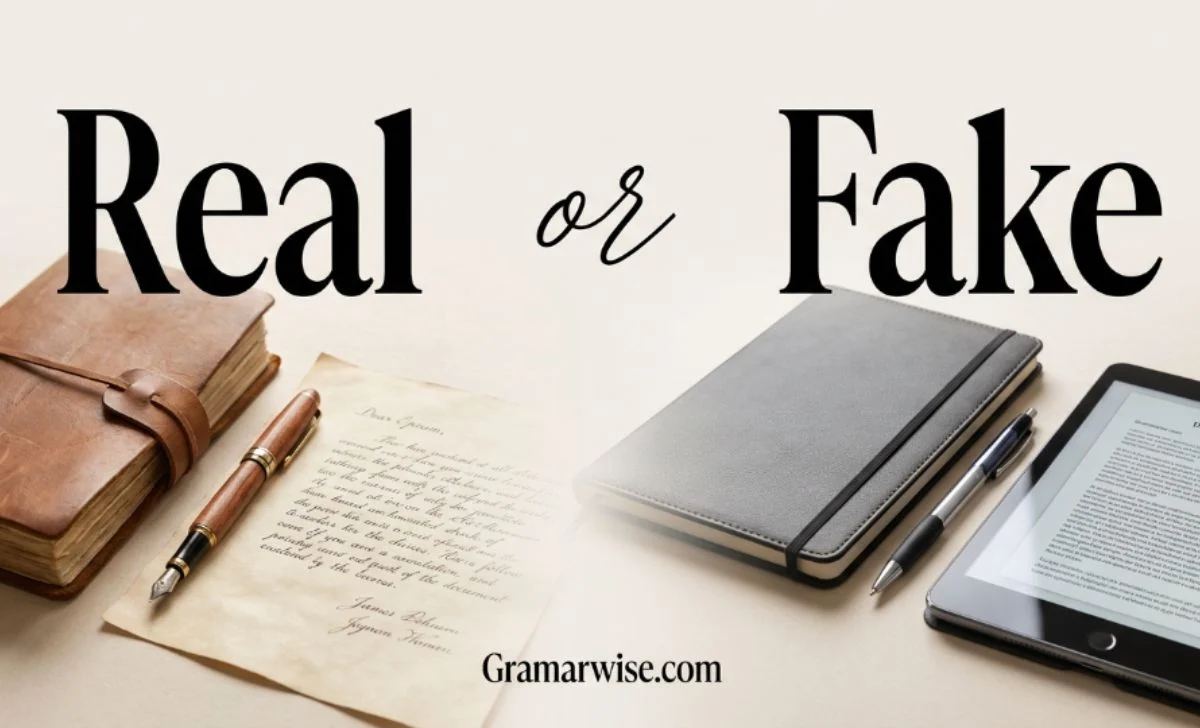
Is something genuine, or is it only pretending to be genuine? That is the simple idea behind real or fake. We use this phrase when checking a product, image, video, website, account, story, or piece of information.
Real means genuine, true, original, or actually existing. Fake means false, copied, artificial, altered, or not genuine. However, the difference is not always obvious.
A product can look authentic but be counterfeit, while a real photo can be used with a completely false story.
This guide explains the meaning of real or fake, the difference between the two, and practical ways to check authenticity in everyday situations.
Quick Answer
Real means genuine, authentic, true, original, or actually existing. Fake means false, copied, artificial, altered, or not genuine. We use real or fake when asking whether something is authentic or trustworthy.
To check, examine the source, details, evidence, context, and identifying information. For digital content, also check the original source and whether the material may have been edited or generated by AI.
The key point is simple: do not judge authenticity from one clue alone. Compare several reliable pieces of evidence before deciding.
What Does “Real or Fake” Mean?
Real or fake is a question about whether something is genuine or not.
Real can mean that something actually exists, is authentic, or is true. Fake describes something that is not genuine, has been copied or altered, or is being presented as something it is not.
For example:
- Is this watch real or fake?
- Is this website real or fake?
- Is that photo real or fake?
- Is this account real or fake?
- Is the story real or fake?
The phrase is common in everyday English because it gives a quick way to question authenticity.
However, fake can have different shades of meaning. A fake product may be a deliberate imitation. A fake story may be completely invented. A fake photograph may be genuine but digitally manipulated.
So, the exact meaning depends on what you are checking.
Real vs. Fake: The Key Difference
The main difference between real and fake is authenticity or truth.
| Real | Fake |
|---|---|
| Genuine | Not genuine |
| Authentic | Imitated |
| Original | Copied or counterfeit |
| True | False |
| Actually exists | Pretends to be something else |
| Can be supported by evidence | May lack reliable evidence |
Consider a branded pair of shoes. If the shoes were genuinely produced by the brand, they are real. If another manufacturer copied the design and presented the shoes as the original brand, they are fake or counterfeit.
The same distinction applies to information.
A genuine news report is based on real events and evidence. A fabricated story may contain invented details and be presented as factual.
Therefore, real and fake are opposites, but the exact test for deciding between them changes with the situation.
How to Tell If Something Is Real or Fake
There is no universal test that works for every item. Instead, use several clues together.
Check the source
Start by asking where the item, information, or content came from.
A product from an authorized retailer has a different level of credibility from one offered by an unknown seller. Likewise, a news claim from an established source deserves a different level of attention from an anonymous social media post.
The source does not prove that something is real, but it gives you an important starting point.
Examine the details
Look closely at the details that should be consistent.
For a physical product, check:
- Labels
- Logos
- Packaging
- Serial numbers
- Model numbers
- Materials
- Printing
- Stitching
- Build quality
Small errors can sometimes reveal an imitation. Incorrect spelling, unusual fonts, poor printing, or inconsistent branding may be warning signs.
Compare it with an authentic example
If possible, compare the item with information from the official manufacturer or another verified source.
Check whether the design, specifications, packaging, dimensions, and identifying marks match.
This is especially useful for branded products. A counterfeit item may copy the general appearance while getting smaller details wrong.
Consider the price
Price can provide a useful clue.
If an expensive product is being offered at an unusually low price, be cautious. A low price does not automatically mean that an item is fake, because genuine products can be discounted. However, an extreme price difference can justify further checking.
Look for independent evidence
Do not rely entirely on the seller’s own description.
Search for independent information, authentication records, reliable reviews, or official product details when appropriate. The more important the purchase or claim, the more evidence you should seek.
The strongest approach is not “Does this one clue look suspicious?” but “Do several independent clues support the same conclusion?”
How to Check Real or Fake Digital Content
The real or fake question is more difficult online because digital content can be edited, copied, taken out of context, or generated with AI.
A photograph may be genuine but have a false caption. A real video may show an actual event but be presented as something that happened recently. A fake account may use a real person’s photograph.
This means you should check both the content and the claim attached to it.
Real or fake images
When checking an image, look at its source, date, context, and surrounding information.
Ask:
- Who first posted the image?
- When was it created or published?
- Does the claimed location make sense?
- Can the original image be found?
- Do reliable sources support the claim?
- Does the image contain obvious signs of editing?
A strange visual detail can be a clue, but it is not automatically proof that an image is fake.
Real or fake videos
For a real or fake video, check its original source and context.
Pay attention to unusual editing, mismatched audio, unnatural movements, inconsistent lighting, or visual distortions. However, modern editing and AI generation can make these clues harder to interpret.
It is often better to verify the event itself. If a video claims to show an important recent event, look for independent reporting or original footage from reliable sources.
Real or fake memes
A real or fake meme can be confusing because a meme may combine real material with false information.
For example, the photograph in a meme may be genuine while the quotation placed over it is completely fabricated.
Therefore, ask two separate questions:
Is the image real?
Is the claim real?
Those answers may not be the same.
Real or Fake AI Content
AI has made authenticity harder to judge.
Modern AI tools can create realistic images, videos, voices, and written content. Some generated material can look convincing even when it does not represent a real event or person.
When checking possible AI content, look at:
- The original source
- Publication history
- Supporting evidence
- Visual inconsistencies
- Audio quality
- Context
- Independent confirmation
AI detection tools can sometimes provide useful signals, but a detector’s result should not automatically be treated as final proof. Detection technology can make mistakes, particularly as generation tools improve.
For important claims, source verification and independent evidence are more reliable than simply asking an AI detector for a yes-or-no answer.
Real or Fake Website: What Should You Check?
A website can look professional and still be misleading.
Before trusting a website, check its domain name, company information, contact details, policies, product descriptions, and payment process.
Be especially careful when:
- The domain looks unusual or misleading.
- The site pressures you to pay immediately.
- Contact information is missing.
- Prices seem unrealistic.
- Product descriptions contain obvious errors.
- The website copies branding from another company.
- Important policies are vague or missing.
A secure connection alone does not prove that a website is trustworthy. A site can use standard security technology and still be operated by an unreliable party.
For important purchases, verify the business through independent sources and, when possible, use the company’s official website to reach its legitimate online store.
Real or Fake: Related Words
There are many words connected with real and fake, but they are not all exact synonyms.
Words related to “real”
- Authentic — genuinely what it claims to be
- Genuine — real rather than false or artificial
- Original — not a copy
- Actual — existing in fact
- True — consistent with reality or facts
- Legitimate — lawful, valid, or genuine
- Verified — checked and confirmed
For example, you could say:
“This is an authentic designer bag.”
Or:
“The information has been verified.”
The best word depends on what you mean by real.
Words related to “fake”
- False — not true
- Phony — not genuine; informal
- Bogus — false or not legitimate; informal
- Imitation — something made to resemble another thing
- Replica — a copy made to look like an original
- Counterfeit — an unauthorized copy presented as genuine
- Forged — falsely made or altered, especially a document or signature
- Fabricated — deliberately invented
For instance, counterfeit is more precise than fake when discussing an unauthorized branded product.
Real or Fake in Everyday English
The phrase works naturally in casual conversation, online discussions, and practical situations.
Product:
“I’m not sure whether this watch is real or fake.”
Website:
“Check the domain before deciding whether the website is real or fake.”
Image:
“Is this photo real or fake?”
Social media:
“I’m wondering if that account is real or fake.”
Information:
“Before sharing the post, find out whether the claim is real or fake.”
Story:
“Was that story real, or did someone make it up?”
These examples show that real or fake is flexible. It can describe physical objects, digital content, information, and claims.
Common Mistakes When Deciding What Is Real or Fake
One common mistake is judging authenticity from appearance alone.
A convincing product is not necessarily genuine. Similarly, a polished website is not automatically trustworthy.
Another mistake is treating one warning sign as conclusive proof. For example, an unusually low price can be suspicious, but it does not prove that an item is counterfeit.
People also sometimes confuse a real object with a true claim about that object. A genuine photograph can accompany a false caption. A real person can appear in a fake video.
The safest approach is to separate the questions:
Is the thing itself authentic?
Is the information about it accurate?
Then verify each question independently.
FAQs
1. What is real vs. fake?
Real describes something genuine, authentic, true, or actually existing. Fake describes something false, copied, artificial, altered, or not genuine.
2. How do I spot a fake?
Check the source, identifying details, quality, price, seller information, and supporting evidence. Look for several inconsistencies rather than relying on one clue.
3. What is a word for fake or not real?
Depending on the context, you can use false, phony, bogus, artificial, imitation, counterfeit, forged, or fabricated.
4. What’s a fancy word for real?
Authentic, genuine, legitimate, actual, and verified are useful alternatives, but the correct choice depends on the meaning of real in the sentence.
5. What are high-quality fakes called?
They may be called replicas, imitations, knockoffs, or counterfeits. These terms have slightly different meanings, so the context matters.
6. What is slang for fake?
Phony and bogus are common informal alternatives to fake. Knockoff is often used for an imitation product.
Conclusion
Real or fake is a simple phrase for asking whether something is genuine, authentic, or true. Real things can be verified through reliable evidence, while fake things may be copied, altered, invented, or falsely presented.
Today, the distinction matters not only for physical products but also for websites, social media accounts, photos, videos, memes, and AI-generated content.
The best way to check authenticity is to look beyond appearance and examine the source, context, details, and independent evidence.
Once you understand that difference, you can also choose more precise words such as authentic, genuine, counterfeit, imitation, false, and legitimate.